


Science Birthday Party Ideas: Experiments Kids Will Love
A science birthday party for ages 6-8, framed for an eighth birthday: an adult-led volcano, slime, fizzy color mixing, static balloons and a density jar, with safety glasses, trays and simple science throughout.
A science birthday party works best for ages 6-8 with five safe, adult-led experiments — a baking-soda-and-vinegar volcano, slime, fizzy color mixing, static balloons and a density jar — run at tray stations with safety glasses on, nothing tasted, and hands washed after slime, finishing with cake and favor bags.

The short version
- Five safe classics only: volcano, slime, fizzy color mixing, static balloons and a density jar — no heat, no flames, nothing tasted, no dry ice.
- An adult leads every experiment: adults pour, add activator and handle candles; children stir, stretch, rub, predict and observe.
- Safety glasses for every fizzy step, every experiment on a tray, hands washed straight after slime.
- The science is simple and true: acid plus base makes carbon-dioxide bubbles, slime's linked molecules stretch, rubbed balloons gain static charge, and oil floats because it is less dense than water.
- Run the full arc: stations, kit-out, experiments, prediction game, then cake with eight candles and favor bags.
- Age
- Ages 6–8
- Prep
- 45 min
- Play time
- 120 min
- Mess
- High
- Difficulty
- Medium
- Where
- Indoor
Why kids love this
Six-, seven- and eight-year-olds are at exactly the age where real science feels like magic they are allowed to touch: a volcano that foams over on cue, slime that stretches further than anyone expected, colors that fizz and change as they mix, a balloon that makes hair stand straight up, and a jar where two liquids flatly refuse to mix. Nothing here is watch-only, either — after the adult-led first run, every guest gets hands on the trays, makes a prediction out loud, and finds out whether they were right, which turns each experiment into a small, cheering contest. The lab coats and safety glasses matter more than adults expect: the moment the kit goes on, shy guests become scientists, noise turns into excited reporting — "it fizzed!" — and the birthday child gets to be lead scientist on their eighth birthday, welcoming the team and blowing out eight candles at the end. As a hands-on STEM party theme, it gives energetic kids a job at every minute, and gives you a running order that practically hosts itself.
What you'll need
- Plain white lab coats — one per child plus a spare, worn over party clothes
- Clear safety glasses — one pair per child and one for the lead adult
- Large shallow trays — one per station, ideally one per child at the slime and color stations
- A small model volcano — a cone on a large tray, with a small container hidden inside the top
- Baking soda and plain white vinegar — the volcano and fizzy mixing both run on these
- Liquid food coloring in red, blue and yellow — a few drops per beaker
- Clear plastic beakers, small jars and cups — all plain and unlabeled; plastic, not glass, for children
- White school glue, plain slime activator solution, mixing bowls and spoons — for adult-mixed slime
- Vegetable oil and water — for the density jar, in one tall, clear, unlabeled jar with a lid
- Plain balloons — one per child plus spares, inflated by an adult beforehand
- Plain colored cards — blank cards in two colors for the prediction game, no writing on them
- A plain round birthday cake with exactly eight candles — for step 9
- Plain colored favor bags — one per guest, plus each child's slime in a sealed pot
- Paper towels, trash bags, a bowl of soapy water and a hand towel — ready before you start
- Plain colored bunting for décor — colors only, no letters, words or numbers anywhere
Before you start
Set up the room as a mini laboratory: one long table with separate stations — volcano tray at one end, slime bowls in the middle, color beakers next, density jar at the far end — and keep the cake out of the room until step 9. Pre-measure everything into plain, unlabeled containers: baking soda into small cups, vinegar into a plastic jug, colored water into beakers. An adult does all measuring; children never open a store bottle. Test the volcano once yourself: check the foam spills down the cone into the tray rather than across the table, and adjust the cone position if needed. Make one test batch of slime so you know your glue and activator behave — activator added a little at a time until it pulls away from the bowl and stretches without snapping — then pre-portion the glue into individual bowls. Inflate all the balloons for the static station and keep them in a large bag out of sight. Lay out one coat and one pair of glasses per place, fill the hand-washing bowl, and brief any helping adult: every experiment is adult-led, glasses stay on for fizzy steps, younger siblings watch from behind the table, and nothing is ever tasted.
How to do it
-
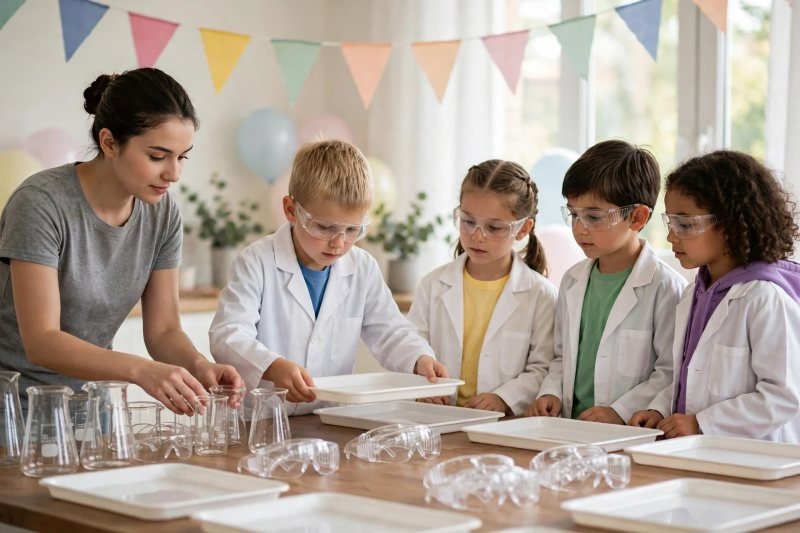
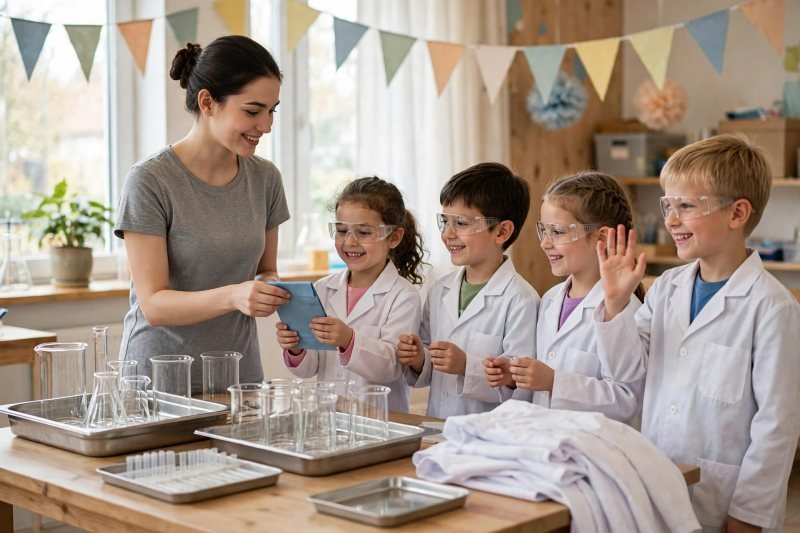
Set up the lab stations first. Before a single guest arrives, turn the party table into a laboratory the children can read at a glance — a large tray at each station; the volcano cone centered on its tray at one end; slime bowls and spoons in the middle; clear unlabeled beakers of red, blue and yellow colored water next; the tall density jar, still empty, at the far end — with a pair of clear safety glasses and a folded lab coat waiting at every place. Walk the table once as an adult safety check — every container plain and unlabeled; every liquid pre-measured by you; paper towels and the soapy hand-washing bowl within reach — then check the standing line behind the chairs, well back from the trays. Keep the cake, the candles and the favor bags completely out of the room, because a lab that starts tidy and mysterious earns ten minutes of awe before you have said a word. Say, "Scientists, our lab is ready — glasses live here, everything happens on a tray, and we never, ever taste an experiment." Setting those three rules into the room before the children arrive makes every later step calmer, safer and much more fun.
-
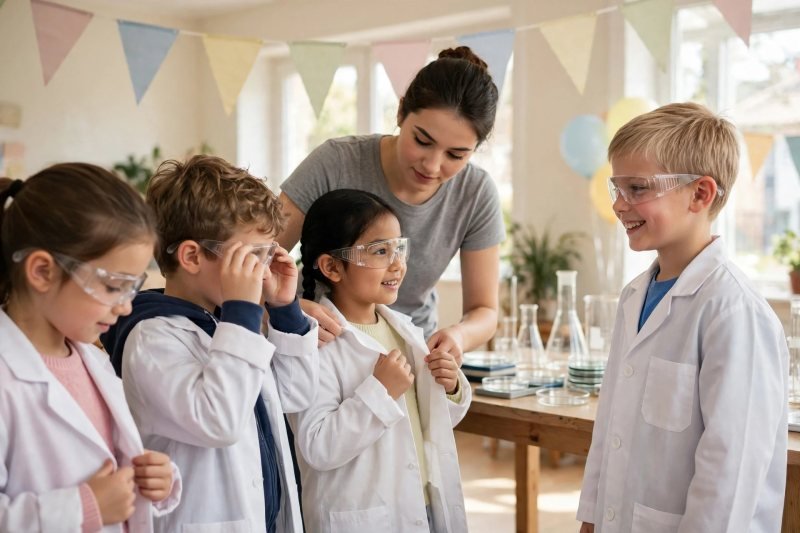
Welcome everyone and kit them out. Greet each guest at the door like a new recruit arriving at a real lab — hand over a plain white lab coat to wear over their party clothes; help them settle clear safety glasses comfortably on their face; walk them to their place at the table where their own tray is waiting — and let the transformation do your crowd control for you, because children in coats and glasses sit down like a team expecting instructions. Introduce the birthday child as today's lead scientist, turning eight today, whose lab this is, then run the three lab rules together as a chant the whole group repeats — glasses on for fizzy steps; hands in our own trays; nothing is tasted, ever, not even a fingertip. Show everyone the hand-washing bowl and explain that slime hands get washed the moment the slime station ends, no exceptions and no detours to the snack table on the way. Seat excitable friends between calmer ones, keep an adult at the pouring end of the table, and park younger siblings behind the chair line with a balloon to hold. Say, "Coats on, glasses on — you are not party guests any more, you are my science team, and this lab runs on teamwork."
-
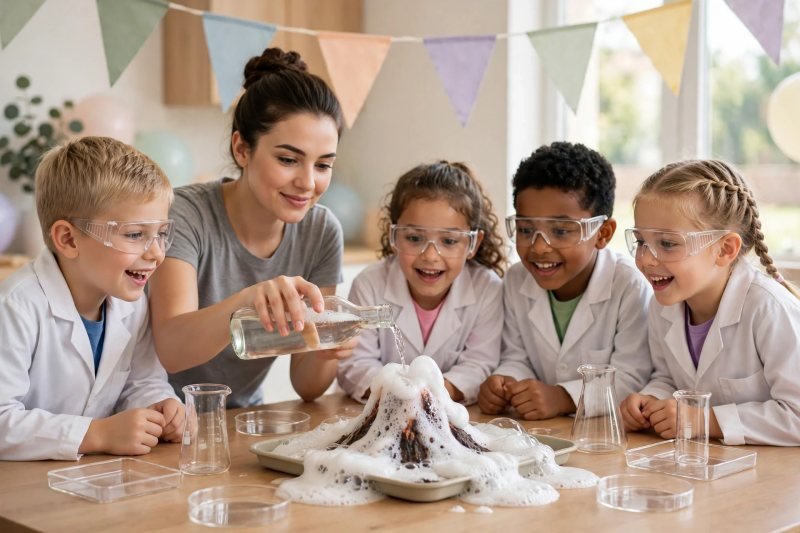
Open with the volcano show. Start the party proper with the biggest reaction of the day, run entirely by an adult — the lead adult stands at the volcano station with every child seated, glasses on and hands in laps for the first eruption; the model cone sits in the middle of its large tray with baking soda already hidden in the container inside its top; a few drops of red and yellow coloring make the foam run in bright lava shades; then the adult pours in the vinegar in one confident pour while the team counts down from five. Explain the science simply while the foam bubbles — vinegar is an acid, baking soda is a base, and when they meet they make carbon-dioxide gas: all those bubbles. Run the eruption two or three times, letting the birthday scientist do the countdown while the adult always pours. For a second fizzing trick at the same party, the blow-up balloon experiment uses the same baking-soda-and-vinegar reaction to inflate a balloon — no extra shopping needed. If your family loves this reaction, the same baking soda and vinegar volcano works as a standalone afternoon activity too, adult-led in exactly the same way. Say, "Count down with me — five, four, three, two, one — and watch what the bubbles do." Opening with the showpiece while everyone is fresh, seated and listening sets the pattern — adult pours, team predicts, everyone cheers — that carries the whole party.
-
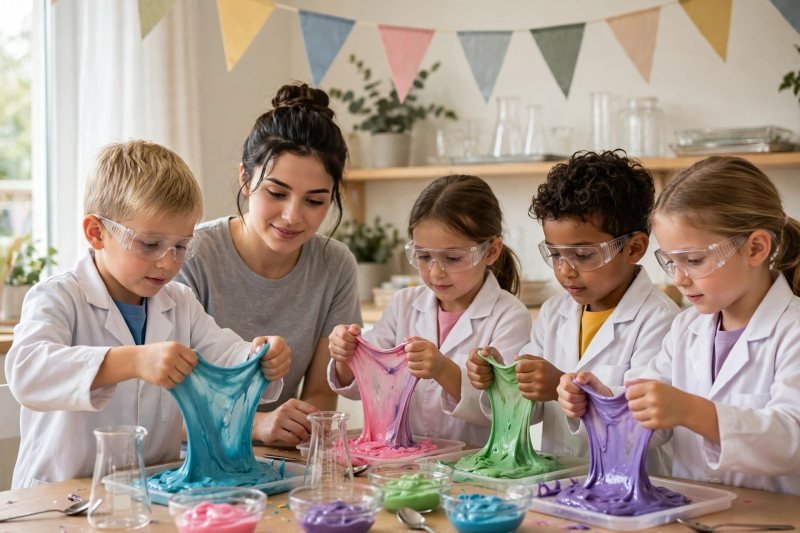
Stretch and squish at the slime station. Move the team one station along to the bowls you pre-portioned earlier — a bowl of white glue per child; coloring drops stirred in first, so every scientist chooses their own slime shade; then the adult, and only the adult, adds the activator solution a little at a time while each child stirs with their own spoon — because too much activator at once makes stiff, snappy slime and too little leaves soup, and the adult's pouring hand is what keeps every bowl in the happy middle. As each mixture pulls away from the bowl, children lift it out onto their tray and start the best part — stretching it slowly to see how far it goes before it parts; poking it quickly and feeling it push back firmer; rolling and folding it. Give them the kid-sized science while their hands are busy — glue is full of long, stringy molecules, a bit like a bowl of tiny spaghetti, and the activator links those strings together into a net that traps the water, which is why slime stretches and squishes instead of pouring like a drink. The rule that closes the station is absolute — the moment slime time ends, every pair of hands goes straight into the soapy washing bowl and gets dried properly, before cake, snacks or touching anything else in the room. Say, "Slow stretch, quick poke — feel how it changes? That is your slime net doing its job." Slime in a sealed pot also makes the perfect favor later.
-
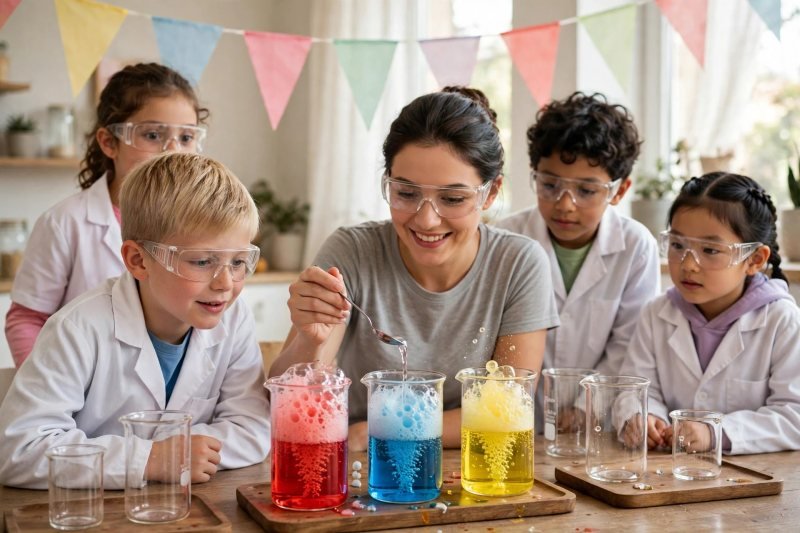
Mix fizzy colors. Settle the team at the color station with glasses firmly on — a tray per child; three clear unlabeled beakers of colored water in red, blue and yellow; a small cup of baking soda and a spoon per tray — and let the adult run the first mix as a demonstration before any child starts. Spoon baking soda into one beaker at a time and watch the fizz climb — the adult adds a splash of vinegar to the beaker and the same acid-and-base reaction from the volcano makes carbon-dioxide bubbles all over again, here fizzing up through colored water so children can see the bubbles rise, swell and pop in slow detail. Then hand over the spoons and let each scientist mix colors in their own beakers — red into blue, watching for purple; blue into yellow, hunting for green; yellow into red for orange — predicting the new color out loud before each pour and cheering when the fizz confirms a good guess. This station is a gentle cousin of the dancing raisins experiment, where the same carbon-dioxide bubbles lift and drop raisins in a glass, so families who love today's fizz have a natural next experiment for a rainy weekend. Keep every beaker on its tray, and remind the team that experiment water is never drinking water even though it looks like juice. Say, "Name your color before you pour — real scientists say what they expect, then they watch." Color mixing quiets the room beautifully between the two loudest stations of the day.
-
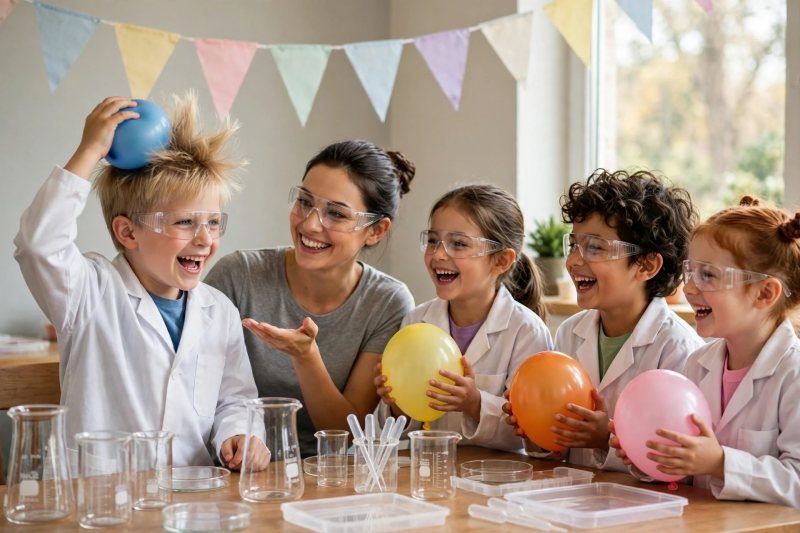
Try static balloon tricks. Clear the trays away, dry the table, and bring out the bag of balloons the adult inflated during preparation — one balloon per scientist, with spares ready, because a popped balloon at this age is a five-second drama best solved by an instant replacement. Demonstrate the trick yourself first — rub your balloon briskly on your own hair or a wool sweater for a slow count of ten; lift it away and show your hair lifting and following it; then hold the charged balloon near small torn tissue pieces on the table and watch them leap up and stick. Explain it simply and truthfully — rubbing moves tiny electric charges onto the balloon, the balloon ends up charged with static electricity, and a charged balloon pulls on light things with the opposite charge, like hair and tissue, which is why they jump toward it. Now let the whole team charge their balloons together — hair standing up in every direction; balloons stuck to the wall; tissue pieces dancing up off the table — and give them challenges: whose balloon stays on the wall longest, and who can lift the most tissue pieces in one go. Popped pieces go straight in the trash bag, and any child who dislikes the crackly feeling can stay happily on tissue-lifting duty. Say, "Rub, lift, and look — your balloon has picked up an invisible electric charge, and your hair knows it." Static is the funniest station of the day, and it costs nothing but balloons.
-
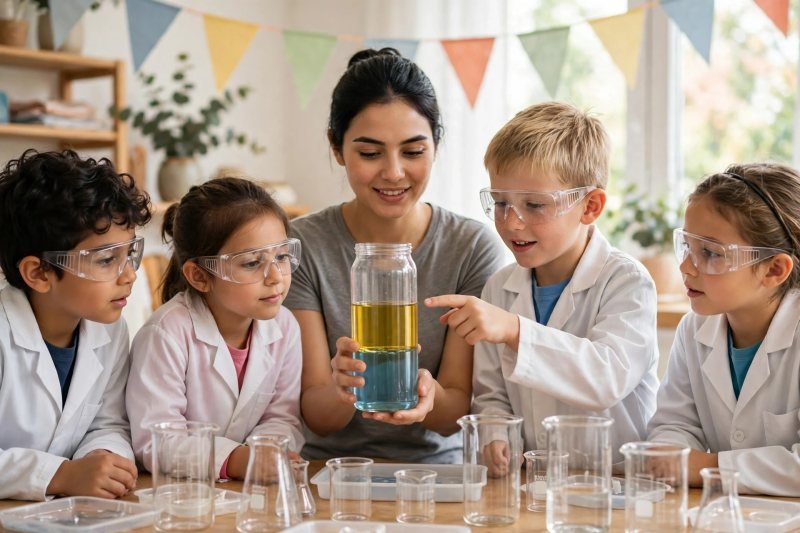
Build the density jar. Bring the team back to their seats for the quietest, cleverest experiment of the party — one tall, clear, unlabeled jar in the middle of the table where everyone can see; the adult pours blue-colored water in first, filling the jar about halfway; then the adult pours vegetable oil in very slowly down the inside of the jar until a thick golden layer sits on top — and the room goes quiet all by itself, because the two liquids simply will not mix. Ask for explanations before you give one, then keep the science simple and accurate — oil and water do not mix because their tiny building blocks do not attract each other, and oil is less dense than water, meaning a cup of oil weighs less than the same cup of water, so the oil floats on top in its own layer, the way it always settles back after shaking. Let the adult tilt and very gently rock the jar so the team can watch the layer wobble, part and settle back into two clean bands, then drop in a small waterproof object chosen by the birthday scientist and let everyone predict — sink through both layers, float on the very top, or hover at the line where oil meets water — before it goes in. Seal the lid on firmly if little hands will pass the jar along a line of seated scientists, and never let the jar leave the tray. Say, "Two liquids, one jar, and they refuse to be friends — watch the oil float home to the top."
-
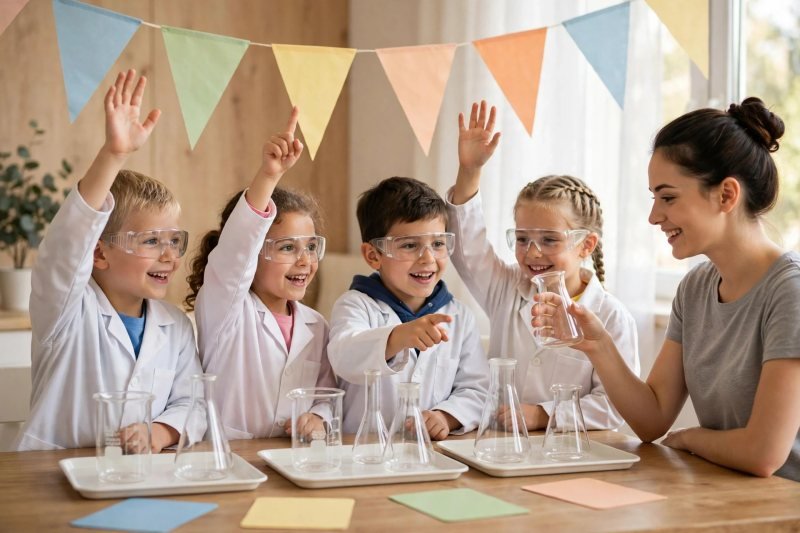
Play the prediction-and-results game. Turn everything the team has learned into a game while the table is reset — each scientist gets two plain colored cards, one in each of two bright colors, with no writing on them; one color means "it will fizz, float or stick" and the other means "it will not," explained by the adult before the first round — then run a fast series of mini-challenges using today's own experiments. Hold up a beaker and ask whether adding vinegar will make it fizz; a balloon and ask whether it will stick to the wall after rubbing; the density jar and ask which layer a new drop of colored water will fall through; a fresh spoon of slime mix and ask whether it will stretch or snap. Every scientist slaps down a prediction card before each test, the adult runs the test exactly as promised, and correct predictions earn a huge cheer while wrong ones earn the even better prize of finding out why. This is the same observe, predict and record habit that makes it so rewarding to build a weather station with kids over a whole season, squeezed here into ten loud minutes at a party table. Keep the pace quick, the questions fair, and the birthday scientist as your official card-counter and score-shouter. Say, "Cards down, eyes up — no changing your mind after the fizz starts."
-
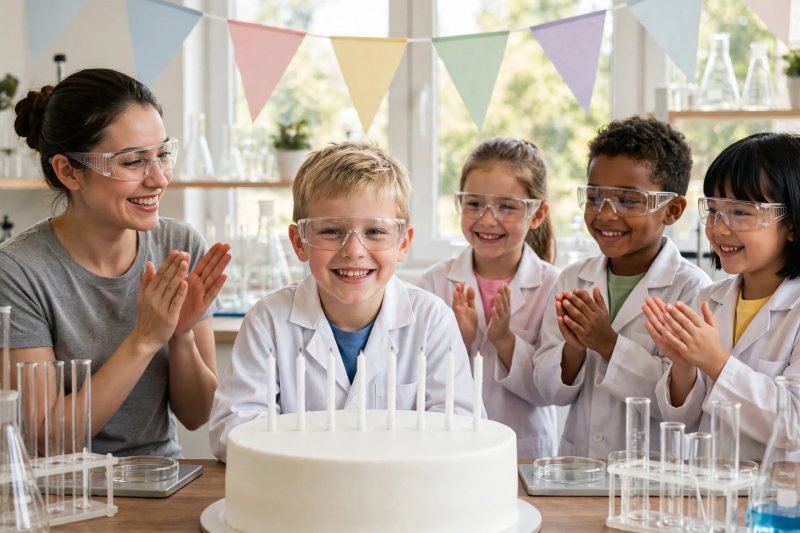
Bring out the cake. Clear the lab table completely — trays stacked, beakers to one side, glasses pushed up or taken off, hands checked clean — then dim nothing, fetch nothing flammable near the stations, and simply carry in the plain round birthday cake with exactly eight candles standing in it, one for every year of the birthday scientist turning eight today. The adult handles the candles and any lighting entirely, away from the experiment table and its paper towels, while the team stays seated in their lab coats for the funniest, sweetest photograph of the day — a whole laboratory singing to its lead scientist. Count the candles out loud together before the song, because eight-year-olds find an eight-candle count deeply satisfying and it makes the birthday child check, grin and nod like a scientist confirming a result. After the wish and the cheer, the adult cuts and serves the cake at a clean table or on laps with plates, well away from the slime pots and beakers, so party food and experiment kit never share a surface at any point in the day. If a guest cannot have the cake, serve their alternative with the same ceremony and no fuss. Say, "Eight candles for our eight-year-old lead scientist — team, make some noise."
-
Hand out favor bags and wrap up. Finish the party the way the lab ran all afternoon — tidy, cheerful and on a system — coats unbuttoned and hung over chair backs; glasses collected into one tray; each scientist's slime sealed into its own small pot by an adult and dropped into their favor bag — along with the plain colored bag's other simple treasures, gathered by the birthday child who hands a bag to each teammate personally with a proper scientist's handshake. Send hands to the washing bowl one final time before anyone touches a favor, a coat zipper or a parent, because slime and color station hands need soap before the real world. As parents arrive, let the birthday scientist give the lab report — "we made a volcano, my slime was blue, the oil always floats." Families already planning ahead for a much smaller sibling's turn will find gentler inspiration in 2nd birthday party ideas, while today's team graduates with honours. Keep one spare favor bag by the door for the guest who inevitably leaves theirs under a chair, and wave the team off in their coats if they want to wear them home. Say, "Lab coats off, favor bags in hand — thank you, scientists, best team ever."


Make it easier
Run three stations instead of five: the volcano as the opening show, slime as the hands-on station, and static balloons as the finisher. Fizzy mixing folds into the volcano station, and the density jar can be one adult demonstration during a snack. Pre-make the slime and hand each child a finished blob to color, stretch and pot — you lose the mixing moment but gain twenty calm minutes. Shrink the group: this format is happiest with six to ten children; for a bigger list, add a second helping adult and a strict one-station-at-a-time rotation. Buy the lab feel: plain coats, glasses, bunting and one tray per child create the whole theme — the experiments themselves are the decoration.
Make it harder
Add a prediction thread for confident seven- and eight-year-olds: before each station every child states a prediction, and after it they report the result in one sentence — with a "best prediction" cheer at cake time. Run a double volcano: two cones side by side, one with more baking soda than the other, and the team predicts which foam climbs higher before the adult pours both at once. The adult still does every pour; the children do the comparing. Extend the density jar: with the jar sealed and adult-held, the team predicts where a grape, a cork and a small plastic bead will settle, one at a time — floating, sinking, or hovering at a layer line. Give the birthday scientist a closing job: a two-minute lab report to parents at pick-up, naming each experiment and one true thing they learned at it.
Other ways to play it
- Garden science party: move the lab outdoors onto a patio table — volcano and fizzy stations become worry-free over a washable surface, static balloons work best back indoors where the air is drier, and the density jar stays in the shade so the layers stay easy to see.
- Small-space apartment party: run one station at a time at a single cleared table, guests seated throughout, the adult bringing each experiment to the table; serve cake in the living room while the table is reset.
- Rainy-day classroom-style party: teams of three share a tray at the slime and color stations, prediction cards become a team vote, and the volcano runs twice so every child gets a front-row countdown.
How it changes by age
- Age 6: Six-year-olds can do everything here with adults doing the heavy lifting: an adult pours every liquid, adds every activator and runs every first demonstration while sixes stir, stretch, rub balloons and shout predictions. Keep stations short, and run hand-washing as a supervised queue. Younger sixes do best seated throughout, with their tray as their whole world.
- Age 7: Seven-year-olds are the sweet spot for the prediction game: they can hold a guess in mind, watch a fair test and change their thinking out loud. Let sevens spoon their own baking soda at the fizzy station under a watching adult, lead countdowns, and explain the density jar back in their own words.
- Age 8: Eight-year-olds, like the birthday child here, can take real responsibility: welcoming guests at kit-out, demonstrating the balloon trick after the adult shows it once, checking the eight candles, handing out favor bags and giving the closing lab report. Keep every pour, activator addition and the candles adult-only even at eight.
What they're learning
Acids, bases and gas: vinegar is an acid and baking soda is a base, and when they meet they make carbon-dioxide gas — the volcano and fizzy beakers are the same real reaction seen twice. Materials and molecules, in kid terms: slime stretches because the activator links the glue's long, stringy molecules into a net that traps water — children feel that explanation with their hands long before they meet the word polymer in a classroom. Static electricity: rubbing a balloon moves tiny electric charges onto it, and the charged balloon attracts light objects — an invisible force children can test, repeat and predict. Density and floating: oil floats on water because it is less dense and because oil and water do not mix — one layered jar teaches both ideas at once. Predicting and testing fairly: say what you expect before the test, run the same test for everyone, and let the result — not the loudest voice — decide who was right.
Clearing up
Work station by station while the children eat cake, and the lab disappears faster than it arrived. An adult pours volcano and fizzy liquids away in the sink — children never carry full beakers across the room — and the foam goes in the trash bag. Slime belongs in its sealed favor pots; stray slime lifts off hard surfaces with a dry paper towel first, then a damp one. The density jar, lid sealed, keeps for a week of re-tests before an adult disposes of the oil with the trash, not down the sink. Coats go in one pile, glasses get a soapy rinse, trays stack after one wipe each, and an adult gathers all balloon pieces before any younger sibling is set down. One slow floor lap with the trash bag finishes the job in about fifteen minutes.
Questions parents ask
What experiments are safe for a kids science birthday party?
How do you run a science party safely for ages 6-8?
What do you need for a science birthday party at home?
How long should a science birthday party last?
What goes in science party favor bags?
Can younger siblings join a science birthday party?
Internal link targets for publisher: baking-soda-vinegar-volcano-preschool (step 3, anchor "baking soda and vinegar volcano"); dancing-raisins-experiment-preschool (step 5, anchor "dancing raisins experiment"); build-weather-station-kids (step 8, anchor "build a weather station with kids"); 2nd-birthday-party-ideas-toddlers (step 10, anchor "2nd birthday party ideas"); blow-up-balloon-baking-soda-vinegar (step 3, anchor "blow-up balloon experiment"). All five live URLs are embedded inline in the steps above. | Eighth-birthday framing: the birthday child is the eight-year-old lead scientist, the candles are counted aloud in step 9, and the step-9 cake carries exactly eight candles, verified by count on the raw and the final image. | Experiment set (fixed): volcano; slime; fizzy color mixing; static balloons; density jar. Nothing with heat or flames, nothing ingestible, no candy-soda geysers and no dry ice anywhere in text or images. | Décor and imagery discipline: generic plain décor — bunting with no letters, unlabeled beakers with no readable text, no logos or brands; children fully clothed; the cake appears in the step-9 image only.

save it for later
Pin this for the next rainy afternoon
Keep it on a board so it is there when you need it, rather than when you happened to find it.
Save to Pinterest


