


Refreshing Toddler Curls Between Washes: The Spray-Bottle Method
Learn how to refresh toddler curls between washes in about five calm minutes with a plain spray bottle, damp palms, and gentle finger-twisting — no brushing, no heat, and no soaking wash needed.
To refresh toddler curls between washes, mist each section lightly with plain water from a spray bottle until just damp, smooth frizz with damp palms, re-twirl flat pieces around a finger, scrunch gently for bounce, and leave hair alone to air-dry.

The short version
- Look first and refresh only what needs it: most mornings just the slept-on sections need misting, smoothing, and re-twirling.
- Mist until damp, never soaking, working section by section so you can smooth and twirl each part while it is still damp.
- Fingers only on dry curls — never brush them; smooth with damp palms, twirl flat pieces around a finger, and scrunch upward for bounce.
- Finish soft and loose: soft bands only, no tension, no gel crust, no heat — then hands completely off while the curls air-dry.
- Age
- Ages 3–4
- Prep
- 5 min
- Play time
- 5 min
- Mess
- Low
- Difficulty
- Easy
- Where
- Indoor
Why kids love this
Mornings go better when refreshing toddler curls takes five minutes, involves no sink and no tears, and leaves her free to play while her hair dries. A 3- or 4-year-old loves this routine because it feels like almost nothing: a cool little mist she can help aim, your warm palms smoothing, curls she can watch spring back around your finger like tiny coils, and a soft clip or two puffs she chose herself at the end. There is no dry brushing pulling at her scalp, no soaking head of water, and no long sitting still. She gets to hold the towel, count the sections, pick the finish, and hear her curls praised exactly as they are — bouncy, soft, and hers. When a refresh is this quick and this kind, she stops dreading hair time and starts treating it as one more small, familiar part of getting ready together.
What you'll need
- One spray bottle with a fine mist setting — plain and completely unlabeled, filled fresh with plain water
- An optional tiny drop of leave-in conditioner — only if you already use one, shaken into the water; less is always more on toddler hair
- A small soft towel or cloth — for catching drips at the neckline and drying your own hands between sections
- Two or three soft, snag-free hair bands and one soft clip — fabric-covered, no metal edges, and never pulled tight
- A cushioned stool at a mirror — so she can sit comfortably, watch the curls come back, and feel part of the process
- A satin or silk-feel pillowcase or a very loose pineapple band from the night before — the night protection this routine starts from
- A favorite song or a small toy for her hands — five minutes passes happily when her hands and ears are busy
Before you start
The night before, gather her curls very loosely on top of her head in a soft pineapple band with no tension, or let her sleep on a smooth satin pillowcase, so the curls rest above her shoulders instead of being flattened underneath her. In the morning, fill the plain, unlabeled spray bottle with fresh plain water — or water with one tiny drop of leave-in conditioner shaken in — and test the mist on your own wrist so it feels cool and fine, never a jet. Set the stool by the mirror, lay the small towel over her shoulders, and put the soft bands and clip within reach, so the whole refresh happens in one calm spot with no fetching mid-routine.
How to do it
-
Look before you touch. Before any water comes out, take a slow look at her hair in the mirror together and sort what you see into three kinds: curls that are flat from sleep and need waking up, curls that are frizzy at the surface and need smoothing, and curls that honestly look fine exactly as they are and need nothing at all. Most mornings, only some sections need help — often the back that she slept on and the top that rubbed against the pillow — while the front and sides bounce back on their own once the night protection comes off. Looking first stops you over-wetting hair that was never the problem, keeps the whole routine down to the minutes it should take, and teaches her that a refresh is a small tidy-up, not a daily do-over of perfectly good curls. Say, "Let's look together first — which curls are sleepy, and which ones are already awake and fine?" A child who helps judge what needs doing feels like a partner in her own hair, not a project being fixed.

-
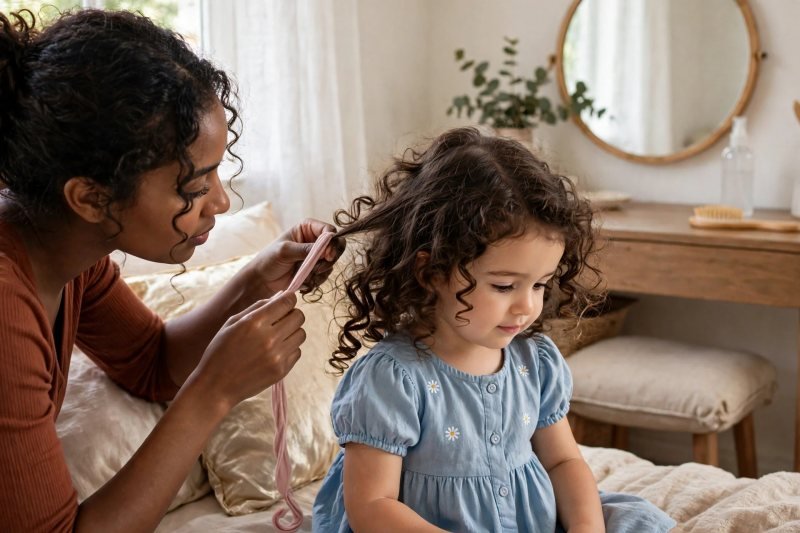
Take down the night protection. Start by undoing last night's help: slide the soft band out of her loose pineapple very gently, letting the gathered curls fall down on their own rather than pulling the band through them, or, if she slept on a satin pillowcase instead, lift her head and let the curls that the smooth fabric protected shake loose as she sits up. The night-before trick is simple and worth explaining while you work: curls gathered loosely on top of the head, or resting on a smooth pillowcase, spend the night gliding instead of rubbing, so they wake up with their shape mostly intact instead of matted flat against cotton. This is the same protect-it-between-times thinking behind keeping toddler hair healthy between trims, which this toddler first haircut guide covers for families planning that first salon visit. Say, "Off comes the pineapple, nice and gentle — see how your curls stayed up high and safe all night?" Naming the trick out loud helps her understand why the band or pillowcase matters, so she starts asking for it herself at bedtime.
-
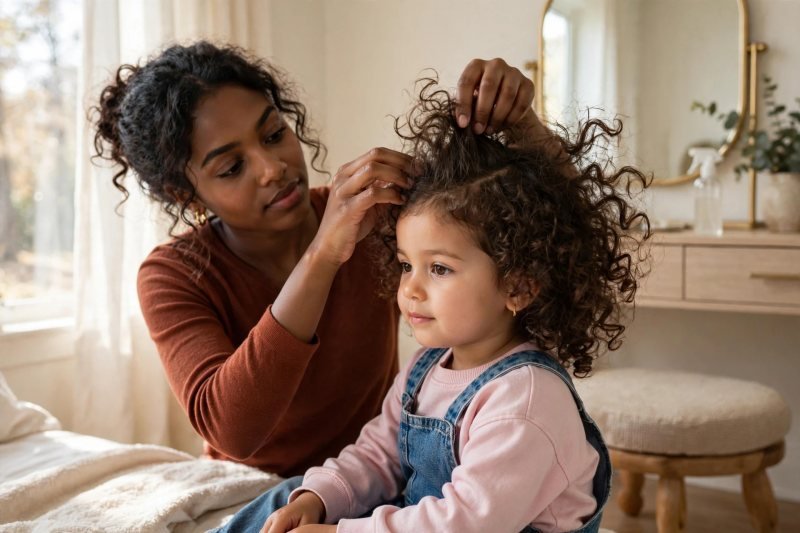
Shake out the roots. With the hair down, slide your fingertips in at the scalp — fingertips only, pads flat against her head — and give the roots a gentle lift and shake, working around the head in small spots so the hair lifts away from where sleep pressed it flat. This thirty-second shake restores air and volume at the roots, separates curls that clumped together overnight, and shows you the true shape you are working with before any water touches it. One rule governs this whole routine and it matters most right here: never brush dry curls, because a brush dragged through dry curls pulls them apart into frizz, tugs at the scalp, and undoes in seconds the shape you are trying to keep. Fingers can feel what a brush cannot, stopping at any snag instead of forcing through it. On wash days, when her hair is wet and conditioned, the best brush for curly toddler hair is the right tool — but on a refresh morning, fingers only. Say, "Fingertips in, little lift, little shake — we wake the roots up without any brush at all." If you meet a genuine tangle, leave it alone for now; the mist in a later step will soften it far better than dry fingers ever could.
-
Fill the spray bottle. Take the bottle to the tap together and fill it fresh: plain water does the whole job on most mornings, because water alone reactivates yesterday's curl shape and any product already in the hair, while a second option — water with a single tiny drop of leave-in conditioner shaken in until it disappears — suits a morning when her curls feel especially dry at the ends. Hold to the less-is-more rule firmly: toddler hair is fine, product builds up fast, and a heavy mix will weigh curls down and leave them looking dull by lunchtime, which is the opposite of a refresh. In every photo and every real-life version of this routine the bottle stays plain and completely unlabeled, and in real life it should be a bottle used only for hair water, kept with the hair things, and refilled fresh rather than topped up for days. Say, "Just water today, or one tiny drop shaken in — a little bit is plenty for your curls." Letting her shake the bottle is a small job she will claim proudly, and it makes the mixture hers too.

-
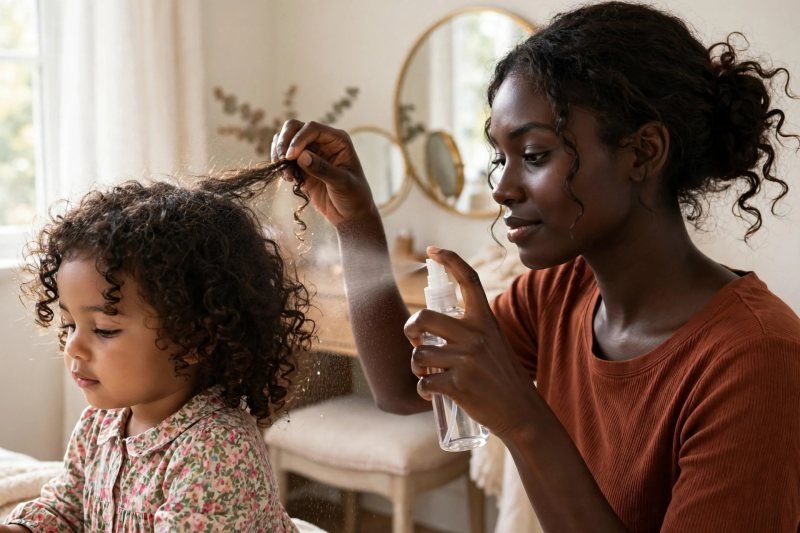
Mist section by section. Now work around her head in four to six loose sections — lift one area of curls at a time, hold the bottle a short distance away, and mist that section lightly and evenly until it feels damp to your palm, which is very different from soaking: the curls should look revived and slightly darkened by water, never dripping, never wet enough to soak her top. Move section by section rather than spraying the whole head at once, because damp curls start drying straight away and you want to smooth and twirl each section while it is still in that perfect just-misted state. This light-touch pacing follows the same less-is-more gentle-routine logic as a simple kids' skincare routine — small amounts, gentle hands, and a routine short enough to repeat without anyone dreading it. Say, "Mist, mist — just damp, never dripping. Can you count this section with me?" If a section accidentally gets too wet, blot it once with the towel and carry on; a refresh forgives small mistakes instantly.
-
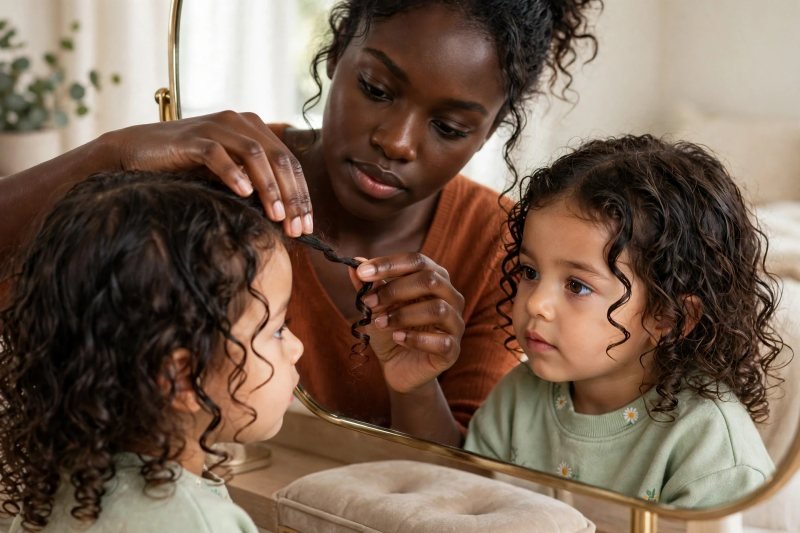
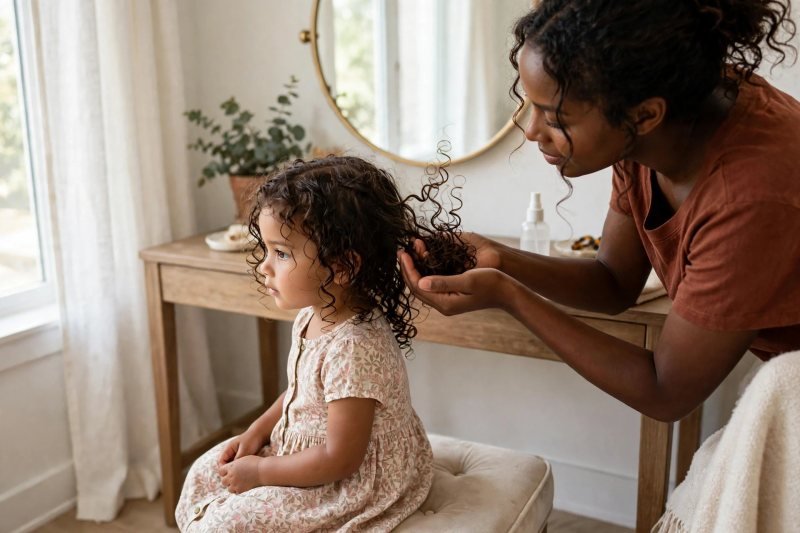
Finger-smooth and re-twirl. While a misted section is still damp, smooth its surface frizz down with damp palms, pressing and gliding gently from roots toward ends in the direction the curls naturally fall — your wet palms lay the fluffy halo down without disturbing the curl pattern underneath. Then take any flat or stretched-out pieces and twirl them around your finger in the direction they naturally curl, hold for a breath, and slide your finger out, leaving a re-formed coil that matches its neighbors. Work piece by piece through the section, twirling only the pieces that lost their shape and leaving the good curls completely alone, because a refresh fixes the few instead of redoing the many. Never pull a curl straight to make it behave, and never force a piece to curl the opposite way it wants to go; your fingers are persuading, not wrestling. Say, "Smooth with my palms, then twirl, twirl — watch that curl spring right back." The twirl is the moment most toddlers watch in the mirror with real delight, because the cause and effect is instant and visible.
-
Scrunch up for bounce. Once a section is smoothed and twirled, cup its ends in your palm from below, lift the curls upward toward her head, and scrunch gently — squeeze, hold for a moment, and release — two or three times per section before moving on. Scrunching encourages the damp curls to gather into their natural springy shape instead of drying long and flat, and it gives you a built-in test for wetness: correctly damp curls make a soft squelch sound in your palm when you squeeze them, while silent, dry-feeling curls need one more light mist and dripping curls need a blot. Keep every scrunch gentle and upward; there is no pulling down, no rough tousling, and no separating the curls you just encouraged to clump together. Say, "Cup them up, scrunch, scrunch — listen for the little squelch that says just right." Let her scrunch one easy section with her own small hands if she wants to; her squeeze will be gentler than yours and she will love being trusted with a real step.
-
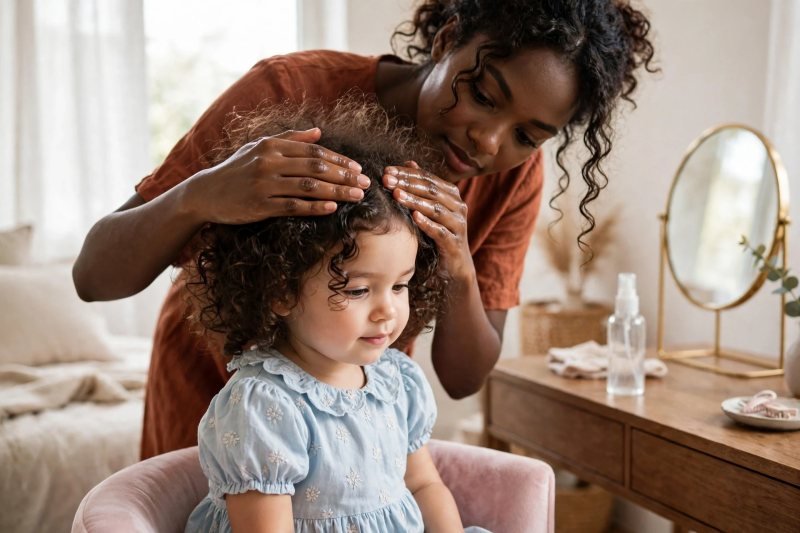
Calm the top layer and edges. When all the sections are done, look at the overall shape and deal with the finishing layer: re-wet your palms lightly and press them gently over the top of her hair, smoothing the fine halo of frizz that sits on the surface, then pat — never drag — along the front edges with the same damp palms. The top layer is what catches the light and what everyone sees first, so thirty calm seconds here makes the whole refresh look finished rather than merely less messy. Keep your touch feather-light at the edges especially, where toddler hair is finest and most delicate, and resist every urge to perfect: a soft, natural edge suits a 3- or 4-year-old far better than a slicked, stiff one. Above all, never gel-crust a toddler's hair into place — no heavy products, no crunchy hold, nothing that makes her curls feel like anything other than soft hair. Say, "Damp palms, gentle press — just calming the fluffy top down, nice and soft." What you are after is tidy and touchable, and her hair should still move when she shakes her head.
-
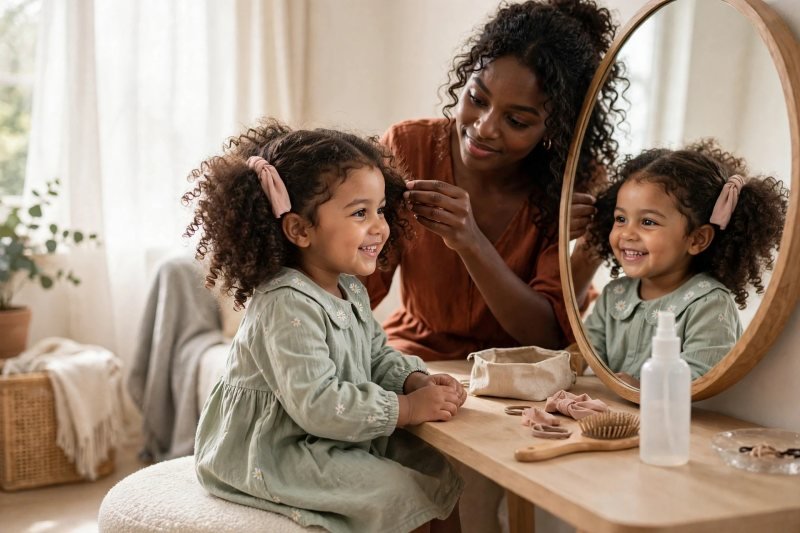
Finish the style. Choose the finish together from a short, kind menu: leave the curls loose and free, gather them into one soft side puff, make two puffs, or hold one side back with a single soft clip — every option done with soft bands only, placed with no tension, and checked with two of your fingers slipped underneath to prove it is loose. A band that pulls her eyebrows up, dents the skin, or makes her say anything at all about how it feels is too tight, full stop: take it out and redo it looser without debate. Sit her back from the mirror, then bring her forward for the reveal, because the small ceremony of the finished look is half the pleasure at this age. Ask which finish she wants rather than announcing it, since a child who chose her own puffs wears them happily all morning. Say, "Loose, one puff, two puffs, or a clip — you choose, and I will keep it soft and loose." If she wants it all left down today, loose is a complete and lovely answer. And when the curls outgrow the style and need a trim, our guide to cutting toddler hair at home keeps that job calm too.
-
Hands off while it dries. The last step is doing nothing, and it is a real step: once the style is finished, hands off completely while the curls air-dry as she plays, eats breakfast, or gets dressed, because every touch, twirl, and well-meaning adjustment while hair is damp pulls frizz back up and stretches out the shape you just restored. Drying takes only a short while after a light mist — far faster than after a wash — and the curls will firm gently into their refreshed shape best if nobody fusses with them, including her, so give her hands something better to do. Skip any heat entirely; a refresh never needs it, and warm air would only undo the calm you created. Later, a quick thirty-second midday check — a glance, one palm-press on any frizz that popped up, one re-twirl if a piece fell flat — is all a refresh day needs to carry her curls to bedtime. Say, "All done — now we leave your curls alone to dry while you play, and they will do the rest themselves." A routine that truly ends, instead of trailing through the morning, is the one a toddler will happily repeat tomorrow.


Make it easier
Refresh only the sections that need it: on a good morning, the back and the slept-on side may be the whole job, and two misted, twirled sections count as a complete refresh. Keep the bottle filled and the stool, towel, and soft bands living in one spot, so starting takes seconds and nobody has to hunt for supplies with a sleepy toddler waiting. Do the refresh during breakfast or a favorite song: seated, fed, and entertained is the easiest version of still, and five minutes disappears inside an ordinary morning.
Make it harder
Let her take over one real job at a time: holding the bottle while you guide the mist, scrunching one section with her own hands, or doing the final palm-press over the top layer herself. Add a counting and noticing game: count sections out loud, count re-formed twirls, and spot which curl bounced back the springiest — early math and observation inside real self-care. Teach her the order with a picture sequence you draw together — look, mist, smooth, twirl, scrunch, style, hands off — so she can point to the step you are on and eventually lead the routine.
Other ways to play it
- Extra-dry morning version: use the water with one tiny drop of leave-in conditioner shaken in, mist a touch more generously at the ends only, and spend the saved time on slow finger-twirling rather than extra product anywhere else.
- Puffs-refresh version: if yesterday's puffs are still neat at the base, leave them in entirely, mist and smooth only the puff ends and the loose top layer, re-twirl the front pieces, and the style looks new in about two minutes.
- Out-the-door version: for a rushed morning, mist just the top layer and front, smooth with damp palms, re-twirl the two or three flattest pieces, add one soft clip, and save the full section-by-section refresh for a calmer day.
How it changes by age
- Age 3: Keep the refresh very short and very seated: a cushioned stool, a toy in her hands, four sections at most, and a finish she picks from just two choices — loose or one clip. Expect her help to be shaking the bottle, holding the towel, and scrunching one easy section with you, and expect the whole thing to end the moment she is done with it; a half-refresh given happily teaches her more than a perfect one endured. Narrate every mist before it lands so the cool spray never surprises her.
- Age 4: A 4-year-old can follow the full sequence, count sections and twirls, tell you clearly which pieces look flat to her, choose between loose, one puff, two puffs, or a clip, and do the final hands-off check in the mirror with real pride. Give her the mirror verdict — did the refresh work? — and believe her reports about any band feeling tight. Her growing independence is the point: this is her hair, learning its morning routine, with you as the gentle coach beside her.
What they're learning
Body autonomy and voice: choosing her finish, reporting any tightness and being believed instantly, and helping judge which curls need help — early lessons that her body and her words both matter. Counting and sequencing: four to six sections misted in order, twirls counted as they spring back, and a routine with a clear beginning, middle, and hands-off end — math and logic inside real life. Cause and effect: a light mist plus a twirl brings a flat curl back, touching damp hair brings frizz back, and a loose night pineapple means less work in the morning — process lessons she can see in the mirror. Self-care and identity: her curls are celebrated exactly as they grow, cared for gently without being pulled straight, heated, or crusted into place — a foundation for confidence that reaches far beyond hair. Curls come in many patterns, from loose waves to tight coils, and this mist-and-twirl method works the same way for all of them — you are only waking up the shape her hair already has. For the bigger picture of keeping curls healthy week to week, our curly hair care for toddlers guide covers washing, detangling and trims.
Clearing up
Pour out any leftover conditioner mix rather than storing it, rinse the spray bottle, refill it with fresh plain water for next time, and stand it with the hair things in its usual spot. Shake the shoulder towel into the laundry if it caught drips, put the soft bands and clip back in their container, and wipe any misted spots off the mirror and floor so nothing stays slippery. Tonight, remember the other half of clearing up: her loose pineapple or smooth pillowcase at bedtime is what makes tomorrow's refresh a five-minute job instead of a rescue mission.
Questions parents ask
How do you refresh toddler curls between washes without washing?
How wet should toddler curls get during a morning refresh?
Can you brush dry toddler curls to tidy them?
What should go in the spray bottle for refreshing toddler curls?
How do you protect toddler curls overnight so mornings are easier?
How long does a spray-bottle curl refresh last during the day?
Internal link targets for publisher: toddler-first-haircut-guide; kids-skincare-routine-simple-steps; best-brush-curly-toddler-hair; cut-toddler-hair-at-home; curly-hair-care-for-toddlers. All five are live URLs.

save it for later
Pin this for the next rainy afternoon
Keep it on a board so it is there when you need it, rather than when you happened to find it.
Save to Pinterest

