


Rain Cloud in a Jar Experiment for Toddlers
Make it rain inside a jar with this gentle rain cloud in a jar experiment for toddlers — shaving-foam clouds, blue food-coloring rain, and real weather learning in ten minutes, with full safety notes for ages 2–3.
To make a rain cloud in a jar: fill a clear jar three-quarters with water, spray a thick layer of white shaving foam on top as the "cloud", then drip blue food coloring onto the foam. Within a minute or two the color seeps through and falls as blue "rain". An adult leads throughout; toddlers help with the drops and do the watching. Allow 10–15 minutes; expect repeats.

The short version
- A clear jar, water, shaving foam, and blue food coloring are all you need — five minutes to set up.
- The foam is the cloud, the coloring is the gathered water, and the falling streaks are the rain — a genuinely honest weather model.
- An adult must lead: water, foam, and food coloring are not for tasting, and coloring stains.
- The rain takes a minute or two to appear — add more drops if nothing happens.
- Explain it in one sentence for toddlers: "The cloud got too heavy, so the rain fell out."
- Repeat it, try new colors, then watch real rain together on the next rainy day.
- Age
- Ages 2–3
- Prep
- 5 min
- Play time
- 10 min
- Mess
- Some
- Where
- Indoor
Why kids love this
Toddlers love this experiment because it looks like actual magic. One moment there is a jar of water with a fluffy white cloud on top; the next, blue rain is falling through it — inside the jar, on the table, right in front of them. There is no waiting, no complicated steps, just a big, beautiful cause-and-effect they can see with their own eyes. And because an adult does the fiddly bits, the toddler's job is the best part: squeezing the color, pointing at the rain, and saying "again!"
Some activities make a toddler go quiet with wonder. This is one of them. The rain cloud in a jar experiment takes five minutes to set up, uses four things from your kitchen and bathroom, and ends with your two-year-old watching blue rain fall inside a jar — on your table, in real time. It is the rare toddler activity that is genuinely a first science experiment and not just a craft with a lab coat on.
How does the rain cloud in a jar experiment work? The jar is a tiny, honest model of the sky. The water is the air; the shaving foam floating on top is the cloud. Real clouds are made of tiny water droplets clinging together — when enough gather, the cloud gets too heavy to hold them and they fall as rain. In the jar, the blue food coloring plays the part of that gathered water: it soaks slowly through the foam, gets heavier, and then streams down through the "air" as bright blue rain. The mechanism is simplified for little eyes, but it is not faked — heavy things fall out of clouds, in the sky and in the jar.
What do you need for the rain cloud experiment? Almost nothing, which is the beauty of it. A clear glass jar or large clear cup (jam jars are perfect), water, plain white shaving foam — the foamy kind, not gel — and blue food coloring. You will also want an eye dropper, pipette, or teaspoon for the coloring, a tray or old towel under everything, and old clothes on your toddler, because food coloring stains with real enthusiasm. That is the entire shopping list, and you probably own all of it already. For more ideas in the same low-prep spirit, our toddler learning activities at home collection is full of them.
How do you make a rain cloud in a jar? An adult does the setup; the toddler does the magic part. Here is the whole experiment, step by step.
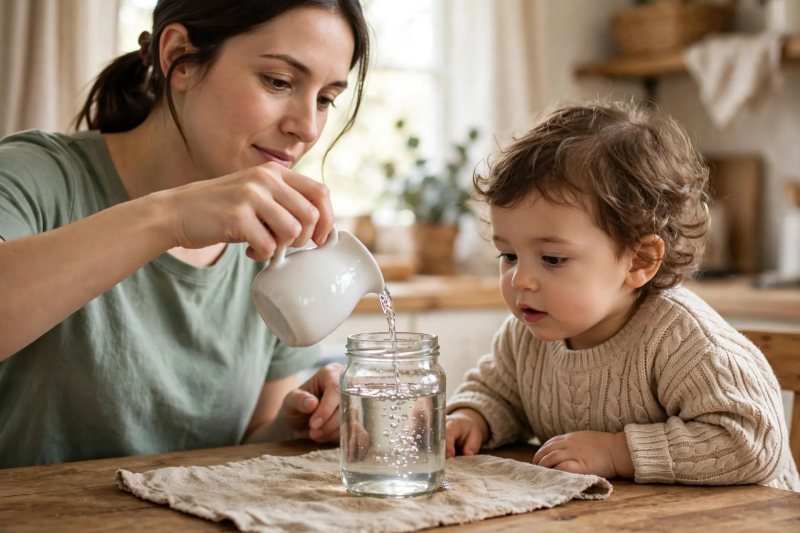
Fill the jar Pour water into the clear jar until it is about three-quarters full. Do this where your toddler can watch — pouring water is genuinely fascinating at two, and it sets up the "we're making something" anticipation. Set the jar on the tray.
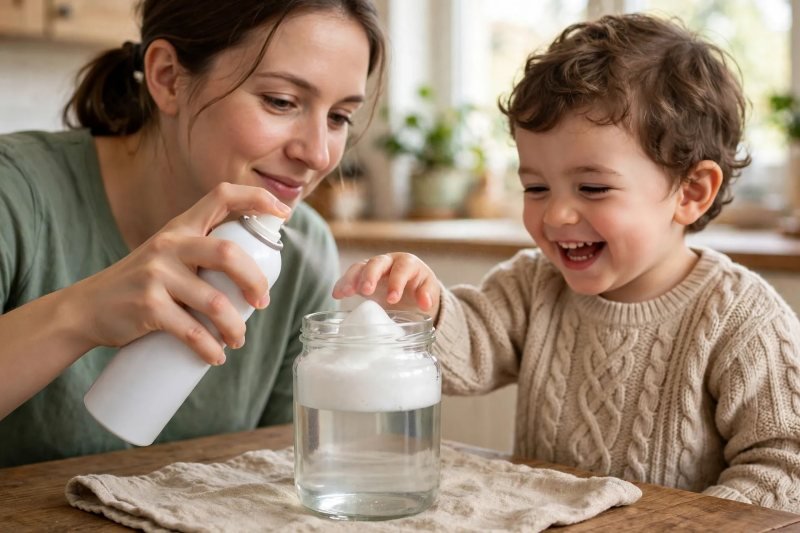
Make the cloud Spray a thick layer of white shaving foam across the top of the water, about 3–4 cm deep. Announce it: "This is our cloud!" Then let your toddler touch the foam. Most two-year-olds will spend a full minute just squishing it, and that is fine — it is their experiment too.
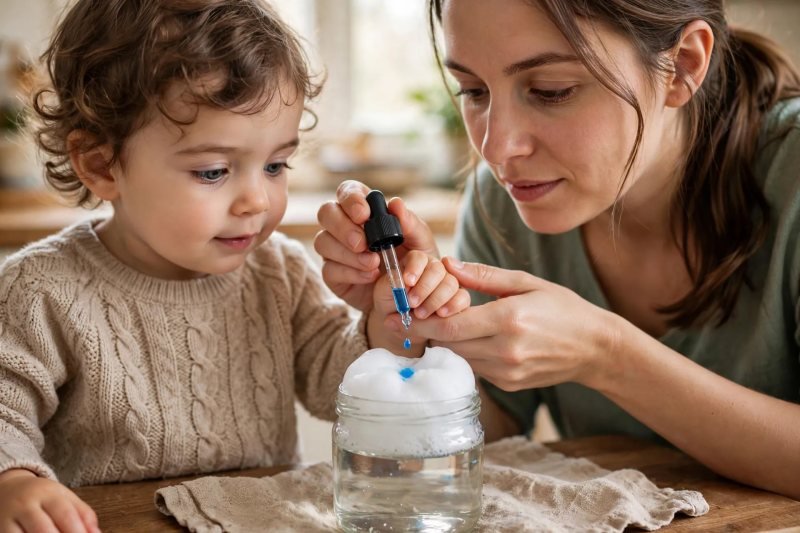
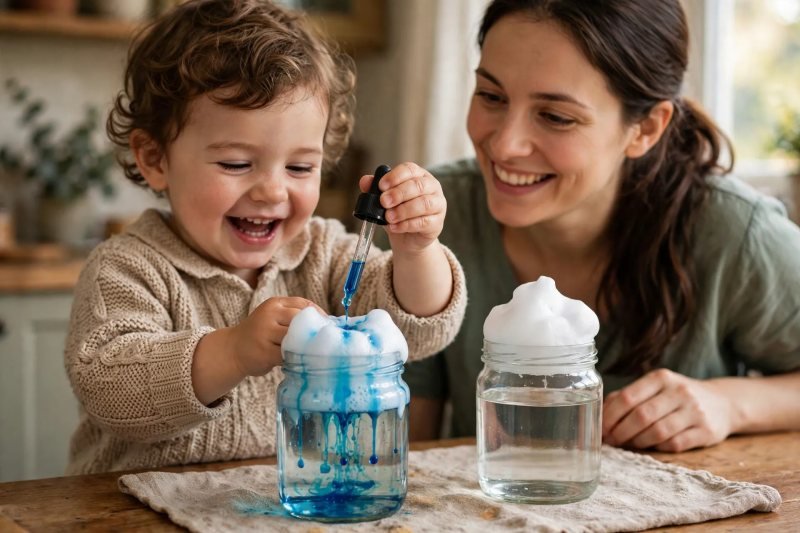
Add the rain Drip the blue coloring onto the top of the foam cloud, a few drops at a time. Guide your toddler's hand on the dropper or let them spoon drops over with a teaspoon. Spread the drops around so the whole cloud gets some. This is the moment of agency — they are making the weather.
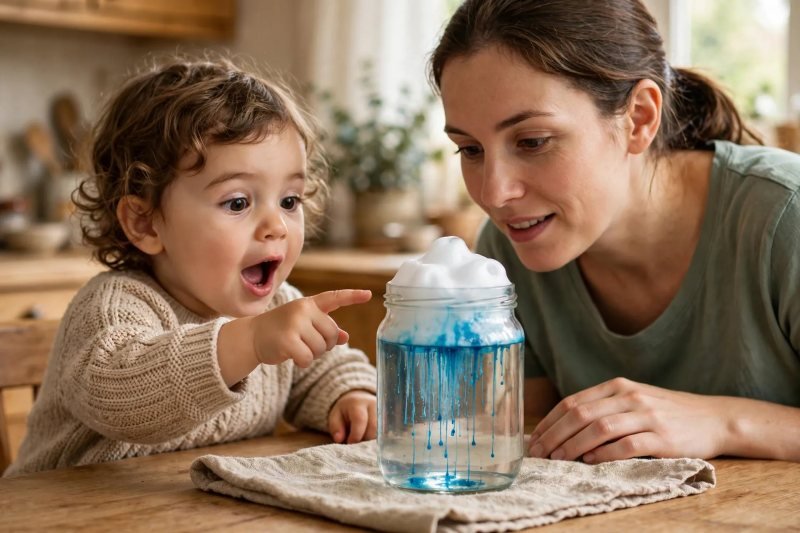
Watch it rain Now wait, and watch together. Within a minute or two, blue streaks start seeping through the foam and falling through the water. Point and narrate simply: "Look — it's raining in the jar! The cloud got too heavy!" Toddlers typically gasp, point, and immediately demand another round. Give them one. And another.
Play it again Add more drops for heavier rain, or start a fresh jar and let your toddler run the round again — most toddlers ask for at least three rounds, and each repeat is the learning landing, not a rerun. Try rainbow rain with several colors in different spots, or a storm cloud with lots of coloring at once, and finish by watching real rain together the next rainy day.
How do you explain rain to a toddler? Keep it to one true sentence: "The cloud got too heavy, so the rain fell out." That is it. At two and three, children do not need the water cycle — they need a cause they can see (drops went in) and an effect they can watch (rain fell down). You can build on it later: on the next real rainy day, point at the sky and say, "Look — those clouds got too heavy, just like our jar!" That single connection, weeks later, is the learning landing. Resist the urge to lecture; the jar is doing the teaching.
What if the rain doesn't fall? First, wait. The color needs a minute or two to soak through the foam — nothing happening in the first thirty seconds is completely normal. If after a few minutes there is still no rain, the usual culprit is too little coloring: add several more drops across the top of the cloud. A very thin foam layer can also let the color through too fast to see as "rain" — next time, spray it thicker. And if the foam was gel instead of foam, start over with the foamy kind; gel does not behave the same way. None of these are failures — troubleshooting together ("let's add more drops and see") is itself part of the experiment.
How can you play it again? Repetition is the toddler learning strategy, so plan on multiple rounds — most children ask for at least three. Then stretch it: try rainbow rain with several colors dropped in different spots, make a "storm cloud" with lots of coloring at once, or set up two jars — one with a thin cloud, one with a thick one — and see which rains first. Afterwards, paint rain pictures together with blue crayons or watercolors while the experiment is fresh in mind. And the loveliest follow-on costs nothing: the next time it rains for real, revisit the jar first, then watch the sky together. For the years beyond toddlerhood, our preschool learning activities at home collection picks up where this leaves off — or browse the science learning hub and the learn hub for the full library. Keep the weather play going with build a weather station for kids, try color mixing for toddlers for more water-play color, or watch another first experiment with dancing raisins.
What you'll need
- A clear glass jar or large clear cup (a jam jar or mason jar is ideal)
- Water
- Plain white shaving foam (the foamy kind, NOT gel)
- Blue food coloring (a few drops)
- An eye dropper, pipette, or teaspoon for the color
- A tray, baking sheet, or old towel to work on
- Old clothes or an apron for your toddler (food coloring stains)
Before you start
1. Cover your work surface with a tray or old towel, and dress your toddler in old clothes. 2. Fill the jar about three-quarters full with water. 3. Have the shaving foam and food coloring ready — mix a few drops of blue coloring with a spoonful of water in a small cup so it is easy to drop. 4. Seat your toddler where they can see into the jar clearly — a highchair or a cushion booster at the table works well.
How to do it
-
Fill the jar. Pour water into the clear jar until it is about three-quarters full. Let your toddler watch the water go in — pouring is fascinating at this age.
-
Make the cloud. Spray a thick layer of white shaving foam (about 3–4 cm) across the top of the water. Tell your toddler: "This is our cloud!" Let them touch the foam — it is half the fun.
-
Add the rain. Using the dropper or teaspoon, drip the blue coloring onto the top of the foam cloud, a few drops at a time. Your toddler can squeeze the dropper with your hand guiding theirs.
-
Watch it rain. Within a minute or two, the blue color seeps through the foam and starts falling through the water in streaks — rain! Watch together, point, and narrate: "Look, it's raining in the jar!"
-
Play it again. Add more drops for heavier rain, or start a fresh jar. Most toddlers ask for at least three rounds.


Make it easier
Use a teaspoon instead of a dropper for the coloring — easier for very young toddlers. Do the whole thing in the bath or at the kitchen sink for zero-stress cleanup. Keep the "lesson" to one sentence: "The cloud got too heavy and the rain fell out!" That is plenty for a two-year-old. If your toddler just wants to squish the foam, let them — sensory play is learning too.
Make it harder
Try different "rain" colors — red, yellow, green — and watch them fall. Make two jars: one with a thin cloud, one with a thick cloud. Which rains first? After the experiment, paint rain pictures together with blue crayons or watercolors. Look out of the window together: can you see real clouds? What color are they?
Other ways to play it
- Rainbow rain: add drops of several colors around the cloud and watch them fall as separate streaks.
- Storm cloud: add lots of coloring quickly for a dramatic downpour.
- Ocean jar: skip the foam and drop coloring straight into the water — watch it swirl and mix instead.
- Window watching: on the next rainy day, revisit the jar experiment, then watch real rain together and spot the clouds it falls from.
How it changes by age
- Written for ages 2–3, when cause-and-effect play is at its most thrilling. At this age the adult does the setup and the fiddly steps; the toddler's role is dropping color (with help), watching, pointing, and narrating. Three- to four-year-olds can take over more steps — spraying the foam, counting the drops. Older siblings love running the whole experiment as the "scientist" while the toddler watches.
What they're learning
Cause and effect: my action (drops on the cloud) makes something happen (rain falls) — the foundational logic of science. Early weather concepts: clouds hold water; when they get too full, rain falls. A genuinely true first model of the water cycle. Observation skills: watching closely, noticing change over time, pointing out what is happening. New vocabulary: cloud, rain, drop, fall, heavy, wet — rich, concrete words anchored to something they just saw. Sensory exploration: the foam's texture, the water's coolness, the color spreading — all valuable sensory input.
Clearing up
Clearing up: rinse the jar, wipe the tray, and wash hands — food coloring stains, so old clothes and a damp cloth nearby save the table. This is a real model of rain, simplified — not a trick. Clouds genuinely are collections of tiny water droplets, and rain genuinely falls when they get too heavy to hold it. The one-sentence explanation ("the cloud got too heavy") is honest, just toddler-sized. The rain takes a minute or two. If nothing happens immediately, that is normal — the color needs time to soak through the foam. Add a few more drops rather than declaring it broken. Shaving foam is the cloud, not the point. If the foam fascinates your toddler more than the rain, that is fine — sensory exploration is the priority at this age. One experiment, many replays. Repeating it is not "doing it again for no reason" — repetition is how toddlers consolidate what they observed.
Questions parents ask
How do you make a rain cloud in a jar for toddlers?
What age is the rain cloud in a jar experiment for?
How do you explain the rain cloud experiment to a toddler?
Why isn't my rain cloud in a jar raining?
Is the rain cloud in a jar experiment safe for toddlers?
What can toddlers learn from the rain cloud experiment?

save it for later
Pin this for the next rainy afternoon
Keep it on a board so it is there when you need it, rather than when you happened to find it.
Save to Pinterest


