


One-to-One Correspondence Activities: The Counting Skill Everyone Skips
One to one correspondence activities teach toddlers the quiet rule behind real counting: one number word per object, each touched once. Ten hands-on activities for 2–3-year-olds that build the skill through play — no worksheets, no drilling.
One-to-one correspondence means matching each number word to exactly one object while counting — one touch, one number, no skips or double-ups. Most children develop it between ages 2 and 3 through touch-counting games. It turns reciting numbers into actually knowing how many.

The short version
- One number word per object, each touched once while counting — that is the whole rule.
- It turns reciting ("one-two-three!") into real counting (knowing how many).
- Touching is not a crutch — it is the teaching.
- Slow wins: about one number per second, one touch per number.
- Double-touches, skips, and speed-counting are normal rehearsal at 2–3.
- Ten little activities, roughly one a day, build it over two weeks.
- Age
- Ages 2–3
- Prep
- 5 min
- Play time
- 15 min
- Mess
- Some
- Difficulty
- Easy
- Where
- Both
Why kids love this
Toddlers love counting games where their hands do the work: feeding a puppet, stamping dots, dropping toys into a basket, splashing ducks back into the tub. Every game here is a small job with a clear ending — one touch, one number — and the counting rides along inside the play instead of sitting on top of it. There is nothing to get wrong, because recounting is part of the game, and a toddler who counts five crackers gets to eat them.
What is one-to-one correspondence? It is the invisible rule behind every count: every object gets exactly one number word, and every number word gets exactly one object. One touch, one number. A toddler who touches each of five crackers once while saying "one, two, three, four, five" is using it. A toddler chanting the same words while waving a hand over the pile is not — and the chanting usually comes first. Real counting is two jobs at once: remembering the number words (a song, mostly memory) and coordinating one touch per word (a motor-planning challenge). A 2-year-old can nail the song while the touching is months away — so reciting to 20 yet unable to count four grapes is nothing to worry about.
Why does one-to-one correspondence matter so much? Without it, counting is a performance — impressive, but empty. With it, numbers mean something: the last number tells you how many. One-to-one matching is one of the core principles of counting, and it underpins comparing, sharing, and eventually adding. A toddler who can truly count five objects understands more math than one who chants to fifty.
How do I know if my toddler is really doing it? Watch the fingers, not the mouth. Clicking: they slow down, touch each object once, backtrack after a stumble. Still cooking: the machine-gun chant, double-taps, hover-pointing, skipped objects. All normal at 2–3.
How long does one-to-one correspondence take to click? Most children need weeks to months of daily little counting moments, and the path zigzags: accurate to 3, shaky to 5, perfect to 7 on Tuesday and forgetting 4 on Wednesday. That is rehearsal, not regression.
What you'll need
- Five crackers or similar snacks for the first game
- Toy cars for pointing and lining up
- Two bowls and chunky wooden blocks
- Big dot stickers and plain paper
- A sock puppet with a mouth cut in it, plus pom-poms or crackers to feed it
- A soft die or number cards 1–5, and small toys for fetching
- A muffin tin and grapes, blocks or pom-poms (cut grapes lengthwise for under-3s)
Before you start
1. Line up the day's objects before you start — crackers, cars, blocks, stickers, puppet, die or cards, muffin tin — so nothing interrupts the count. 2. Cut grapes lengthwise if your toddler is under 3, and keep small items (pom-poms, stickers) in a bowl you control. 3. Clear a small floor or table space with nothing else to grab. 4. Plan one activity a day, 5–15 minutes, for a week or two — short bursts beat one long session.
How to do it
-
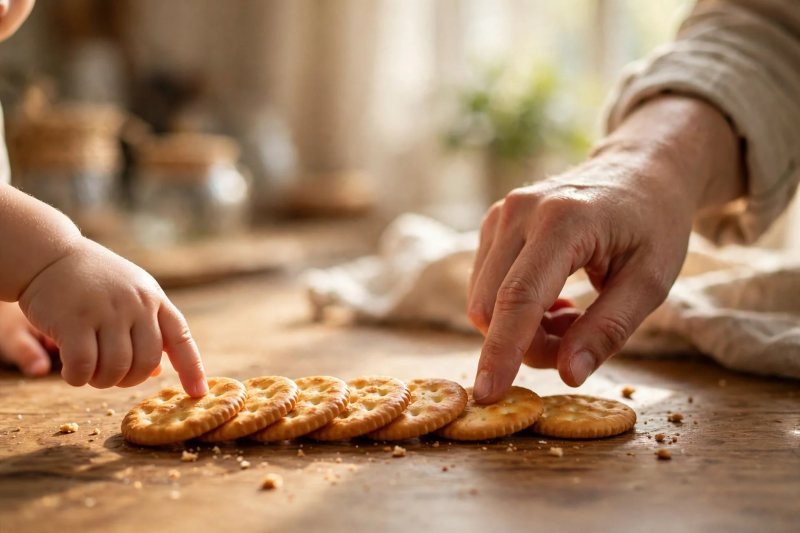
Set the one-touch rule with snacks. Line up five crackers, say "one touch, one number," and touch each one slowly as you count, letting your toddler eat each cracker as it is counted — the eating is the reward and the proof that each object was counted exactly once. Keep your voice slow and your finger obvious; your toddler is watching the touch more than listening to the words at this age. If they grab a handful, smile and start again with three crackers instead of five — smaller sets make the rule visible.
-
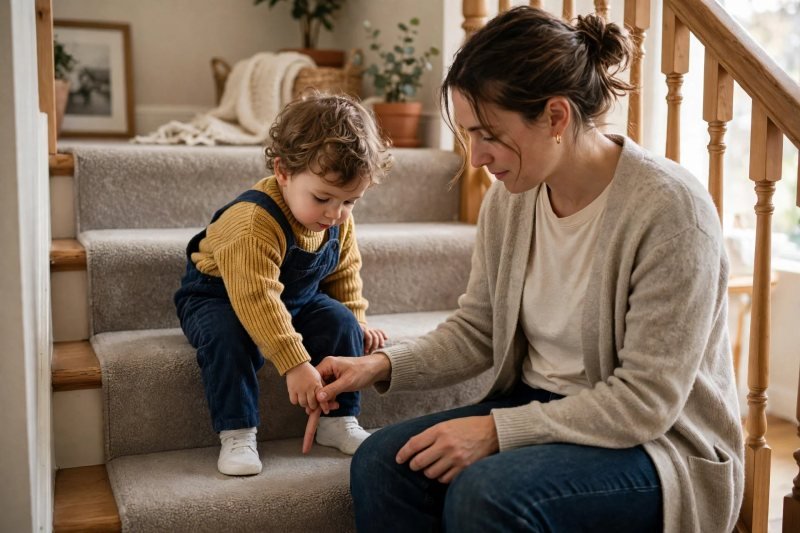
Slow it right down to one number per second. Count the stairs together at a snail's pace, touching each step as you say its number, and hold your toddler's hand to the rhythm if they race ahead — speed is the enemy of matching at this stage. One number per second feels almost too slow to an adult, and that is exactly the pace a 2-year-old's fingers need. Do the same staircase every day for a week; the familiar stairs let the counting do the growing.
-
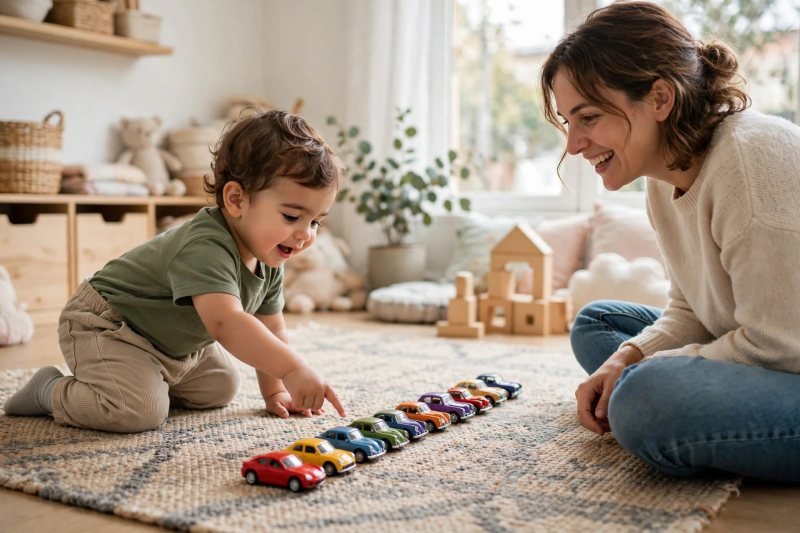
Point first, and let the adult say the number. Line up toy cars and let your toddler point while you say each number as their finger lands — splitting the jobs lets the coordination click sooner, because pointing is easier than pointing and talking at once. Wait for the finger before you say the word, even if the pause feels long; the pause is the lesson. When the pointing is steady, hand over one number at a time — "you say the next one" — and let them take the words when they are ready.
-
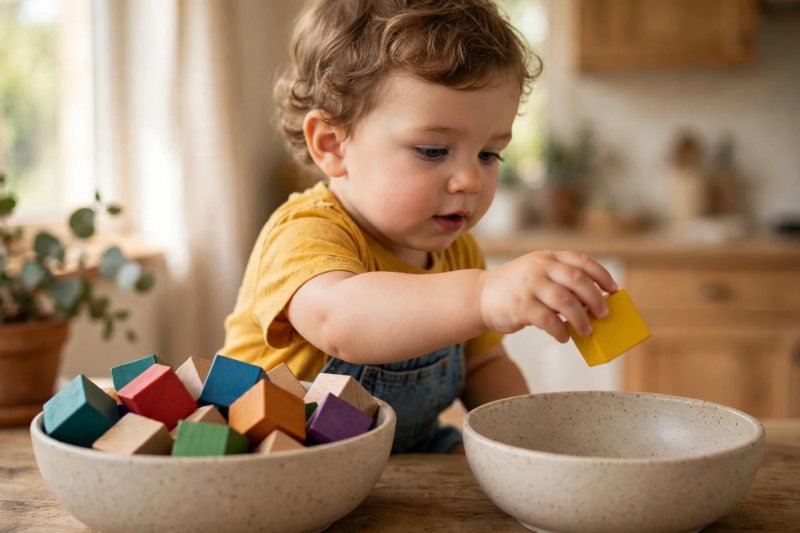
Move it as you count it. Start with the blocks in one bowl and let your toddler move one block per number into an empty bowl while you both count — nothing in the second bowl can be double-counted, because it only arrives there once. Say the number as the block lands, not before, so the word and the movement happen together. If a block gets moved without a number, gently move it back and count it again; the redo teaches more than any correction.
-
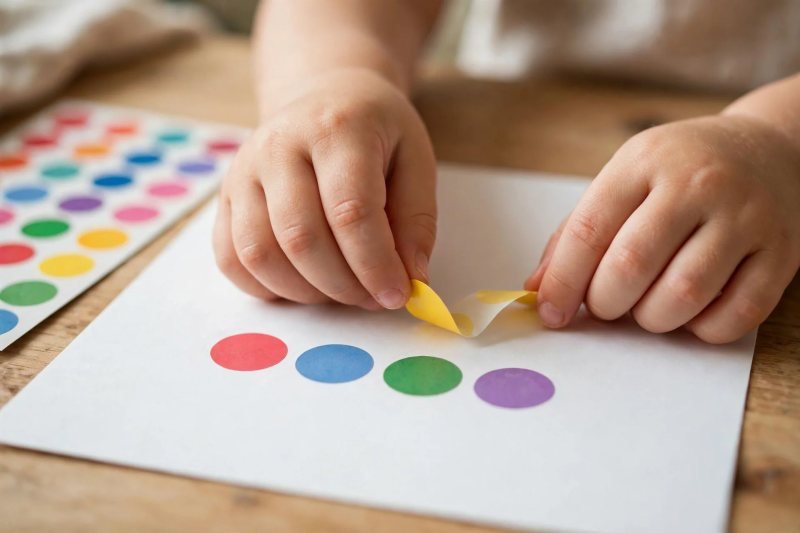
Stamp one dot per number. Stick big dot stickers on paper, one per number, counted out loud together — peel-and-place is perfect practice for little fingers, and each sticker stays exactly where it was put, so the counted set is visible at the end. Count the stickers again when the row is finished and celebrate the match: the same number twice is the first hint that counting gives a real answer. Keep the paper — a row of five stickers is a trophy worth putting on the fridge.
-
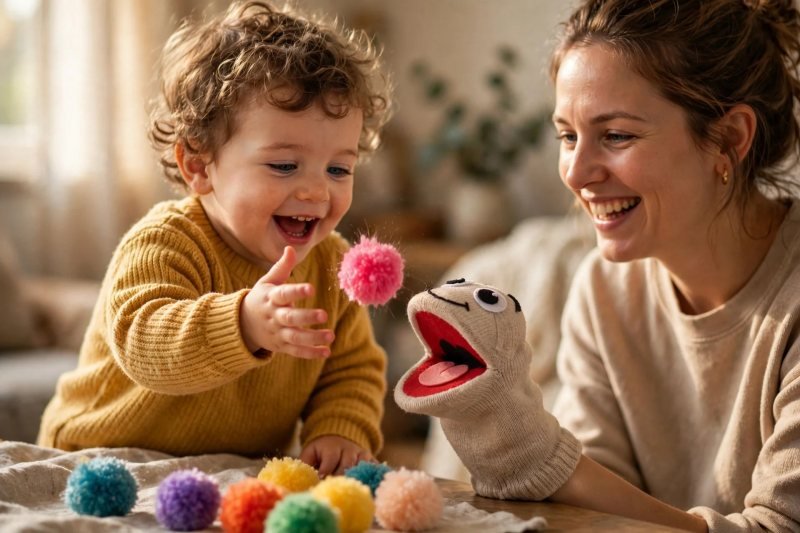
Feed the puppet, one pom-pom at a time. Cut a mouth in a sock puppet and let your toddler "feed" it one pom-pom or cracker per number — each drop is an unmissable match, because the puppet can only eat one thing at a time. Count together as each piece goes in, and let the puppet "ask" for one more when the count is done. Keep small items in your sight throughout this game and tidy them away when you finish — see the safety notes below.
-
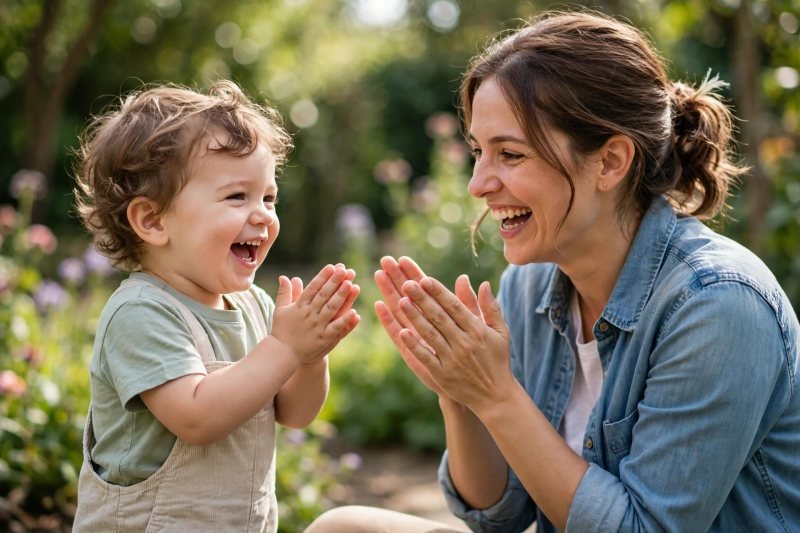
Clap it, stomp it, tap it. One clap gets "one," two claps get "two," up to five — then take it outside and stomp it across the garden, where the body sets the pace and the ground gives every number a thump. Clapping, stomping, and tapping all teach the same rule through movement: one action, one number, no extras. If your toddler adds an extra clap, laugh and count the claps back together — the mistake is the practice.
-
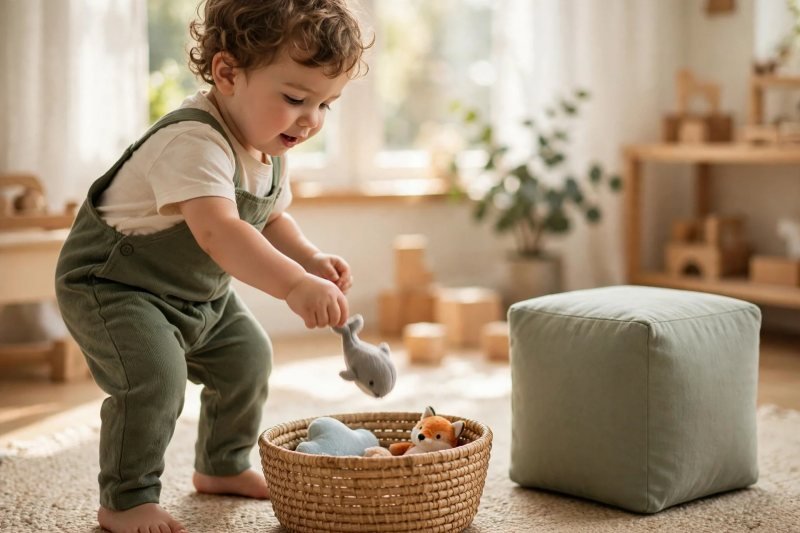
Roll and fetch exactly that many. Roll a soft die or flip number cards 1–5, and let your toddler count that many toys into a basket, one per number — stopping at exactly the right number is the whole challenge, and the hardest part of the game. If they fetch one too many, count the basket together and take the extra one back out, saying its number as it leaves. Keep the target at 1–3 for a young 2-year-old and stretch to 5 only when stopping feels easy.
-
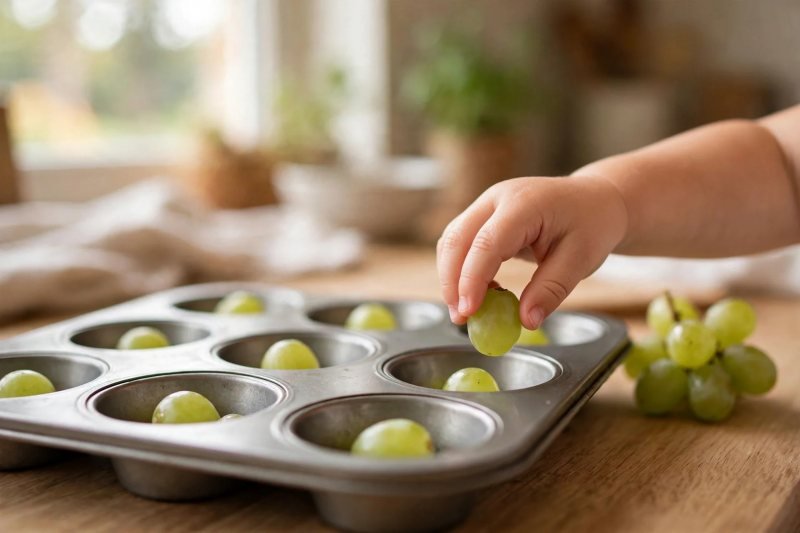
Fill the muffin tin, one cup at a time. Place one object — a grape, a block, a pom-pom — into each cup, counting as you go — the compartments do the organizing, so every object has exactly one home and none can be counted twice. Cut grapes lengthwise for under-3s before you start, and count the full tin together at the end. When the tin is full, tip it out and fill it again with a different object; the same game with new things is new practice, not repetition.
-
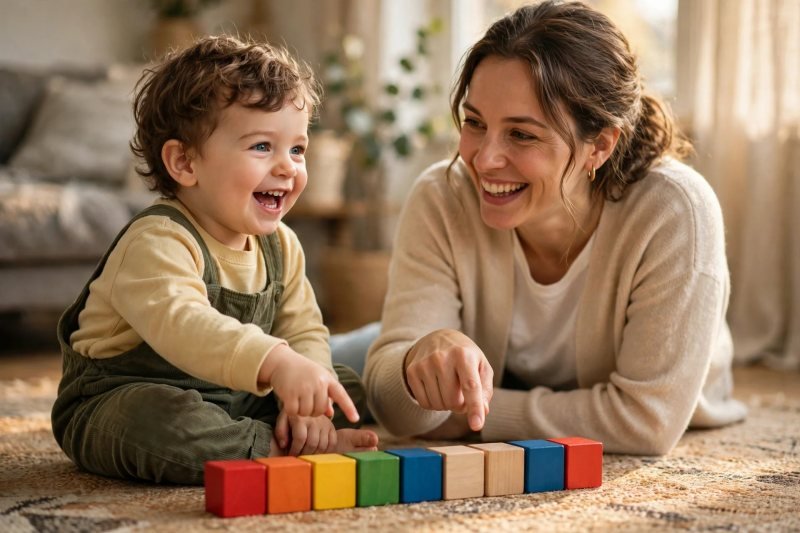
Play the recount game. Count the blocks together, then grin: "let's check!" and count again slowly, touching each block a second time — matching totals get a cheer, and a different total gets a third slow count, not a correction. Recounting teaches the deepest lesson of all: real counting gives the same answer twice. End the game on a match, even if it takes three tries — the cheer belongs to the checking, not the speed.


Make it easier
You count; your toddler just touches, points, or moves along. Stay at 1–3 for a young 2-year-old. Keep sets tiny — one, two, three objects only — until the touching feels steady.
Make it harder
Stretch the sets to 7, then 10. After counting, ask "so how many?" — the next skill (cardinality) knocking. When 10 feels steady, our counting to 20 activities are the next milestone to work toward.
Other ways to play it
- Bathtime: count rubber ducks back into the tub, one splash per number.
- Snack math: count apple slices onto the plate, one per number, then eat them in order.
- Nature walk: count pinecones into a bucket, one per number.
How it changes by age
- Young 2s: do best on steps 1–5 with you counting — the touching is their job, the words are yours.
- Older 2s and young 3s: can try all ten and start saying the numbers.
- Next: our counting to 10 activities milestone plan, and counting games for preschoolers for the next age up.
What they're learning
Math: one-to-one correspondence — one number word per object, the foundation of real counting. Math: the first whisper of cardinality — counting tells you how many. Fine motor: pointing, pinching, peeling, placing with control. Language: number words in order, plus "each" and "one more." Self-regulation: slowing down and stopping at the right number.
Clearing up
If they count faster than their fingers, hold their hand and set the pace — the words are memorized while the matching is still being built. If they touch some things twice, that is normal; recount together slowly instead of correcting. If they will not count at all, drop back to steps 1–3 with you doing all the counting; listening is the first phase, not a delay.
Questions parents ask
What is one-to-one correspondence in simple terms?
At what age do children learn one-to-one correspondence?
How can I teach one-to-one correspondence at home?
My toddler counts but skips objects. Is that normal?
Why does my child say numbers faster than they can touch the objects?
What comes after one-to-one correspondence?
One activity a day for a week or two beats a single long session — the skill builds through daily little counting moments. If a game flops, try it again tomorrow with a smaller set; a smaller set makes the one-touch rule visible again. More ideas in our counting activities for toddlers, and if you want more at-home learning games between counting sessions, our toddler learning activities at home round up simple ideas for the same age.

save it for later
Pin this for the next rainy afternoon
Keep it on a board so it is there when you need it, rather than when you happened to find it.
Save to Pinterest

