


Kindergarten Sight Words List: All 52 Dolch Words (+ Practice Plan)
The complete 52-word Dolch kindergarten sight words list, grouped into six small practice sets, with a four-week practice plan and screen-free games. Ten minutes a day, no worksheets, no drilling — just playful repetition that makes every word stick.
The kindergarten sight words list is the 52-word Dolch primer list — words like all, are, have, they, with, and went — taught after the 40 pre-primer words. This article groups all 52 into six practice sets with a four-week plan: learn two to three words a day through short games, review weekly, and graduate a word once it's read instantly three days running.

The short version
- The Dolch kindergarten list is 52 specific words (the primer level) — learn them after the 40 pre-primer words are comfortable.
- Six small sets beat one big list: finishable chunks keep a five-year-old motivated.
- Two to three new words a day, ten minutes daily, beats weekend cramming every time.
- Every game mixes new words with already-learned ones (about half and half) so nothing fades.
- A word graduates after three instant reads across three different days — no sounding out, no hesitation.
- Lookalike pairs (was/saw, on/no) should be taught on different days so they don't blur together.
- Age
- Ages 5–6
- Prep
- 10 min
- Play time
- 10 min
- Mess
- Low
- Difficulty
- Easy
- Where
- Indoor
Why kids love this
Kids love collecting things — stickers, shells, shiny rocks — and this turns reading into a collection. Every word learned goes into their very own Word Bank tin, and the four-week plan works like game levels: finish a set, unlock the next one. By the final week they're reading real sentences built from their own cards, and the graduation moment — counting all 52 mastered words — is genuinely thrilling for a five-year-old.
If your child has worked through the first set of sight words and is starting to spot familiar words in every bedtime story, they're ready for the next rung: the kindergarten sight words list of 52 Dolch words. These are the words widely taught in US kindergarten classrooms after the pre-primer set — slightly longer, slightly trickier, and the key to reading real sentences with confidence.
This guide gives you the complete list, split into six small practice sets, plus a four-week practice plan that takes about ten minutes a day. No worksheets, no drilling, no tears — just short games and a simple routine that makes all 52 words stick.
What is the Dolch kindergarten sight words list? In the 1930s and 40s, educator Edward William Dolch studied children's books to find the words that appear most often, and grouped them by level. The pre-primer list (40 words) is the starting point for the youngest readers; the primer list — the 52 words below — is the kindergarten list most American classrooms use next. These 52 words turn up again and again in early readers. Once a child recognizes them instantly, their reading energy goes toward the new words they're still sounding out, instead of stumbling over familiar ones on every line. Other word lists exist — the Fry list is another common one — but this guide follows the Dolch primer list throughout, so every word below belongs to that one list.
How is this list different from the first 40 sight words? The first 40 words are the gentlest high-frequency words: short, simple, and everywhere. This 52-word list is step two. The words are a little longer and do more grammatical heavy lifting — pronouns like they and who, past-tense verbs like came and went, connectors like but and with. If your child hasn't learned the first 40 yet, start there — this list builds directly on them. If those already feel easy, you're in exactly the right place.
What are the 52 words, grouped in practice sets? Don't hand a five-year-old 52 words at once. The six sets below move roughly from easiest to hardest, and each one is small enough to feel finishable. Make cards for one set at a time, and don't print the next set until the current one is underway. Set 1 — The Tiny Ones: am, are, at, be, do, he, no, on, so. Set 2 — Pointing Words: all, our, she, that, they, this, there, what, who. Set 3 — Action Words: ate, came, did, eat, get, ran, ride, saw, went. Set 4 — Describing Words: black, brown, four, good, new, pretty, soon, white. Set 5 — Joining Words: but, into, like, must, now, out, too, under, with. Set 6 — Sentence Builders: have, please, say, want, was, well, will, yes.
What does the 4-week practice plan look like? The plan runs on a simple rhythm: two sets per week for three weeks, then a review week. Ten to fifteen minutes a day is plenty — short and daily beats long and occasional, because young memories are refreshed by frequent, brief encounters. Week 1 — New sets 1–2 — Daily focus: meet the words, flashlight hunt, beat-the-clock checkpoint. Week 2 — New sets 3–4 — Daily focus: sentence train, word bingo, keep reviewing Sets 1–2. Week 3 — New sets 5–6 — Daily focus: sticky-note rescue, mix old and new words in every game. Week 4 — Review — Daily focus: full-deck games, beanbag toss party, graduation. Introduce two to three new words a day. Every game session should mix new words with already-learned ones — about half and half — so nothing fades while new words arrive.
How many new words should we learn each day? Two or three. That pace covers all 52 words in about three weeks with room to breathe, and it matches what a five-year-old's memory can actually absorb. If your child begs for more, add a fourth — enthusiasm is the best accelerator there is. If two feels like a lot, drop to one. The plan bends; the daily habit is what matters.
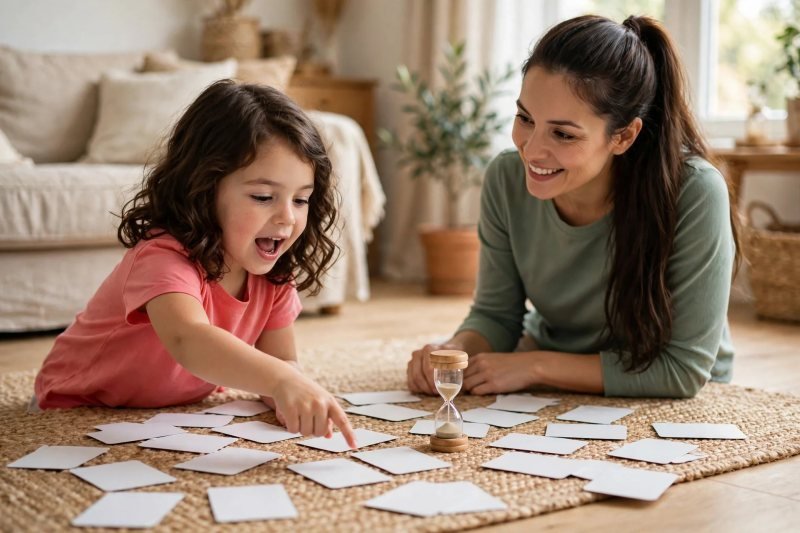
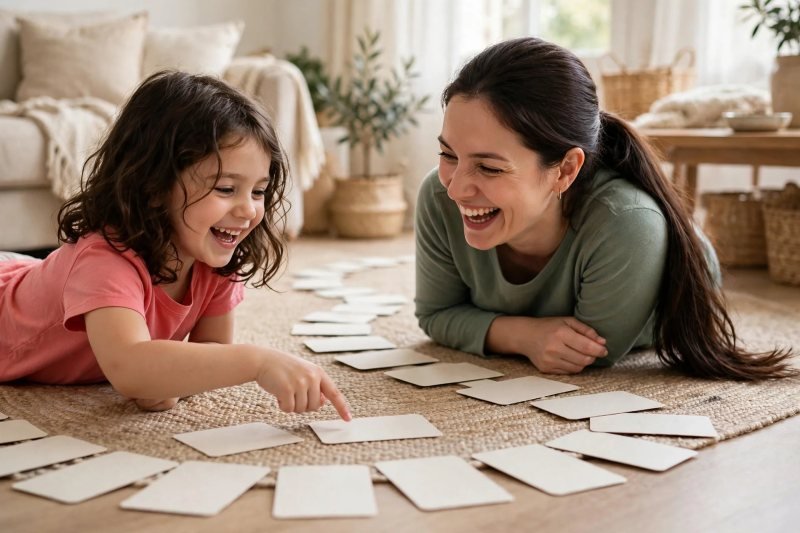
What are the best games for practicing sight words? Every game below works with any set, so rotate them through the four weeks without repeating yourself into boredom. Flashlight word hunt. Dim the lights, hide that week's cards around one room, and hand your child a flashlight. Each card they find, they read aloud to "collect" it. Darkness makes an ordinary review feel like an expedition. Beat the clock. Spread the week's words face-up and time how fast your child can read them all — the only competitor is their own best time from yesterday. Keep it cheerful; if the timer adds pressure, drop it. Sentence train. Lay cards end to end on the floor like train cars and read the resulting "sentence" together: "they went out soon." Nonsense sentences get the biggest laughs, and every laugh is repetition. Word bingo. Draw a 3×3 grid on paper, write nine words from the current sets into it (a fresh arrangement each game), and cover called-out words with buttons or coins. Homemade grids beat store-bought ones because your child watches the words go in. Sticky-note rescue. Stick that week's words on a wall or door at your child's eye level. Call out a word; your child "rescues" it by finding and reading it, then sticking it on their shirt like a badge. Beanbag word toss. Scatter cards on the floor and toss a beanbag (or a rolled-up pair of socks). Read whatever word it lands on. This is the week-four celebration game — full deck, high energy.
How will I know when my child has mastered a word? Use the three-in-a-row rule: when your child reads a word instantly — no sounding out, no hesitation — three times across three different days, it graduates. Move it to the Mastered envelope with a star sticker ceremony. Words that wobble stay in the active pile without any commentary; there's no failing here, only "not yet." Keep a simple tally on the fridge: "17/52" written in marker is enormously motivating for a five-year-old who loves watching numbers climb.
What if some words just won't stick? First, check whether the word has a lookalike causing the trouble — was and saw, on and no, want and went trip up nearly every kindergartner. Teach lookalikes on different days so they don't blur together. For a genuinely stubborn word, change the channel: if card games aren't working, try writing it big in chalk, building it from magnetic letters, or chanting it while bouncing a ball. A word learned through movement often sticks where a word learned sitting still wouldn't. And if a word resists everything, shelve it for two weeks and come back. Forgetting curves are real at this age, but so is the sudden click when a rested brain meets a word again. Patience isn't just kindness — it's strategy.
What you'll need
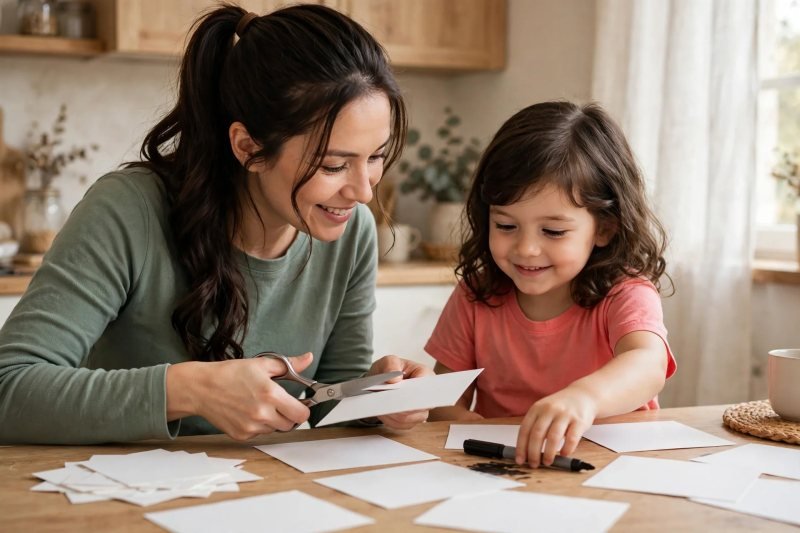
- Index cards (cut in half) and a dark marker for the word cards
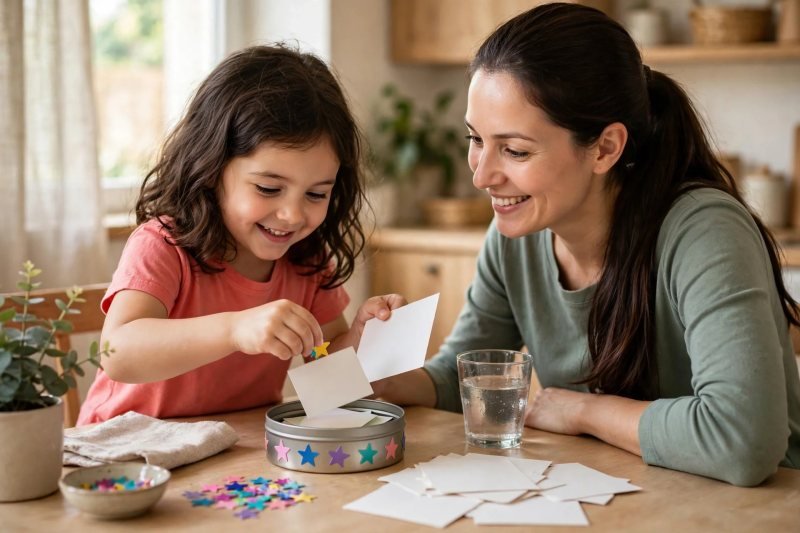
- A small tin or box — the Word Bank — plus an envelope for mastered words
- Star stickers for graduations
- A flashlight for the word hunt
- Sticky notes for the rescue game
- A beanbag (or a rolled-up pair of socks) for the toss game
- Buttons or coins for bingo markers
- A kitchen timer or sand timer (optional — skip it if timers add pressure)
Before you start
1. Bookmark or print the six word sets below — you will make cards one set at a time, never all 52 at once. 2. Cut a stack of index cards in half and grab a dark marker; you and your child will write the nine Set 1 cards together in Step 1. 3. Find a tin or small box for the Word Bank and an envelope for mastered words, and let your child decorate both — ownership makes the collection feel real. 4. Pick a regular 10-minute slot. Right after breakfast or before bath time works for most families.
How to do it
-
Make the Set 1 word cards together. Cut index cards in half and write each of the nine Set 1 words in clear lowercase letters, one word per card.
-
Meet the words. Read each card aloud slowly while your child echoes it back, then do one full round in silly voices to keep it playful.

-
Start the Word Bank. Let your child decorate the tin or small box, then "deposit" the Set 1 cards into it with a little ceremony.
-
Play the flashlight word hunt. Hide the Set 1 cards around one dim room; your child finds each card and reads it aloud to collect it.

-
Add Set 2 and run the Week 1 checkpoint. Spread the Sets 1–2 cards face-up and play beat-the-clock; any word read instantly three days running earns a star sticker and moves to the Mastered envelope.
-
Add Sets 3–4 and play sentence train. Lay the cards end to end on the floor like train cars and read the silly sentences together.
-
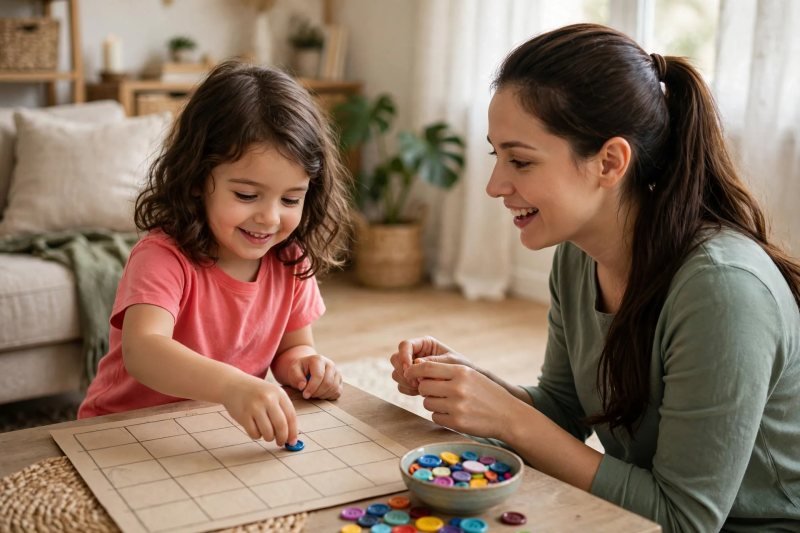
Play word bingo. Draw 3×3 grids on paper, fill each with nine words from Sets 1–4, and cover called-out words with buttons or coins.
-
Add Sets 5–6 and play sticky-note rescue. Stick the new words on a wall at your child's eye level; they find, read, and "rescue" each one onto their shirt like a badge.

-
Run the grand review. Spread all 52 cards, read through the full deck together, then celebrate with the beanbag word toss using every word.

-
Graduate and keep it up. Count the mastered words together, write the 52/52 tally where your child can see it, and start the five-minute daily keep-up: one quick game a day to keep every word fresh.



Make it easier
Start with our first-40-words article if the pre-primer words aren't solid yet — this 52-word list builds directly on them. Introduce one new word a day instead of two or three, and stretch the plan to six weeks; the routine matters more than the calendar. Read the words TO your child and have them point to the right card — recognition comes before production. Skip beat-the-clock entirely if timers cause stress; every game in this plan works untimed.
Make it harder
Once all 52 are mastered, time the full-deck read-through and challenge your child to beat their own record. Have your child write each word — rainbow writing (tracing over it in three colors) is a favorite. Build written sentences from the cards, then copy the silliest one into a notebook to "publish" it. Peek at sounding out short CVC words together when all 52 feel easy — our CVC words list is the natural next step after memorizing whole words.
Other ways to play it
- Word walk: tape that week's cards along a hallway; your child reads each one as they walk past — perfect for restless kids.
- Car-ride call-out: keep a few cards in the car and hold one up at red lights for a 30-second review.
- Team bingo: two children (or parent versus child) each get their own grid while one caller reads the words for both.
- Grocery-store spotting: hunt for the week's words on signs and labels while shopping — new, good, all, and out appear everywhere.
How it changes by age
- This plan is written for ages 5–6, the kindergarten year — ideally after the 40 pre-primer words feel comfortable. The kindergarten age hub has more ideas pitched at this exact year. A confident four-year-old who finished the first list can start Set 1. A six- or seven-year-old who is catching up can move faster: three to four new words a day through Sets 1–2, then settle into the regular pace. Follow the child — if a set feels hard, camp there for an extra week without apology.
What they're learning
Instant word recognition across a bigger, trickier vocabulary — the fluency foundation for longer books. Sentence sense: these 52 words are the grammatical glue — pronouns, verbs, and connectors — that hold English sentences together. Retrieval practice: recalling words through games strengthens memory far more than re-reading a list. Stamina and confidence: finishing a 52-word collection proves to a child that big reading goals are doable. The reading hub gathers more early-reading ideas by stage, and the phonics hub explains the sounding-out side of reading that runs alongside this list.
Clearing up
This is the Dolch primer list — the "kindergarten list" that US classrooms teach after the 40 pre-primer words. If those aren't solid yet, start with our first-40-words article; this plan assumes them. Sight-word lists don't teach reading by themselves. Keep phonics practice going alongside — sounding out new words and recognizing familiar ones are partners, not rivals. Once your child can sound out short words, blending sounds activities build the next step. Four weeks is a pace, not a deadline. Some children take six weeks and some take three; the daily habit matters more than the calendar. Mixing up lookalikes is normal. Was/saw, on/no, and want/went confuse nearly every kindergartner — teach confusing pairs on different days.
Questions parents ask
What words are on the Dolch kindergarten sight words list?
How long does it take to learn all 52 sight words?
Should my child learn the pre-primer sight words first?
How many new sight words should I teach per day?
What is the best way to practice sight words at home?
Why does my child confuse words like was and saw?

save it for later
Pin this for the next rainy afternoon
Keep it on a board so it is there when you need it, rather than when you happened to find it.
Save to Pinterest


