


Jolly Phonics Sounds in Order: A Parent's Guide With Actions (UK)
The complete jolly phonics sounds in order for UK parents — all 7 groups of 42 letter sounds, why this clever order helps children blend words sooner, and easy at-home games with simple actions for ages 4–5.
The jolly phonics sounds in order are: s, a, t, i, p, n | c/k, e, h, r, m, d | g, o, u, l, f, b | ai, j, oa, ie, ee, or | z, w, ng, v, oo, oo | y, x, sh, ch, th, th | qu, ou, oi, ue, er, ar — seven groups of six sounds. Teach one new sound every two or three days with a fun action; children blend words after group one.

The short version
- The 42 letter sounds are taught in 7 groups, not alphabetical order.
- Group 1 (s, a, t, i, p, n) comes first so children can blend words like sat and pin almost immediately.
- Confusable letters such as b and d are deliberately placed in different groups.
- Each sound is paired with a physical action to make it memorable through movement.
- Practise one sound at a time, 10–15 minutes a day, and only move on when each group is secure.
- Letter pairs like sh, ai and th are taught as single sounds on a single card.
- Age
- Ages 4–5
- Prep
- 5 min
- Play time
- 10 min
- Mess
- None
- Difficulty
- Easy
- Where
- Indoor
Why kids love this
Most four-year-olds are bored rigid by the alphabet song, but give every sound a silly movement and phonics becomes a game. The jolly phonics sounds in order are arranged so children read their first real words after just six sounds — that early "I did it!" moment is rocket fuel. With an action per sound, wiggly children get to move, shout, slither and stomp instead of sitting still.
Why is the Jolly Phonics order different from A to Z? Alphabetical order causes two problems. First, lookalike letters sit near each other — b and d, p and q — and young children mix them up; this order separates confusable pairs into different groups. Second, alphabetical teaching makes children wait weeks before blending anything. With s, a, t, i, p and n first, a child can build real words like sat, pin, pat and tap almost immediately.
How quickly should my child move through the groups? There is no official timetable — children move at their own pace. Many families find one new sound every two to three days comfortable, working through all seven groups over several months. In UK schools the sounds are typically spread across the reception year. Let confidence set the speed: secure sounds first, new sounds second. Useful next steps: phonics activities for preschoolers for more game ideas, the reading hub for what comes after the sounds, and our CVC words list for blending practice once Groups 1 and 2 are secure.
What you'll need
- 42 small plain cards (cut from card or thick paper, playing-card size)
- A felt-tip pen for writing one sound per card
- A fabric bag or small box for the cards
- Familiar toys or household objects (a sock, an apple, a toy snake)
- Stickers and one sheet of paper for a progress chart
- A cushion or beanbag for a cosy practice spot
Before you start
Cut out the cards and write one sound on each, following the group order below (Group 1: s, a, t, i, p, n; Group 2: c/k, e, h, r, m, d; Group 3: g, o, u, l, f, b; Group 4: ai, j, oa, ie, ee, or; Group 5: z, w, ng, v, oo, oo; Group 6: y, x, sh, ch, th, th; Group 7: qu, ou, oi, ue, er, ar). Write pairs like sh on a single card, since they make one sound. Pop the cards face down in the bag and draw a seven-column chart for stickers.
How to do it
-
Set up a calm practice corner. Choose a quiet spot — a rug with cushions is perfect — and sit at your child's level. Keep a simple routine: one new sound, its action, one quick game, then done. Short and predictable beats long and impressive.

-
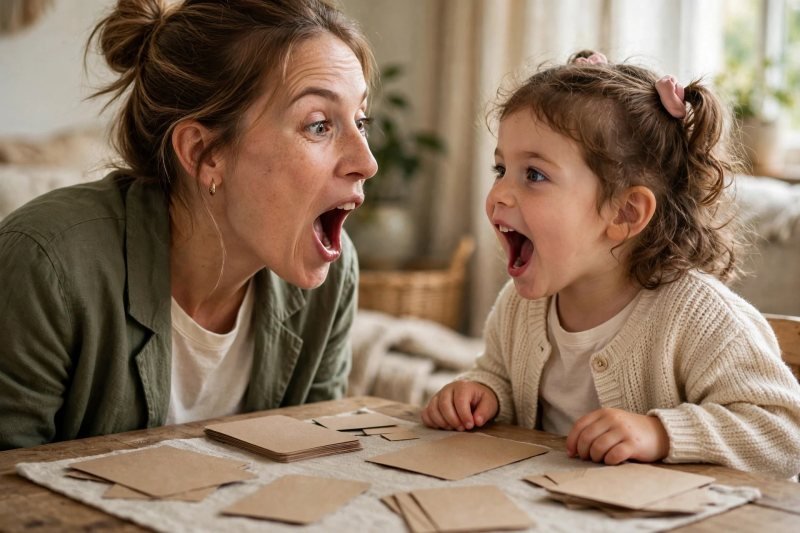
Begin with Group 1, starting with s. Always start at the very beginning: s, a, t, i, p, n. Hold up the s card, say "ssss" slowly and exaggerate your mouth shape. Teach pure sounds only — "sss", never "suh" — and no letter names at this stage.
-
Invent a simple action for every sound. This is the heart of the programme: each sound gets a movement, giving the memory something physical to hold. Use the programme's published actions or invent your own — slither an arm like a snake for s, open your mouth wide for a. The sillier, the stickier.

-
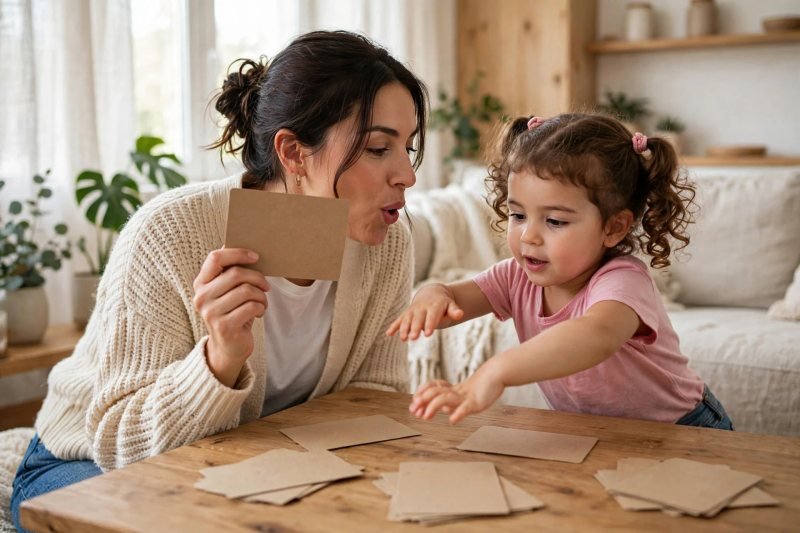
Practise in three quick passes. Your child hears it (you say the sound while they watch your mouth), sees it (they look at the card), then moves it (they say the sound while doing the action, three times). Hear it, see it, move it — two minutes of this beats ten minutes of drilling.
-
Play a two-minute sound hunt. Call out the new sound and challenge your child to find something starting with it — a sock for s, an apple for a. Scamper with them, celebrate loudly, and model it gently if they get stuck ("something soft that starts with sss…"). The same hunt format works as one of the letter sounds games for preschoolers when you are ready to widen the hunt beyond one sound.

-
Add the rest of Group 1, one sound every few days. Introduce a new sound every two or three days, recapping the earlier ones with their actions first. Make the recap a warm-up game, not a test — if your child hesitates, do the action with them and carry on. Six secure sounds beat twelve shaky ones.
-
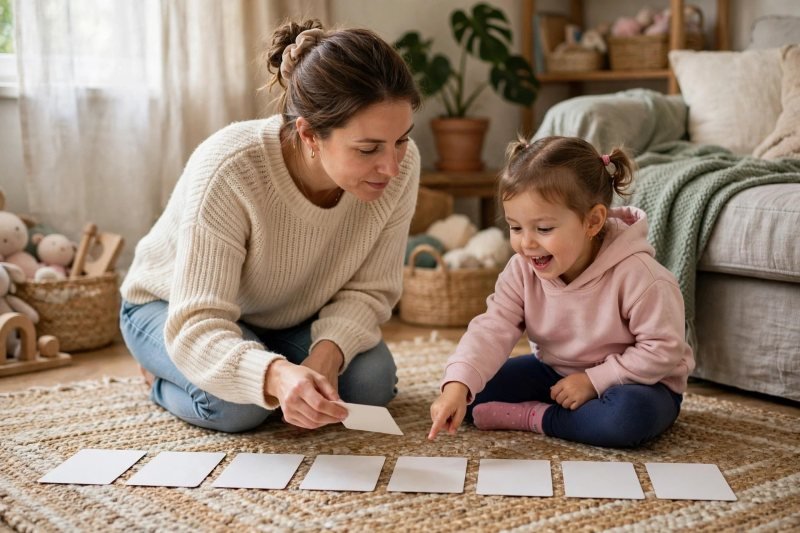
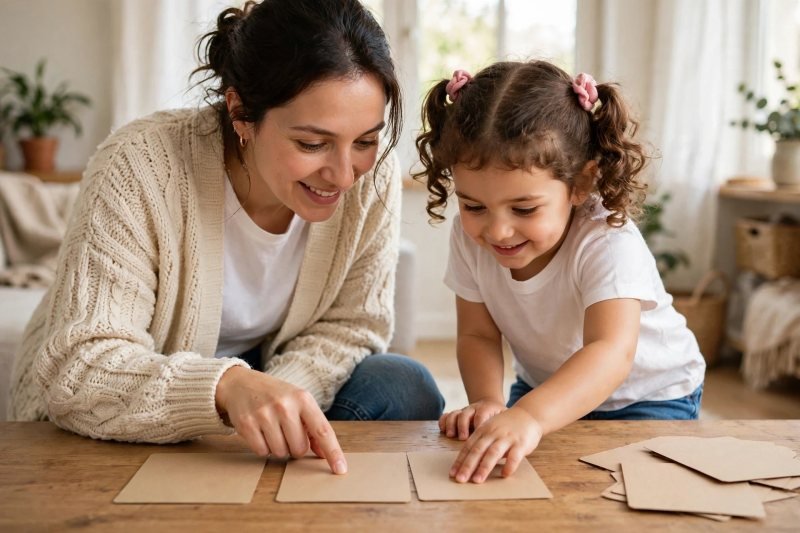
Blend your first tiny words. Once s, a, t and p are comfortable, line up the cards and slide your finger beneath them, stretching the sounds together: sss-aaa-t → sat. This is why the order exists — blending comes almost immediately. Let your child push the cards together and cheer like they have won a prize. For more blending games once the first words click, see blending sounds activities.
-
Test Group 1 with a recap game before moving on. Spread the six cards face down and take turns flipping one, saying the sound and doing the action. If your child recalls each easily, Group 2 (c/k, e, h, r, m, d) is ready. If two or three wobble, replay the games for a few more days — no deadline.

-
Work through Groups 2 to 7, treating letter pairs as one sound. From Group 4 you will meet digraphs — two letters, one sound, like ai, oa, sh and th. Give each pair one card and one action: "best friends making one sound together." Keep the same routine and ten-to-fifteen-minute sessions.

-
Celebrate every finished group. Each secure group earns a star on the chart — seven columns, seven celebrations. A special sticker, a silly dance, a phone call to Grandma to show off the actions. Visible milestones matter enormously on tricky days.



Make it easier
Teach one sound per week — slow and secure wins. Practise just two sounds per session, opening with the actions as a warm-up. Keep sessions to five minutes for easily distracted fours. Let your child choose the daily game so they feel in charge.
Make it harder
Ask for three words starting with the new sound, not just one. Speed round: flip through known cards quickly and time the actions. Blend longer words once Groups 1 and 2 are secure, like mast or mist. Let your child "teach" the sound and action to a teddy or grandparent.
Other ways to play it
- Mystery bag: hide a toy in the bag; your child feels it, guesses it, then says its first sound with the action.
- Action freeze: dance to music; when it stops, hold up a card and everyone freezes in that sound's action.
- Sound hop: lay cards on the floor and hop from one to the next, saying each sound on landing.
- Bedtime recap: run through the day's actions at bedtime — no cards needed.
How it changes by age
- Written for ages 4–5, when most UK children start learning letter sounds in earnest. Three-year-olds can join the actions and sound hunts — the movement games suit them — but don't expect blending yet. For shaky six-year-olds, the same sequence works as a recap: start at Group 1 and move faster through known groups.
What they're learning
The headline skill is phonemic awareness: hearing individual sounds inside spoken words, the foundation of reading. Children also build letter-sound correspondence, blending (pushing sounds together to read) and segmenting (pulling words apart, which later powers spelling). The actions build memory through movement, the games sharpen listening, and those first tiny words build genuine confidence.
Clearing up
Make tidying part of the game: cards back in the bag face down (a two-minute sorting challenge), stickers and pens away, chart up on the wall or fridge. Two minutes, and your child learns that learning time has a satisfying finish.
Questions parents ask
What are the Jolly Phonics sounds in order?
Why are the Jolly Phonics sounds taught in this order instead of alphabetically?
How many letter sounds are in Jolly Phonics?
How long does it take to learn all the Jolly Phonics sounds?
Can I teach the Jolly Phonics sounds at home without buying the official materials?
This is an independent parent guide, not an official publication — the programme's own actions, songs and materials come from its UK publisher if you want the full set. The order above is the factual teaching sequence, described here in our own words for use with homemade resources.

save it for later
Pin this for the next rainy afternoon
Keep it on a board so it is there when you need it, rather than when you happened to find it.
Save to Pinterest


