


4th of July Crafts for Toddlers
4th of July crafts for toddlers ages 2-3: fork-painted fireworks, handprint flag-inspired art, star stamping and a large-item sensory bin in red, white and blue — paint only, no real fireworks.
4th of July crafts for toddlers ages 2-3 are paint, paper and large-item play in red, white and blue: fork-painted fireworks on dark paper, handprint flag-inspired art on plain paper, star stamping, tissue collage and a large-item sensory bin — with no real fireworks or sparklers anywhere near toddlers.

The short version
- Every firework is paint, tissue or paper — real fireworks and sparklers stay far away from toddlers, with displays left to adults and professionals.
- Handprint art in flag colors is made on plain paper — never paint on, cut up or sit on a real flag.
- Sensory bins for under-3s use large items only, with close supervision and nothing small enough to mouth.
- Straw blowing is adult-helped with paint kept out of mouths; the youngest toddlers stamp instead.
- Wands use short ribbons, no sticks, waved low and away from faces, with an adult marching alongside.
- Age
- Ages 2–3
- Prep
- 45 min
- Mess
- High
- Difficulty
- Easy
- Where
- Indoor
Why kids love this
Toddlers love color they can push, stamp, splash and swish themselves, and this set gives them red, white and blue in ten different ways so no one gets bored waiting for a turn. A fork dragged through paint makes a burst shape in one happy scrape; a hand pressed down becomes handprint art in flag colors they recognize as their own; a sponge star lands with a satisfying thump; and a big bin of red, white and blue scarves, balls and cups invites endless scooping, pouring and hiding. Everything here is made on plain paper or at the craft table — crafts are inspired by the flag and its colors, never made by painting on, cutting up or sitting on a real flag. Independence Day stays toddler-sized too: every firework in this guide is paint, paper or tissue, made quietly at the table, while real fireworks and sparklers stay far away from toddlers and are left for adults and professionals to handle at a distance. Short steps, big color and a gallery to admire at the end make the whole morning feel like a party built exactly for small hands.
What you'll need
- Dark blue and black construction paper, plus plenty of plain white paper for handprint art, fans and collage bases
- Washable paint in red, white and blue, poured into wide, shallow trays or plates an adult manages
- Plain plastic forks for fork painting, clean straws for adult-helped blowing, and star-shaped sponges cut by an adult from plain kitchen sponges — plain star shapes only, with no text
- Tissue paper in red, white and blue, torn or cut by an adult into toddler-sized pieces before you start
- A large, shallow sensory bin and only large items for under-3s — soft balls, big cups, chunky scoops, fabric scarves and large ribbon pieces; nothing small enough to mouth, no dried beans, no small pompoms, no coins or beads
- Plain white paper plates or folded plain paper for fans, plus wide ribbon cut short by an adult for parade wands
- A washable glue stick or a small pot of washable glue with a chunky brush, managed by an adult
- A plain plastic table cover, an apron or old shirt for each child, a cup of water, paper towels and wipes for hands between colors
- A length of string and pegs or tape for hanging the finished gallery, placed by an adult out of toddler reach while hanging
Before you start
Cover the table and the floor beneath it, dress your toddler in an apron or old shirt, and roll sleeves up past elbows before any paint opens. Pour small amounts of red, white and blue washable paint into wide, shallow trays; keep lids and extra paint with an adult, away from the edge of the table. Pre-cut everything an adult should cut: star sponges, tissue pieces, fan paper and short ribbons — toddlers never handle scissors in this set. Fill the sensory bin with large items only and check each one with fresh eyes: anything that could fit in a mouth, break into small pieces or be pulled apart comes out before the bin goes on the table. Set out one craft at a time and put the rest out of sight; a calm, simple station helps two- and three-year-olds focus and keeps paint trays from being mixed all at once. Place a damp cloth and wipes in the middle of the table for hand cleaning between colors, especially before handprint art and snack breaks.
How to do it
-
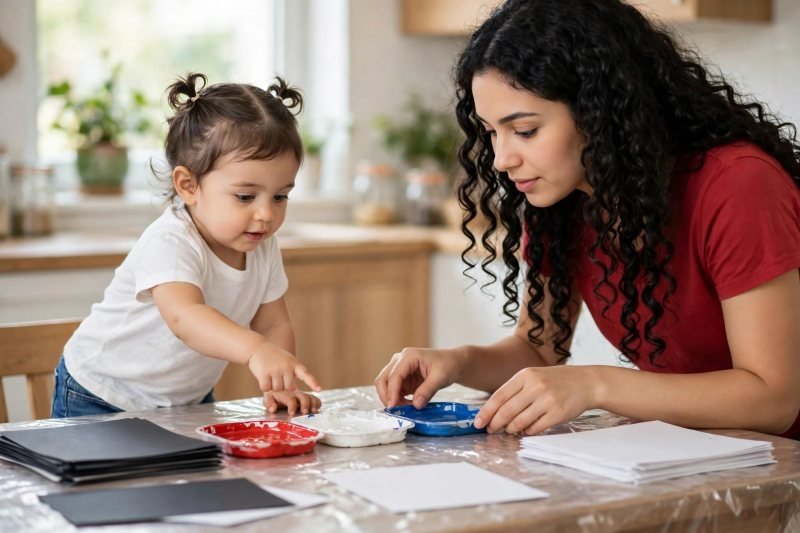
Set up a red, white and blue craft station. Start by turning the table into a simple, inviting station your toddler can understand at a glance — a plain plastic cloth taped down so it cannot slide; three shallow trays in a row, red, white and blue, each with its own tool so colors stay bright; a neat stack of dark paper and plain white paper on one side; and a damp cloth in the middle for hands. Keep everything else — scissors, extra paint, ribbons and the sensory bin — with you and out of reach until its turn, because a clear table is calmer, safer and far less likely to end in a tipped tray. Let your toddler choose the first paper color and point to the first paint tray; that small choice settles them in the way seasonal favorites like Halloween crafts for toddlers settle them, by giving a familiar ritual a new set of colors. Show them where painty hands go — flat on the cloth, not on clothes, faces or each other — and practice one pretend dip and press on dry paper before real paint is touched. Say, "Red, white and blue — our colors for today. Paint stays on the paper, hands get wiped here." A station with rules a toddler can actually follow is what makes the next nine crafts feel easy instead of chaotic.
-
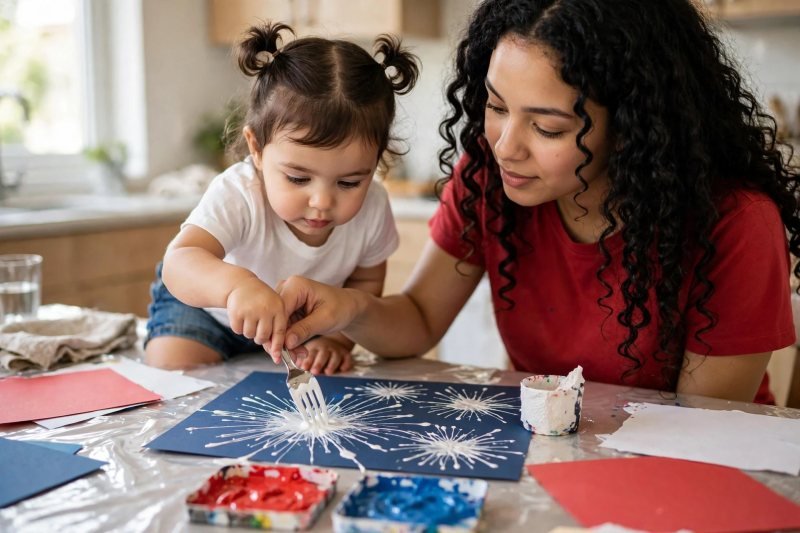
Paint fireworks with a fork on dark paper. Give your toddler a sheet of dark blue or black paper — the dark background is what makes paint fireworks glow — and show them how to dip the back of a plain plastic fork flat into white paint, press it down, and drag or stamp it outward to make burst lines; then repeat in red and blue, turning the fork a little each time so the bursts fan in every direction. Some toddlers stamp one neat burst and study it; others cover the whole page in overlapping sparks of color, and both are perfect — this is process art, so there is no sample to copy and no wrong way to burst. Keep trays wide and shallow so the fork loads with a flat dip rather than a deep plunge, reload paint for them as needed, and wipe the fork between colors if they want clean lines or let them blend for purple edges, which is a happy accident worth naming out loud. If a fork gets mouthed, swap it calmly for a clean one and remind them forks here are paint tools, not snack tools. Say, "Dip, press, drag — boom, a paint firework! Only paint fireworks for us — real fireworks stay far away." By naming the paint version as their version from the very first craft, you set the expectation that carries through the whole set.
-
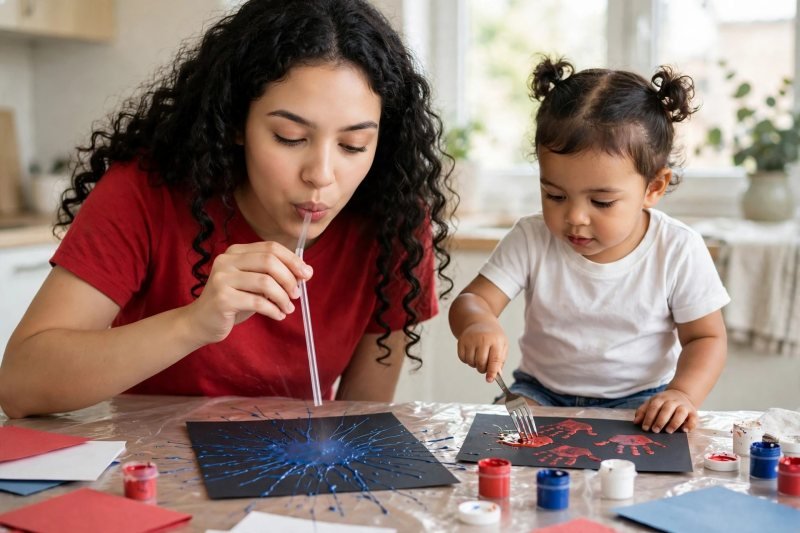
Blow paint fireworks with a straw, or stamp instead. For this craft, an adult puts a small puddle of thinned washable paint near the center of dark paper, and the adult — or a three-year-old with an adult's hands guiding the paper and watching closely — blows gently through a clean straw held above the puddle so the paint spreads into spiky firework tendrils; the straw never touches the paint, paint is never sucked up, and paint stays completely out of mouths at all times. This takes real control, so keep turns short, keep the straw in adult hands between blows, and stop the moment a toddler tries to drink, chew or wave the straw. For the youngest twos — and for any toddler who cannot yet blow outward reliably — skip the straw entirely and use the stamping alternative: dip a fork, a star sponge or fingertips in paint and stamp bursts instead, which gives the same spiky celebration with zero mouth risk. Add a second and third color once the first burst dries a little, so tendrils do not run into one muddy puddle, though a little mixing at the edges is beautiful. Say, "Grown-ups help with blowing — straws stay above the paint, never in mouths. Little ones stamp instead." Being plain about who does what keeps a thrilling technique safe without making it sound forbidden and fascinating.
-
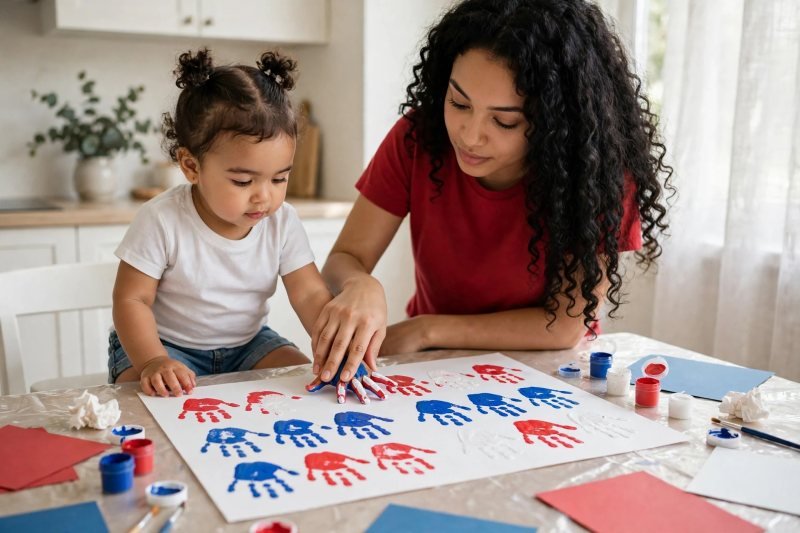
Make handprint flag-inspired art on plain paper. This is the keepsake craft, and it is described carefully on purpose: on a sheet of plain white paper, your toddler makes flag-inspired art in flag colors — an adult paints the toddler's palm blue and fingers in alternating red and white, or paints one hand red and helps them press handprints in rows of red, white and blue on the plain paper — art inspired by the flag, made on ordinary craft paper, never on a real flag. Press the hand flat, count to three together, and lift straight up so fingers do not smudge; then wipe that hand completely before touching anything else, because a painty handprint on a shirt is this craft's most predictable souvenir. Repeat prints across the page to make a pattern, leave one perfect print on its own sheet for keeping, and let your toddler add fork bursts or star stamps around the handprints once they dry a little. Talk about the colors as you work — red, white and blue — and about being gentle and respectful with flag colors, in toddler terms: we make our pictures on paper, and we treat real flags with care. Say, "Your hand, in flag colors, on our paper — flag-inspired art we made ourselves." A print that is literally their size right now is the piece grandparents will ask you to keep, so make one extra.
-
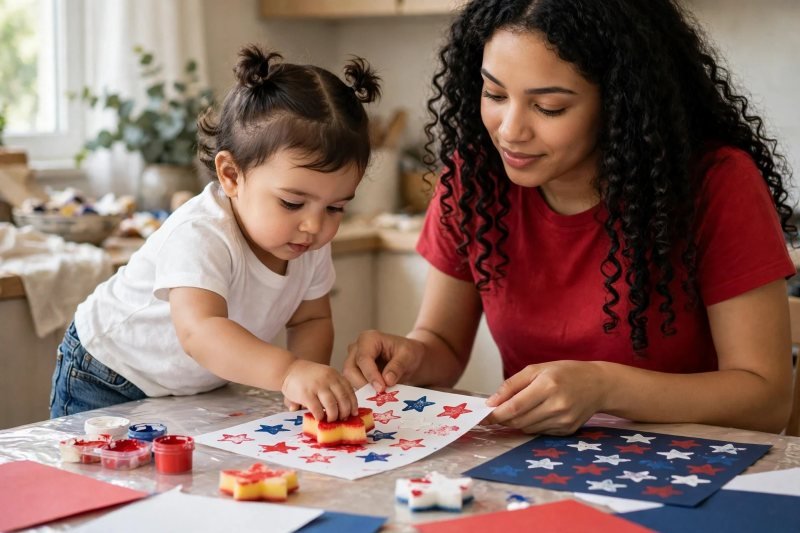
Stamp plain stars with sponges. Set out adult-cut star sponges — plain star shapes with no letters, no words and no numbers — shallow trays of red, white and blue paint, and both dark and white paper so your toddler can see how the same star changes on different backgrounds. Show the full motion once, slowly: dip the sponge flat, lift, press straight down on the paper, hold for one count, and lift straight up; then hand over the sponge and let the stamping rhythm take over, because toddlers will happily stamp thirty stars and each one builds the same pressing, aiming and releasing skills that fine motor activities are designed to grow. Reload paint often so prints stay bold rather than ghostly, offer a fresh sponge for each color if clean edges matter to your toddler, or embrace the blending tray if it does not. Overlap a few stars, make a scattered sky on dark paper, or line stars up in a proud row on white paper — all of it counts. If a sponge gets squeezed like a bath toy, laugh, wipe hands, reload and carry on; squeezing is exploring, not misbehaving. Say, "Dip, press, lift — a star! Again? Stars look great in rows and in skies." Repetition is the point here, so let them stamp long past the point where you would have stopped.
-
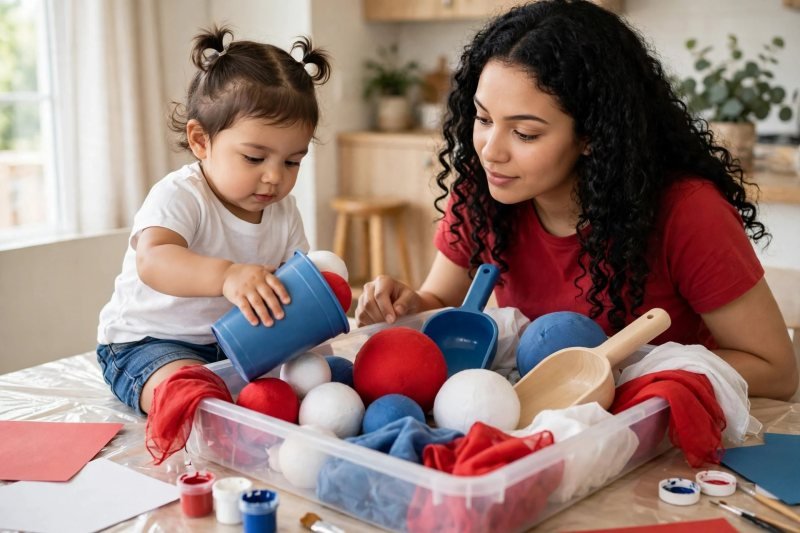
Explore a red, white and blue sensory bin with large items only. Bring out the large, shallow bin filled only with big, mouth-safe items — soft balls in red, white and blue; large stacking cups; chunky scoops; fabric scarves; and large, smooth pieces that are all far too big to fit in a mouth — and set it on the floor or a low table where you sit right beside it for the whole play time. Sensory bins for under-3s follow a strict rule in this guide: large items only, close supervision the entire time, and nothing small enough to mouth in the bin at all — no dried beans, no rice, no small pompoms, no beads, no coins and no tiny figures, however pretty they look in red, white and blue. Show scooping from cup to cup, hiding a soft ball under a scarf for a peekaboo reveal, and pouring scarves from a height so they float down slowly, then let your toddler invent their own games while you narrate colors and actions. If your toddler loves this kind of hands-in play, our crafts for toddlers roundup has more simple table-top ideas in the same spirit. If anything gets mouthed, pause, swap that item out if it is not suitable, and remind them bin toys stay in hands; if mouthing is constant, end bin play kindly and move to the next craft. Say, "Big things only in our bin — scooping and pouring, and I stay right here with you." Supervision is not a footnote for this step; it is the step, from the first scoop to the last tidy-away.
-
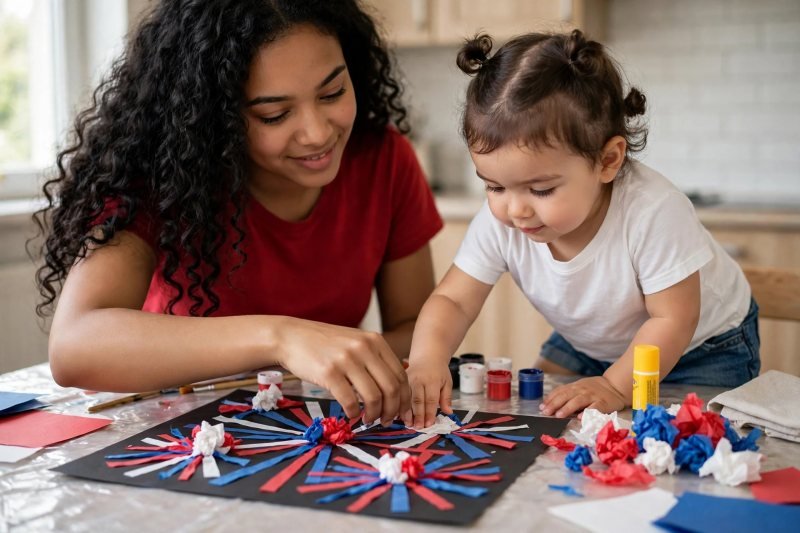
Make tissue-paper collage fireworks. Give your toddler a sheet of dark or white paper, a glue stick or a small area of washable glue spread by an adult, and a pile of pre-torn red, white and blue tissue pieces in toddler-sized strips and squares. Show them how to press tissue flat onto the glue, then how to scrunch a piece into a loose ball and press that down for a puffy burst effect; arrange strips radiating from one center point and you have a collage firework, scrunch balls in a cluster and you have a second style entirely. Tissue is forgiving in a way paint is not — pieces can be patted down, overlapped and layered until the page feels full — and the crinkling sound and fluttery texture give busy fingers a completely different job from stamping and scooping. Pre-tear plenty, because toddlers use tissue generously, and keep the glue managed by you if a glue stick is being eaten more than applied. A finished collage needs a few quiet minutes to set before it joins the gallery, so lay it flat somewhere safe and admire the paint pieces meanwhile. Say, "Pat it flat or scrunch it puffy — tissue fireworks make a lovely crinkle." Naming the sound as well as the color gives toddlers a whole extra reason to keep pressing and arranging.
-
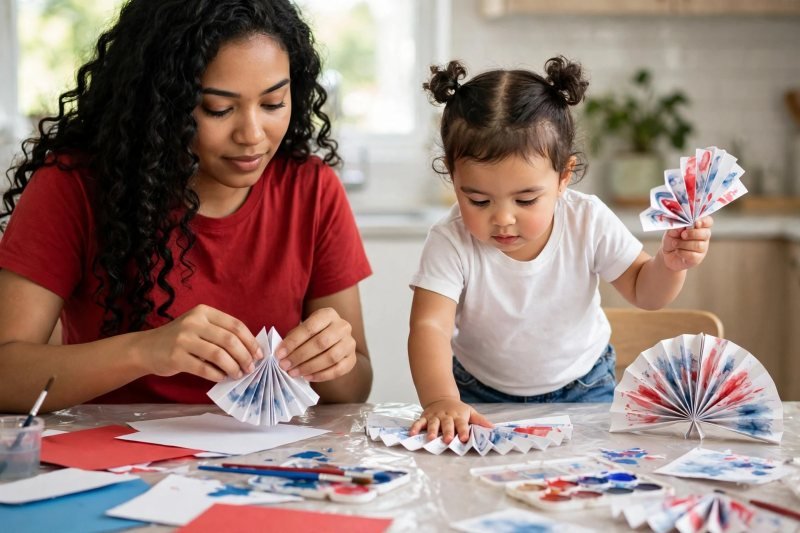
Fold a simple paper fan. Take a plain sheet of white or light-colored paper your toddler has already decorated with stamps, handprints or paint bursts — recycling an earlier craft as the fan's surface makes it instantly personal — and, with adult hands doing the folding, fold it back and forth in wide accordion pleats while your toddler holds the paper steady, presses each fold down with a flat palm, and chooses a short ribbon or a strip of tissue to tie around one end as the handle an adult secures. Wave the fan gently together and feel the breeze; fans are for waving at cheeks and cooling warm faces, not for hitting, poking or waving in anyone's eyes, so demonstrate slow, soft waves and praise exactly that. A two-year-old's job is pressing folds and holding paper; a three-year-old can attempt one or two pleats with hand-over-hand help, and uneven pleats wave just as well as perfect ones. If interest fades mid-fold, finish it yourself and offer the completed fan — the joy is in the waving, not the origami. Decorate the plain side too if they want a second round. Say, "Press the fold flat — now wave it slow and soft. Feel that breeze?" A fan they helped fold becomes the prop they carry into the parade step without any prompting at all.
-
Wave a parade wand with short ribbons. Make a simple parade wand from a sturdy paper roll or a tightly rolled and taped sheet of card an adult prepares, with several short ribbons — cut short by an adult, firmly taped or tied by an adult at one end — in red, white and blue; there are no sticks in this craft, no pointed ends, and ribbons stay short so they cannot wrap around necks, fingers or faces. Show your toddler how to hold the wand low, wave it side to side while marching in place or around the room, and keep it away from faces — their own and everyone else's — at all times, with an adult marching right alongside for the whole parade. Play a short march around the table, wave to the gallery, stop when you stop, and freeze in a silly pose; two or three laps is a full parade for a two-year-old, and the fan from the previous step makes an excellent second prop for the other hand. Check the ribbons are still firmly attached before each wave, and retire any wand that starts to unravel. If wands get swung wildly or pointed at faces, pause the parade, remodel the slow wave, and restart once — toddlers learn the parade rule by practicing it, not by hearing it twice. Say, "Wands stay low, ribbons stay short, and we wave away from faces — march with me!" A parade with a clear, practiced rule lets everyone relax and actually enjoy the marching.
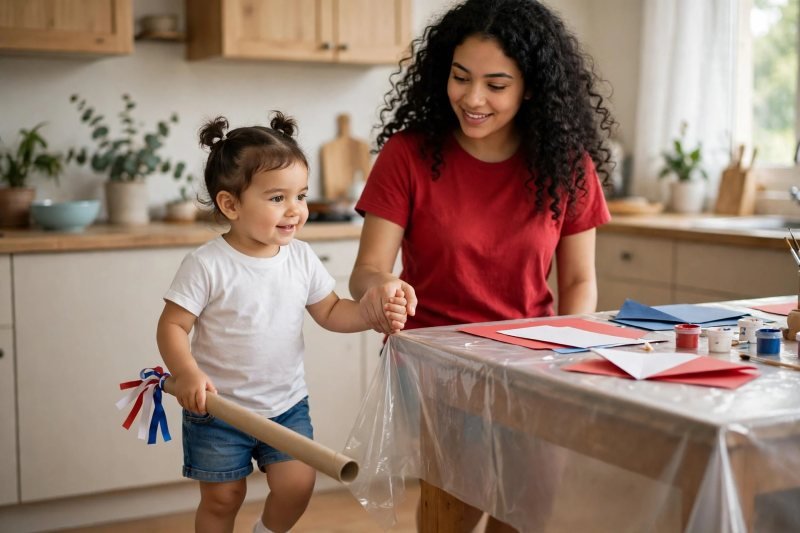
-
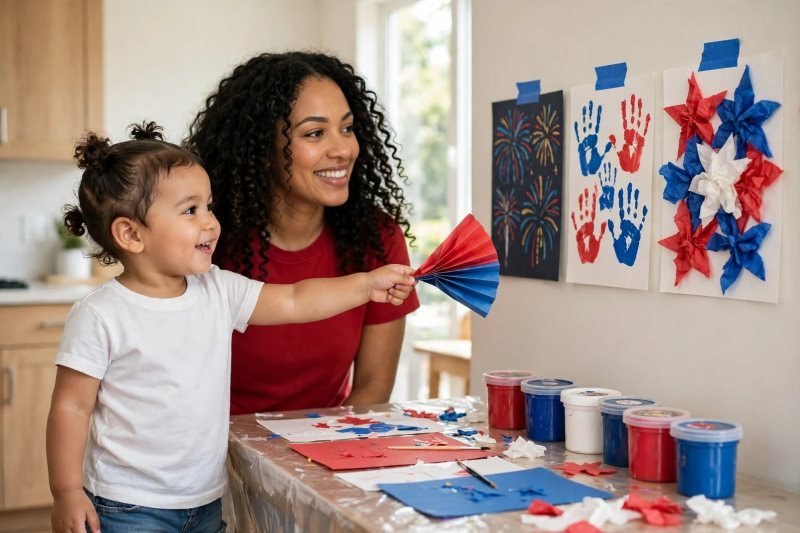
Hang a gallery and tidy together. Finish the celebration by hanging the dried pieces — fork fireworks, blown or stamped bursts, handprint art in flag colors, star pages, tissue collages and decorated fan paper — along a string an adult puts up, or taped in a row at toddler eye level, so your toddler can walk their own exhibition and point to favorites. Narrate the tour out loud: who made the stars, which firework burst is biggest, whose handprint is whose; this proud looking-back is real learning, the same color-naming and noticing that color mixing activities build on when red and blue edges blended into purple earlier today. Take one photo of your toddler standing by the gallery holding the fan or wand, then tidy together as the closing ritual — lids on paint with adult hands, forks and sponges into a washing-up bowl, sensory-bin items counted back into their box, tissue scraps into the bin, and hands washed properly with soap at the sink. Keep one or two best pieces for keeping and recycle practice sheets without ceremony. Say, "Look at everything you made — now we tidy together, then we wash hands all clean." Ending with the gallery first and tidying second means the last memory of craft time is pride, and the tidy still gets done.


Make it easier
Pick just two crafts — fork fireworks and star stamping are the fastest wins — and save the rest for another day; ten crafts is a menu, not a requirement. Pre-load every tool for your toddler: paint already on the fork, sponge already dipped, glue already spread — their job becomes the satisfying press, not the tricky preparation. Use bigger paper, bigger sponges and the biggest sensory-bin items you own; larger materials are easier to aim, grip and enjoy at age two.
Make it harder
Add a pattern challenge for confident three-year-olds: red star, white star, blue star, repeat — and let them spot and fix breaks in their own pattern. Let your three-year-old plan the gallery order: which picture goes first, which two belong together, and which piece gets the middle spot — real early curating and sequencing. Combine crafts into one big scene: a dark sheet with fork fireworks, stamped stars and a handprint border, made across two sittings with drying time between.
Other ways to play it
- Outside craft morning: move painting, stamping and the sensory bin to a shaded outside table or mat — mess sprays wider, hosing down is easier, and fans and wands get a real breeze and a real parade route. More warm-weather ideas live in our summer activities for children guide.
- Quiet celebration version: for toddlers who dislike noise, crowds or surprises, keep the whole set at the table in short bursts across the day, skip the parade, and let the gallery tour be the calm finale.
- Group or sibling version: give each child their own trays, sponges and bin scoops from the start, share only the paint colors by name, and hang one combined gallery with each child's name spoken proudly at their section — by an adult, since no text is needed on the art itself.
How it changes by age
- Age 2: Two-year-olds thrive on fork painting, star stamping, tissue pressing and the large-item sensory bin, with an adult managing every tray, glue pot and ribbon. Skip straw blowing entirely at this age and use the stamping alternative; keep handprint help hand-over-hand, expect mouthing attempts and swap tools calmly, and keep every session short — two or three crafts, then a break, a snack and a hand wash.
- Age 3: Three-year-olds can attempt gentle straw blowing with an adult guiding closely and paint kept completely out of mouths, press fan folds, follow a simple color pattern, and march in the parade holding the low-wand rule with reminders. They love jobs — carrying paper to the gallery, choosing the order, counting bin items back into the box — so give them real responsibilities inside each craft rather than just a turn.
What they're learning
Fine motor control: fork dragging, sponge pressing, tissue scrunching, fold pressing and scoop pouring all build hand strength, aim and bilateral coordination in small, satisfying doses. Color recognition and early mixing: naming red, white and blue across ten crafts, spotting where edges blend, and sorting bin items and stars by color. Cause and effect: a press makes a star, a blow spreads a burst, a scrunch makes a puff — toddlers test each link repeatedly and remember what their own hands did. Respectful celebration habits: making flag-inspired art on plain paper, treating flag colors with care, and learning that real fireworks are for adults and professionals, far away from toddlers.
Clearing up
Work in the order that protects the art: move dried pieces to the gallery first, lay wet pieces flat somewhere safe, then lids go on paint trays with adult hands. Drop forks, sponges and scoops into a bowl of warm soapy water at the table before paint dries on them, wipe the table cover down or shake it outside, and gather tissue scraps while they are still dry and easy to pick up. Count sensory-bin items back into their storage box — counting out loud doubles as a last color game — store ribbons and wands together for the next parade, and finish with a proper soap-and-water hand wash at the sink, checking nails and sleeves for paint that wipes missed.
Questions parents ask
What are the best 4th of July crafts for toddlers?
Are fireworks safe for toddlers to watch or hold?
How do you make a sensory bin safe for a 2-year-old?
How do you make handprint flag-inspired art respectfully?
What can a 2-year-old do instead of straw blowing paint?
Internal link targets for publisher: halloween-crafts-for-toddlers (step 1, anchor "Halloween crafts for toddlers"); fine-motor-activities-for-preschoolers (step 5, anchor "fine motor activities"); color-mixing-activities-for-preschoolers (step 10, anchor "color mixing activities"); crafts-for-toddlers (step 6, anchor "crafts for toddlers"); children-s-summer-activities (Variations, anchor "summer activities for children"). All five are live URLs, embedded inline above and listed here. Flag-respect framing: every reference in this article describes crafts as inspired by the flag or in flag colors, made on plain paper. No craft paints on, cuts up, sits on or otherwise uses a real flag, and handprint art is always on plain paper in flag colors. No real fireworks or sparklers: there are no real fireworks or sparklers in the text beyond the safety statements that they stay far away from toddlers, and none in any image — all fireworks are fork-painted, blown or stamped paint, or tissue collage. Independence Day facts discipline: the only factual claims made are plain, checkable basics — July 4th is the holiday being celebrated and fireworks displays are for adults and professionals. No dates, history or invented facts beyond that are asserted. Imagery discipline: red, white and blue craft scenes only; child fully clothed; no readable text, words, letters or numbers in any image; no logos or brands; no real fireworks or sparklers in any frame.

save it for later
Pin this for the next rainy afternoon
Keep it on a board so it is there when you need it, rather than when you happened to find it.
Save to Pinterest


