


Five Senses Nature Walk for Kids
A five senses nature walk turns a park stroll into a noticing adventure: your 4–5-year-old explores sight, sound, smell, touch, and one safe snack taste across ten playful stops. Almost zero prep.
A five senses nature walk for kids is a guided outdoor stroll where your 4–5-year-old explores with each sense in turn: spotting overlooked sights, listening with eyes closed, sniffing leaves, feeling bark, and finishing with a snack from home. It takes 30–45 minutes and builds observation skills through play.

The short version
- A five senses nature walk is free exploration framed around noticing — ten playful sense stops on a park path, trail, or backyard.
- Each stop targets one sense: sight (twice), hearing, smell, touch, and a taste finale with a packed-from-home snack.
- Best for ages 4–5; threes can join part of it, and 6–8s can add a sense journal.
- The key safety rule: never taste anything growing outside.
- Builds observation, descriptive vocabulary, sustained attention, and comparison skills.
- Almost zero prep, low mess; after rain is best.
- Age
- Ages 4–5
- Prep
- 10 min
- Play time
- 30 min
- Mess
- Low
- Difficulty
- Easy
- Where
- Outdoor
Why kids love this
Four- and five-year-olds are natural noticers — they spot the ant you'd step on and the smell you'd walk past. This walk gives that noticing a job title: sense explorer. No worksheet, no checklist, no right answers — just small surprises, like what a crushed leaf smells like, and a snack at the end.
What you'll need
- A snack from home for the taste stop (apple slices, crackers, anything your child likes)
- Water bottle
- Sunscreen and a hat, applied before you leave
- A small bag for treasures
- Nice extras: a magnifying glass, paper, and a crayon
Before you start
Pick a safe, familiar route — park path, trail, or backyard. A 20–30 minute loop is plenty; the stops are where the time goes. Set the mission before you leave: today you're both sense explorers, noticing slowly with eyes, ears, nose, fingers, and — only at the end — taste buds. One game rule, said upfront: we never taste anything growing outside.
How to do it
-
Set the mission at the trailhead. Before you set off, kneel beside your child and give the walk its job: today you are both sense explorers, noticing one sense at a time. Say it out loud — "Eyes, ears, nose, fingers — and taste buds only at the very end" — and agree on the one rule that never bends: we never taste anything growing outside.

-
Freeze and spot what you would miss. At a good viewpoint, stop and stand still. Take turns naming one thing you would normally walk past — a crack in the path, a feather, a piece of bark. Say, "Point to something small that most people never see," and let your child lead the looking.

-
Close your eyes and count the sounds. Step off the path, close your eyes, and count slowly to twenty together. Then open your eyes and name every sound you heard, loudest first — a bird, a bicycle bell, wind in the leaves. Ask, "Which sound was closest? Which was farthest away?"

-
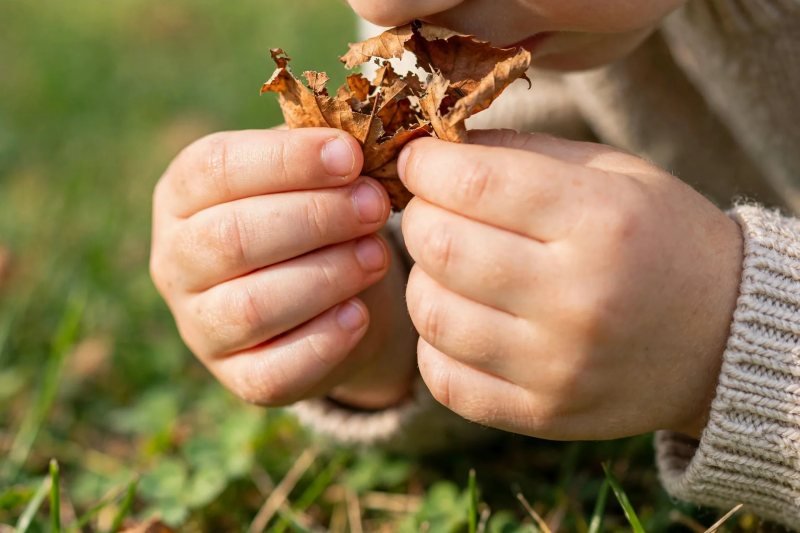
Crush a leaf and sniff. Pick up a fallen leaf, crush it gently between your fingers, and breathe in. Bend close to a flower or a patch of grass without picking it and sniff again. Ask, "Which smell is stronger — the leaf or the flower?" and let your child decide with their nose.
-
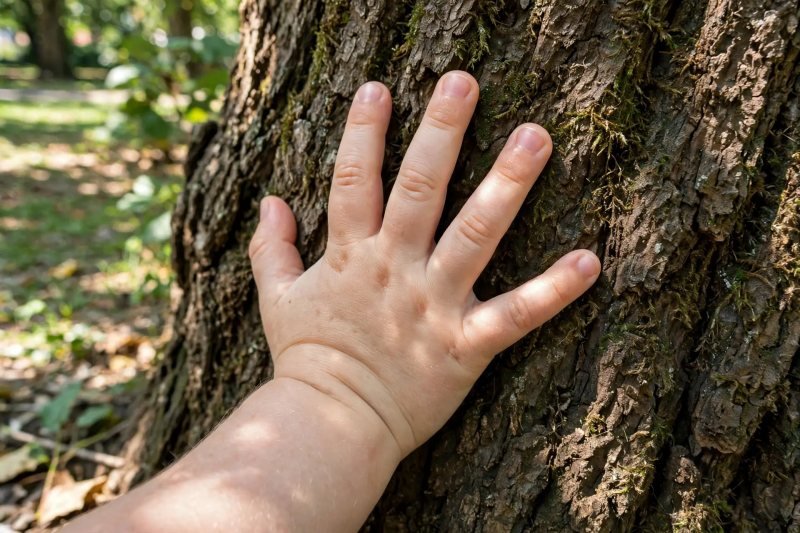
Run the touch test. Find rough bark, a smooth stone, and a soft leaf. Put one hand on the bark and one on the stone, then hold the leaf. Ask your child to describe each in one word — rough, smooth, soft — and say your own word back so they hear the vocabulary used.
-
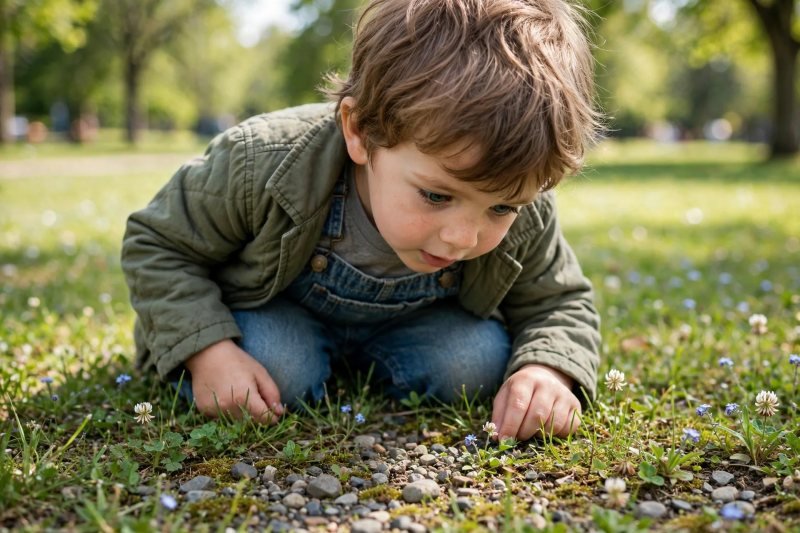
Crouch down to knee height. Get low and study the ground for a full minute: ants marching, tiny flowers, pebbles, seed pods. Say, "Pretend you are ant-sized — what do you see now?" The small world rewards the slow look.
-
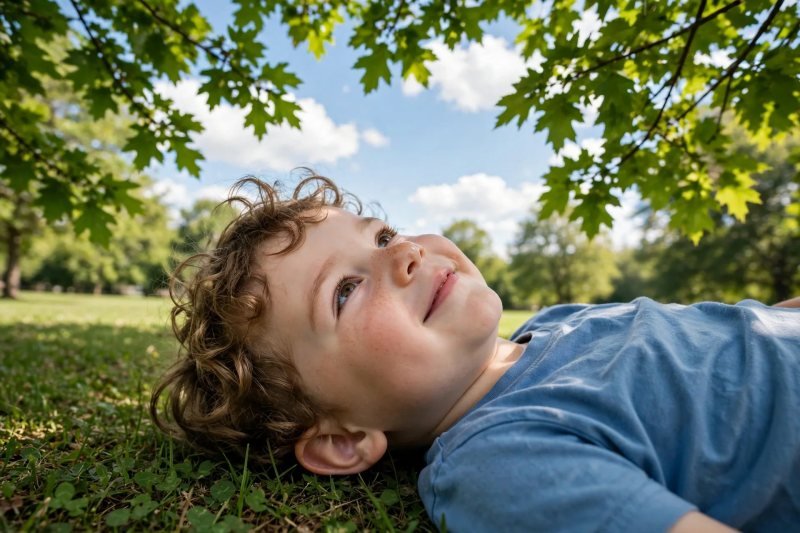
Lie back and watch the sky. Stretch out on the grass and look up through the leaves for a minute. Name the smallest cloud, the biggest branch, anything moving. Whisper, so the watching stays slow: "What is the sky doing right now?"
-
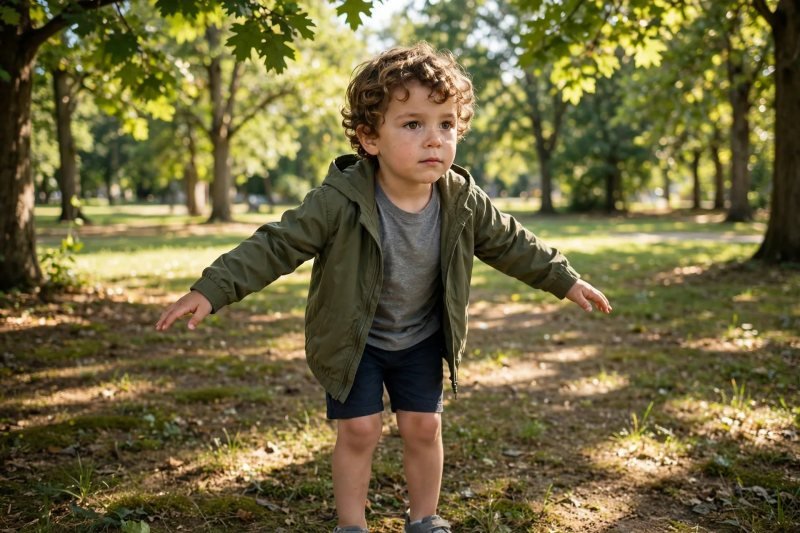
Stand like statues. Freeze for one whole minute — no talking, no wiggling. When the minute ends, ask what your child caught that they would have missed while moving. Stillness is the trick that makes the other senses louder.
-
Taste the snack slowly. Sit on a bench or the grass, wipe hands clean, and eat the snack from home one slow bite at a time. Describe each bite out loud — crunchy, sweet, juicy, salty — and let your child find their own taste words.

-
Share your favorite surprise. Heading home, each explorer names their favorite sense surprise — the discovery they will share at dinner. Say yours first to model it: "Mine was the smell of that crushed leaf." The retelling is where the words stick.


Make it easier
Do three stops — see, hear, feel — on a short loop. Skip the statue minute, and let your child pick the stops and their order.
Make it harder
"Sense journal": draw one thing per sense, then compare at home. Or count sounds during the statue minute and beat the score next walk.
Other ways to play it
- The after-rain walk: smells are stronger and colors deeper — the best version of this activity.
- The evening walk: different light, different sounds, long shadows across the path.
- The backyard edition: all ten stops at home — a small yard holds plenty of senses.
- The seasonal rematch: walk the same route in a new season and compare what changed.
How it changes by age
- Ages 4–5 are the sweet spot: old enough to describe what they notice, young enough to be surprised by a smell. Threes can join the first five stops; six- to eight-year-olds can keep a sense journal and compare routes.
What they're learning
It practices a real scientific skill: careful observation. Each stop trains one piece — sustained attention, descriptive vocabulary, comparison. No memorizing, no testing; the learning is in the noticing itself.
Clearing up
Take any litter you spot — explorers leave parks cleaner than they found them. Wash hands at home, empty the treasure bag, recycle wrappers.
Questions parents ask
What is a five senses nature walk?
What age is a five senses nature walk best for?
What should I pack for a five senses nature walk with kids?
Can kids taste things they find on a nature walk?
What if we can't get to a park?
How does a five senses nature walk help my child's learning?
Follow-ups: after the walk, press your finds into an autumn leaf collection and sort them by size and color; turn the best leaves into art with our leaf art projects; hang a bird feeder and watch who visits; explore animal habitats to learn where the creatures you spotted live; and on a rainy day, our five senses activities for preschoolers bring the same noticing games indoors.

save it for later
Pin this for the next rainy afternoon
Keep it on a board so it is there when you need it, rather than when you happened to find it.
Save to Pinterest


