


Celery Rainbow Experiment: How Plants Drink Water
This celery experiment for kids stands fresh celery in glasses of colored water and watches the color climb the stalks overnight — giving 3- and 4-year-olds a front-row seat to how plants drink.
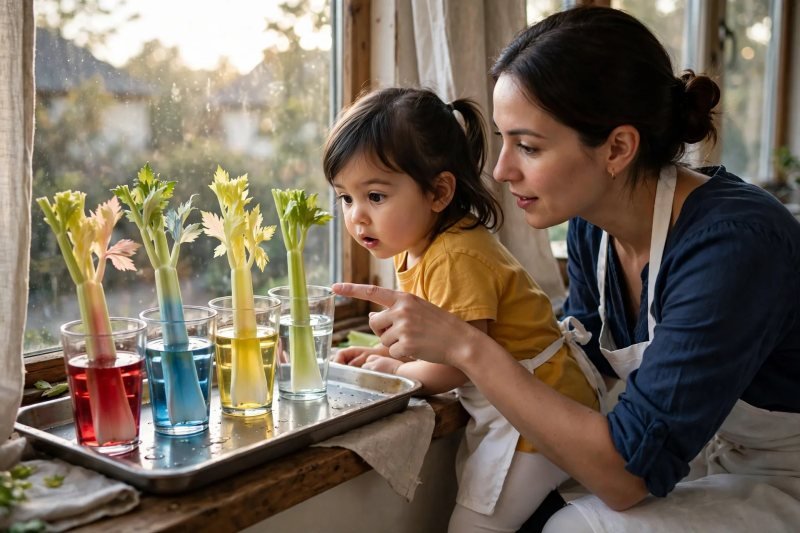
Celery stems contain tiny tubes called xylem that carry water up to the leaves. Stand cut celery in colored water and the tubes draw the dye upward, tinting the stalk's ribs and leaf edges. The first color appears within a few hours, and by the next morning the stalks are vivid. A crosswise slice reveals colored dots — the very tubes that carried the water.

The short version
- Stand cut celery stalks, cut end down, in glasses of tinted water.
- Tiny stem tubes called xylem draw the colored water upward.
- Color shows within hours; boldest by the next morning.
- A crosswise slice reveals colored dots — the water tubes, made visible.
- Red and blue give the fastest, most dramatic results.
- Food coloring stains: use aprons, a tray, and close supervision.
- Age
- Ages 3–4
- Prep
- 10 min
- Mess
- Some
- Difficulty
- Easy
- Where
- Indoor
Why kids love this
Plain green stalks turn red, blue, or yellow before your eyes — it feels like real magic. The color creeps up slowly, building suspense: your child will keep running back to check. And the finale, slicing the stalk open to find colored dots inside, lands like a science-show reveal.
What you'll need
- - 3–4 fresh celery stalks with leaves (crisp, not limp)
- - 3–4 clear, sturdy glasses or small jars
- - Water
- - Food coloring: red, blue, and yellow (green works well too)
- - A rimmed tray or baking sheet to catch drips
- - Spoons for stirring
- - Aprons or old shirts for both of you
- - Paper towels for wiping up splashes
- - A sharp knife and cutting board (adult use only)
Before you start
Set a rimmed tray under your work area and dress you both in aprons or old shirts — food coloring stains fast. Wash the celery and pat it dry. An adult trims a thin slice off the bottom of each stalk so the ends can drink. Line up the glasses on the tray, within your child's reach but away from the table edge.
How to do it
-
**Dress for stains and set up a drip-proof station.** Put aprons or old shirts on both of you — food coloring stains hands, clothes and counters fast. Slide a rimmed tray under your work area to catch every drip.

-
**Fill each glass about halfway with water.** Let your child do the pouring, aiming for roughly halfway up each glass. Keep every glass well back from the table edge.

-
**Add one color of food coloring to each glass.** Squeeze 2–3 drops of red, blue and yellow into their own glasses (green works well too). Your child counts the drops as they fall — a tiny math moment tucked inside the science.

-
**Stir each glass until the color mixes through.** Stir gently with a spoon until the water turns one even shade. This is your child's job: slow circles, no splashing.

-
**Stand one celery stalk in each glass, cut end down.** An adult trims a thin slice off the bottom of every stalk first — old cut ends seal over and drink poorly — then your child stands them cut-end-down in the colored water.

-
**Carry the tray carefully to a bright windowsill.** Settle the tray where the celery gets bright light but stays out of the way. This is where the waiting begins — and the suspense with it.

-
**Check after 2–3 hours for the first blush of color.** Peer at the ribs and leaf edges together: the color creeps up slowly, and the first faint tint is the most exciting part. One peek before bedtime builds the suspense for morning.
-
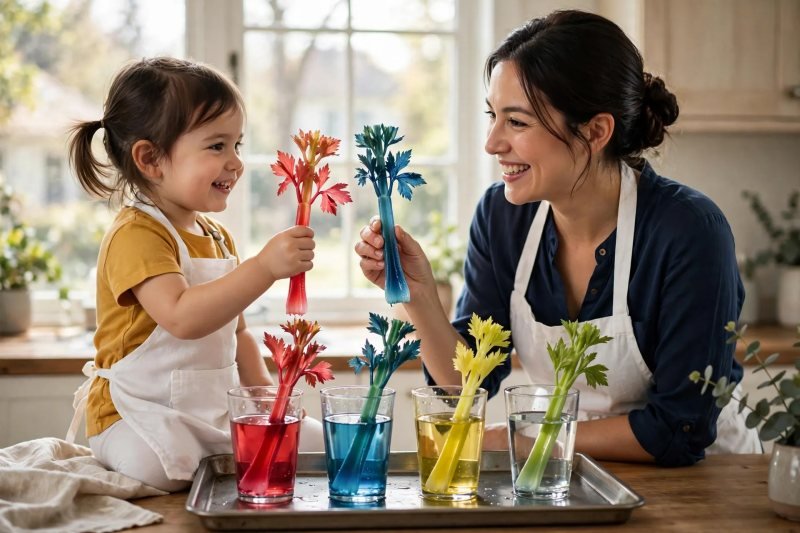
**Compare the stalks the next morning.** Lift each stalk out and line them up side by side — which color climbed highest? Red and blue show fastest; yellow is subtler against the celery's natural green.
-
**Slice one stalk across the middle and look inside.** An adult makes the cut while your child watches closely: tiny colored dots appear across the face of the stalk. Those dots are the xylem — the very tubes that carried the colored water upward.

-
**Crunch a plain, uncolored celery stalk together.** End with a taste test of fresh celery — the experiment's real finale — and talk about how every plant drinks the same way its stalk just did.



Make it easier
Use two colors instead of four — red and blue give the boldest results with simpler choices. The adult pours and adds the drops while your child stirs, places the celery, and does the checking. Keep the waiting light: one peek before bedtime, one in the morning.
Make it harder
Ask your child to predict which color will climb fastest, and note the guess on a scrap of paper. Add a fourth glass of plain water as a control — scientists keep one thing unchanged for comparison. Draw the stalks at bedtime and again in the morning to record the change. For a showstopper, split one stalk lengthwise (adult job) and stand each half in a different color.
Other ways to play it
- - White carnations or daisies drink colored water the same way and look spectacular.
- - Pale cabbage leaves work too, their ruffled edges showing color beautifully.
- - For more water-on-the-move magic, try the Walking Water Experiment, which finishes in a single afternoon.
How it changes by age
- The hands-on part takes fifteen minutes — a good match for a preschooler's attention span — while the slow reveal teaches that some wonderful things take time. Threes need you to manage the water and coloring while they stir, place, and observe. Fours can pour, count the drops, predict, and explain the result.
What they're learning
Real plant science: stems hold tiny tubes called xylem that carry water upward, and the colored dots in the sliced stalk are those tubes made visible. Once they have seen it in celery, children suddenly understand why cut flowers drink from a vase — same tubes, same upward pull. Your child also practices pouring and stirring, compares before and after, and plays with color mixing. To keep the plant theme growing, try Bean in a Bag next — another slow-reveal experiment with the same patient-observation payoff.
Clearing up
Compost or bin the colored stalks and rinse glasses and spoons right away — coloring sets fast, especially on plastic. Wipe the tray and table with warm soapy water and launder clothes promptly; dryer heat sets stains permanently. Wash hands with soap — any skin tint fades within a day.
Questions parents ask
How long does the celery experiment take to change color?
Why does celery change color in colored water?
Can kids eat the celery after the rainbow experiment?
What colors work best for the celery rainbow experiment?
Can I do the colored water experiment without celery?
Start with the crispest celery you can find, leaves and all — limp stalks drink poorly. Trim the bottoms just before starting, since cut surfaces seal over. Two to three drops per half glass is plenty. Red and blue show fastest; yellow is subtler. Keep glasses at room temperature on a bright windowsill, and expect a faint blush within hours, full effect overnight.

save it for later
Pin this for the next rainy afternoon
Keep it on a board so it is there when you need it, rather than when you happened to find it.
Save to Pinterest


