


Cardboard Box Marble Run
Cut a delivery box into ramps and tape them inside the lid. It never works first time, and that is the entire point of it.
Cut cardboard tubes and strips into ramps, tape them inside a large box lid at a slope, and roll a marble down. Suits ages 5 to 8, takes about 20 minutes to build, and teaches trial-and-error problem solving.

The short version
- Test after every ramp, not at the end — that is the difference between building and guessing.
- Tape the next ramp where the marble actually lands, not where you expect it to.
- An adult does the cutting; the child does the designing.
- Age
- Ages 5–8
- Prep
- 10 min
- Play time
- 40 min
- Mess
- Low
- Difficulty
- Medium
- Where
- Indoor
Why kids love this
Because it fails. The marble stops halfway, or flies off the third ramp entirely, and fixing it is the game. There is also a very satisfying moment when it finally works end to end, and children will run it twenty times in a row afterwards to prove it was not luck.
What you'll need
- A large cardboard box, or just the flat lid of one
- Two or three cardboard tubes from kitchen roll
- Masking tape or parcel tape (masking tape is easier for children to tear)
- Scissors — adult ones, used by an adult
- A marble, a bouncy ball, or a large dried bean
- Optional: a paper cup for the marble to land in
Before you start
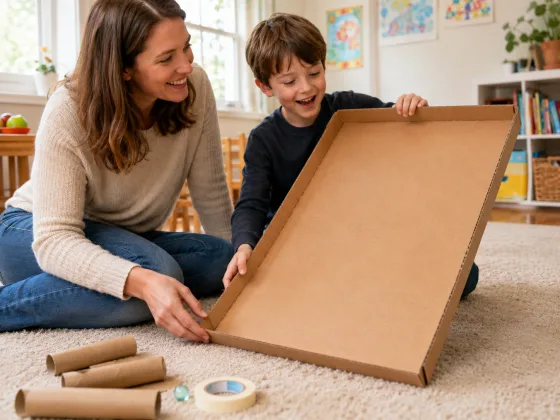
Cut the box down to one large flat panel with a raised edge, or use the lid on its own. Prop it against a sofa or a wall so it slopes. Cut one or two tubes in half lengthways. This is the only part that genuinely needs an adult with sharp scissors.
How to do it
-
Stand the box panel up at a slope, leaning against something solid.
-
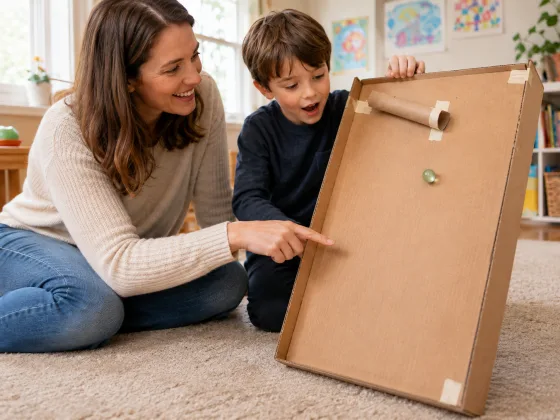
Tape a half-tube near the top, angled slightly downhill.

-
Roll the marble down it and watch where it comes off the end.
-
Tape the next ramp exactly where the marble landed — not where you think it should go.

-
Repeat down the board. Test after every single ramp; adding three at once means you cannot tell which one is wrong.

-
When the marble reaches the bottom, tape a cup there to catch it.

-
Now make it harder: add a jump, a tunnel made from a whole tube, or a bend that turns the marble back on itself.

Make it easier
Pre-cut the ramps and tape the first two yourself, then hand it over. A steeper slope is more forgiving of badly aligned ramps.
Make it harder
Set a rule: the marble must take at least ten seconds to reach the bottom, or must change direction three times. Constraints make it a much better problem.
Other ways to play it
- Race two marbles down parallel runs and see which is faster.
- Add a tunnel — a whole tube taped flat to the board — so the marble disappears and reappears.
- Use a bouncy ball instead and see what has to change.
- Build it on the back of a door so it can stay up for days.
- Time it, and try to build the slowest possible run rather than the fastest.
How it changes by age
- Four to five: they will need you to do the taping while they decide where things go. That division of labour works well.
- Six to seven: they can build it themselves and will mostly want you to watch.
- Eight: give them a constraint and leave them to it.
What they're learning
This is trial and error made visible. The marble gives instant, honest feedback, and the fix is always to observe more carefully rather than to try harder. There is real physics in it too — slope, speed and momentum — but the more valuable habit is testing one change at a time.
Clearing up
It folds flat against a wall and can live behind the sofa. Most children want to keep it for at least a week.