


Blow Up a Balloon with Baking Soda and Vinegar
Drop baking soda from a balloon into a bottle of vinegar and watch the balloon inflate all by itself — a five-minute kitchen experiment that makes the invisible power of gas visible.
The baking soda and vinegar balloon experiment works because the two ingredients react to make carbon dioxide gas. Drop 2–3 tablespoons of baking soda from a balloon into a bottle of vinegar, and the gas has nowhere to escape — so it rises into the balloon and inflates it. Five minutes of setup, no blowing required, and a first look at a chemical reaction for ages 5–6.

The short version
- Baking soda and vinegar react to make carbon dioxide gas.
- The sealed balloon is the gas's only way out, so it inflates the balloon.
- 1 cup of vinegar plus 2–3 tablespoons of baking soda fills a 9–12 inch balloon.
- The "lift" is the trigger: everything before is setup, everything after is the payoff.
- Change one thing — more baking soda, warm vinegar — and watch what happens.
- Age
- Ages 5–6
- Prep
- 5 min
- Mess
- None
- Difficulty
- Easy
- Where
- Indoor
Why kids love this
The balloon inflates ITSELF — the moment it rises with no one blowing, kids gasp. One move triggers it all: the "lift." Cause and effect couldn't be clearer. It looks like a magic trick but it's real, so they demand a repeat for everyone in the house.
What you'll need
- 1 empty clear plastic bottle, 16–20 oz (a soda or water bottle works well)
- White vinegar — about 1 cup (8 oz / 240 ml)
- Baking soda — 2 to 3 tablespoons
- 1 latex balloon, 9–12 inch
- 1 small funnel (or a rolled-up sheet of paper as a cone)
- 1 tray or baking sheet, a measuring cup, a kitchen towel
Before you start
Set the tray on the table — everything happens inside it, so drips never matter. The adult measures 1 cup of white vinegar and pours it into the bottle. Check the balloon for holes: blow it up once, pinch the neck, listen for leaks. This also stretches the rubber so it inflates more easily.
How to do it
-
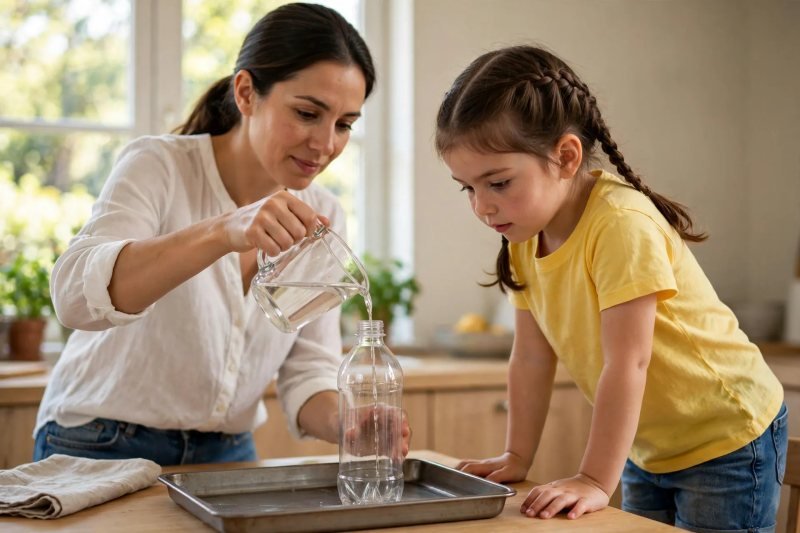
Set the bottle in the tray. Stand the bottle upright. The adult pours the vinegar, then moves the measuring cup aside.
-
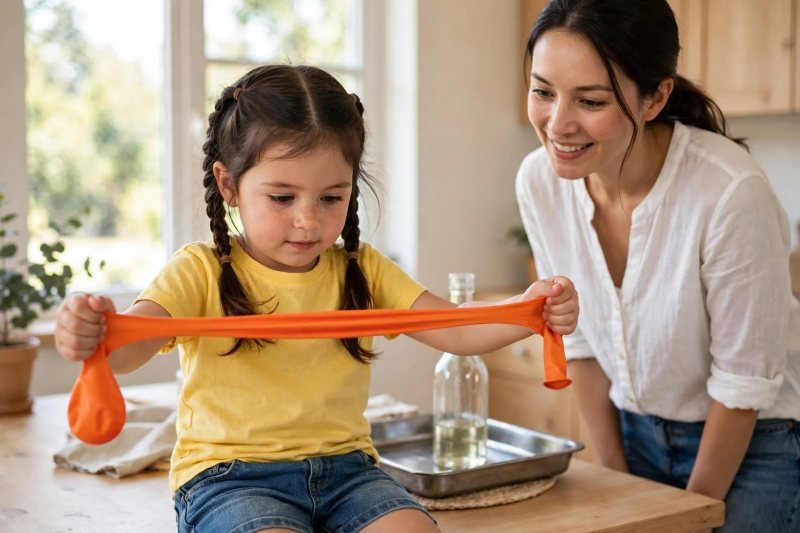
Stretch the balloon. Blow it up once and let it deflate, or pull it gently a few times. Loosened rubber inflates far more easily.
-
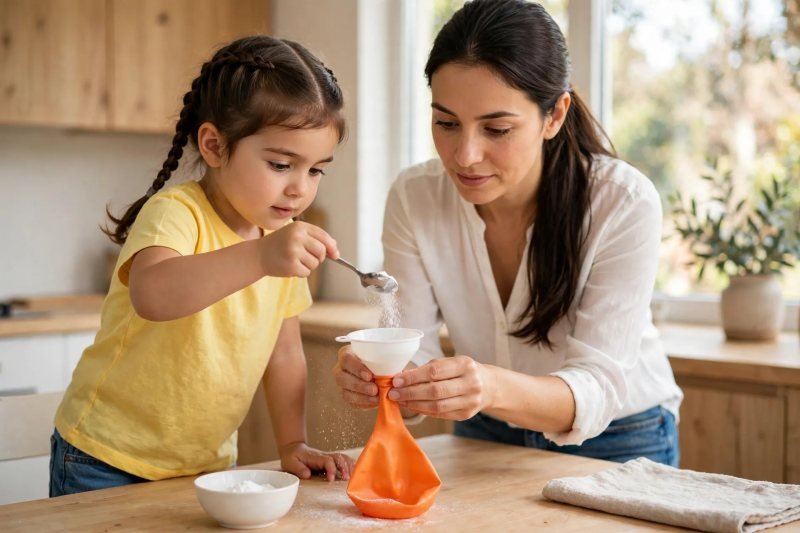
Funnel in the baking soda. Push the funnel into the balloon's mouth and spoon in 2 to 3 level tablespoons. Tap the balloon so the powder settles into the tip.
-
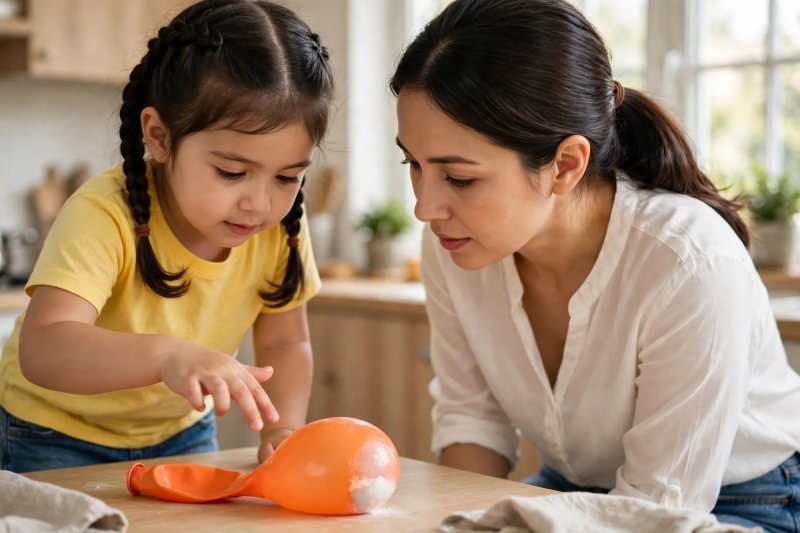
Trap the powder in the tip. All the baking soda must sit in the rounded end — none in the neck, or it spills early.
-
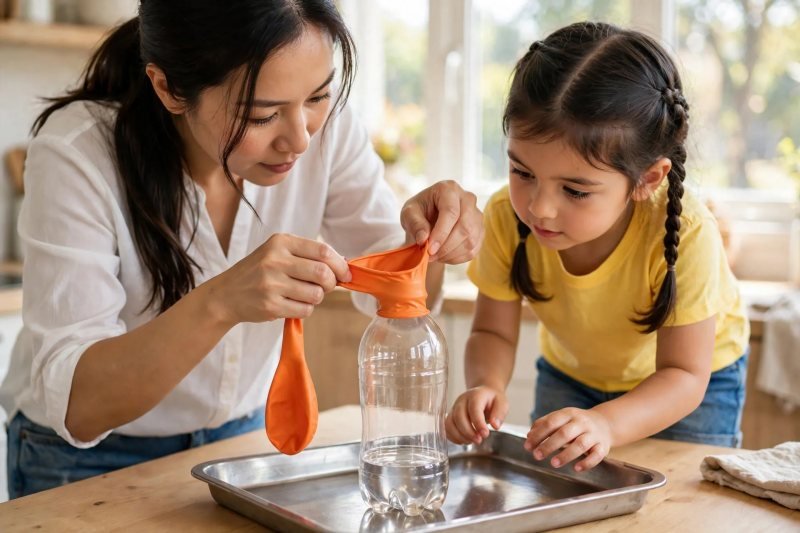
Stretch the balloon over the bottle mouth. The adult pulls the balloon's mouth wide and works it over the opening, letting the limp balloon dangle to one side. The rubber should sit snugly all the way around.
-
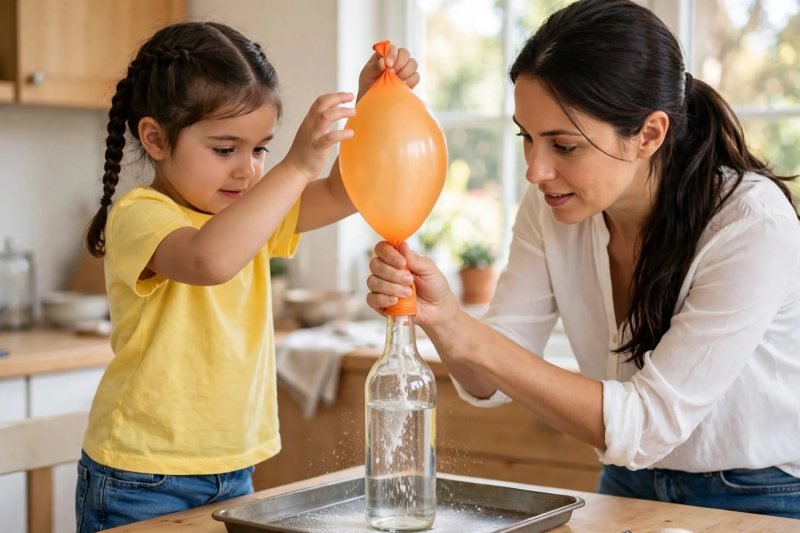
Countdown and lift. "Ready… lift!" Your child lifts the balloon upright so the baking soda slides into the vinegar. The adult keeps a firm hand around the seal.
-
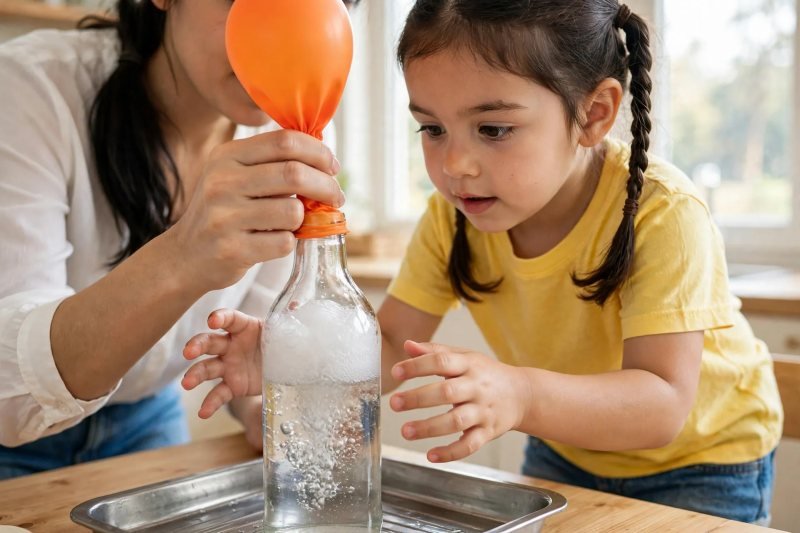
Watch the fizz start. The vinegar foams the moment the baking soda lands — the reaction is making carbon dioxide gas. Keep the balloon upright and keep holding the seal.
-
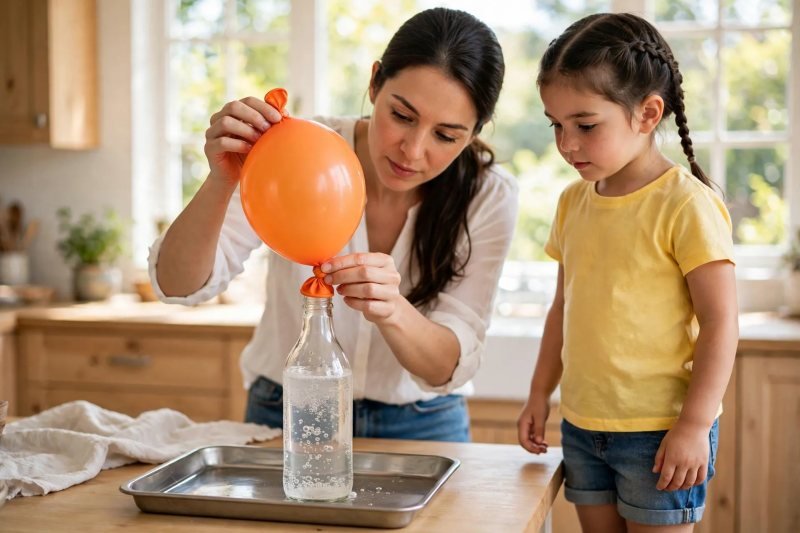
Watch the balloon rise. Within seconds the limp balloon stands up on its own and inflates. The gas has nowhere else to go, so it pushes up into the balloon.

-
Pinch and tie it off. Once the balloon stops growing, the adult pinches the neck, slips it off the bottle, and ties it shut. The bottle keeps fizzing gently — that's normal.
-
Compare and clean up. Hold the gas-filled balloon next to one blown up by mouth: both are the same balloon — one filled with breath, one with a reaction. Rinse the bottle, tray, and funnel with warm water.


Make it easier
Stretch the balloon yourself (step 2) — pre-loosened rubber inflates even with a weaker seal. The adult fits the balloon on the bottle and does the tie-off; the child scoops, stretches, and does the all-important lift.
Make it harder
Before the lift, have your child predict the balloon's size. Afterward, wrap string around the widest part and compare — the same comparing games used in these capacity activities for kids. Ask them to explain it to someone else: "What filled the balloon if nobody blew into it?" For another kitchen-table surprise, try the invisible ink experiment.
Other ways to play it
- What can you change in the balloon experiment?
- More or less baking soda. Try 1 tablespoon against 4 tablespoons with the same vinegar. More baking soda makes more gas — up to a point, because the reaction also needs the vinegar.
- Warm vs cool vinegar. Warm the vinegar just to lukewarm (never hot) and compare with fridge-cold vinegar. The warm batch fizzes sooner and the balloon rises earlier; the cold batch reacts slowly and gently.
- Different bottles. A narrow soda bottle makes the inflation look tall and dramatic; a wider bottle fizzes more but pushes the balloon up more slowly.
- Race two bottles. Two identical bottles, one with 1 tablespoon and one with 3. Predict the winner, then lift both balloons at the same time. For the eruption version of this reaction instead, try the baking soda vinegar volcano.
How it changes by age
- Written for ages 5–6: old enough to predict, follow a multi-step sequence, and explain what happened — and to handle the balloon safely while an adult does the fitting and tie-off.
- Age 4: works with the adult doing steps 5, 6, and 9. The child scoops, stretches, and does the big lift. Expect "the fizz blew it up" — perfect for four.
- Ages 7–8: let them run it themselves with you watching, and record predictions and results (spoonfuls of baking soda vs balloon size). For a follow-up where gas bubbles do the visible work, try the dancing raisins experiment.
What they're learning
Early chemistry: a chemical reaction makes something new — a gas — that wasn't there a moment ago. Cause and effect stretched over time: the lift at step 6 causes the inflation at step 8. Prediction and observation: guess the size, then check. Fine motor skills: spooning, pouring, stretching rubber. Vocabulary: react, gas, carbon dioxide, seal, mixture, predict. More kitchen science in our science hub.
Clearing up
Pour the fizzy liquid down the sink and rinse the bottle, tray, and funnel with warm water — everything washes out easily. The tied-off balloon stays inflated for a day or two; when it goes flat, save it for the next round.
Questions parents ask
How does baking soda and vinegar blow up a balloon?
How much baking soda and vinegar do you need to inflate a balloon?
Why didn't my balloon inflate?
Is the balloon experiment safe for kids?
Why does the balloon inflate on its own? Baking soda and vinegar react when they meet: the mixture fizzes and gives off carbon dioxide gas. Gas takes up far more space than the powder and liquid it came from, so the bottle fills with invisible gas pushing outward. The balloon is the only way out, so the gas flows up and stretches the rubber — like air filling a bicycle tire, made by chemistry instead of a pump.
The reaction is strongest in the first minute or two, then slows — that's normal. The balloon stops growing because the reaction is finished, not because anything went wrong. A cold kitchen makes balloon rubber stiffer; room temperature is ideal. For a party, set up three bottles and let each child do their own lift.

save it for later
Pin this for the next rainy afternoon
Keep it on a board so it is there when you need it, rather than when you happened to find it.
Save to Pinterest
