


Bead Pattern Activities: String, Copy and Create Sequences
Bead pattern activities for ages 3–4: copy pattern cards onto a shoelace, continue a started necklace, invent your own bead sequences, and sort beads by pattern — all with big, safe wooden beads and an adult at the table.
Bead pattern activities are stringing crafts where preschoolers copy, continue, and create bead sequences — red, yellow, red, yellow on a shoelace. Kids match large wooden beads to pattern cards, finish necklaces you start, then invent their own sequences. It works through touch: the rule sinks in bead by bead. For ages 3–4, use beads too big to swallow and stay right there the whole time. Copy, continue, fix, create — that's the whole method.

The short version
- - Start with AB — red, yellow, red, yellow — one rule at a time. Add ABC only when AB feels easy.
- - The pattern card is the secret: a strip with colored squares your child matches bead for bead.
- - Follow the four stages in order: copy your card, continue a started necklace, fix your mistake, invent their own.
- - Large beads only — too big to fit through a toilet-paper roll — with an adult sitting beside the child the whole time.
- - Read every necklace aloud together ("red, yellow, red, yellow") — saying the colors is what teaches the rule.
- - Keep sessions to about 15 minutes and stop while it's still fun.
- Age
- Ages 3–4
- Prep
- 10 min
- Play time
- 15 min
- Mess
- None
- Difficulty
- Easy
- Where
- Indoor
Why kids love this
Because it ends with treasure. A finished necklace is something to wear, show, and give away — and every bead on it is a choice they made themselves. Kids love the hunt of the wrong bead, the pride of catching your mistake, and the moment you have to copy THEIR card. The rhythm is soothing too: pick, thread, slide, say the color — it's craft time that feels like a secret code.
What you'll need
- - Large wooden beads in 3–4 colors — chunky, about an inch across, holes big enough for a shoelace; every bead must be too big to fit through a toilet-paper roll
- - Shoelaces or thick cotton cord — tie a knot at one end so beads don't slide off; short lengths for necklaces, shorter still for bracelets
- - A shallow tray or baking sheet with a lip — beads roll, and this keeps them on the table
- - Small bowls or a muffin tin — one color per bowl
- - Card strips and chunky crayons — for drawing pattern cards
- - Tape — to fix the knotted end of the lace to the table so the string stays still while little hands thread
Before you start
1. Test every bead against a toilet-paper roll. Anything that fits through is too small — put it away somewhere a baby or toddler can't reach. 2. Cut laces to length (about 24 inches for a necklace, 10 for a bracelet) and knot one end. Tape the knotted end to the tray. 3. Draw 2–3 starter pattern cards: an AB card (red, yellow, red, yellow), another AB in different colors, and one ABC. 4. Sort the beads into bowls by color and set the tray on the table. 5. Set the two rules before a single bead is touched: we sit down to bead, and beads stay on the table — never in mouths.
How to do it
-
**Step 1 — Check every bead together.** Hold up a toilet-paper roll and test one bead: "See? Too big to fit — safe." Let your child test the rest. This isn't a lecture; it's a ritual that makes the safety rule theirs. Any bead that fits goes in a bag for later — out of reach, right now.

-
**Step 2 — Sort the beads into bowls.** Tip the beads into the tray and sort them by color, one bowl per color. "All the reds here, all the yellows here." Sorting by color is bead sorting by attribute — the first pattern skill — and it ends with a tidy station where every bead is findable.

-
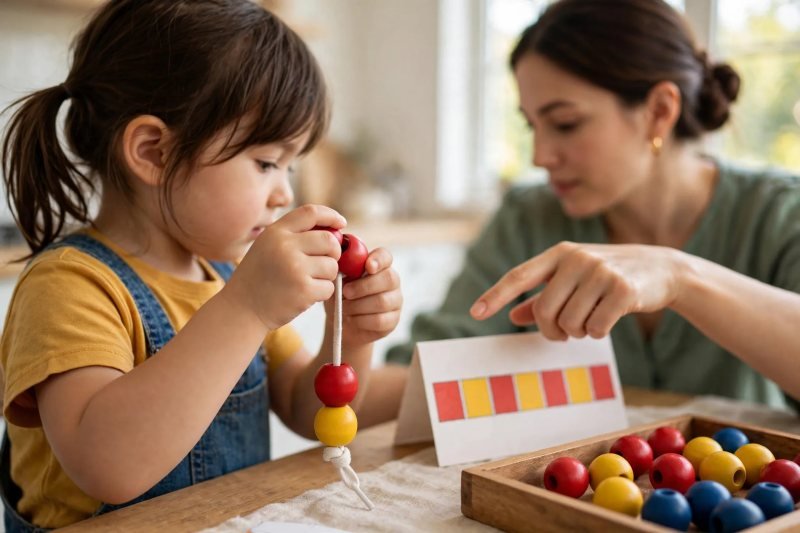
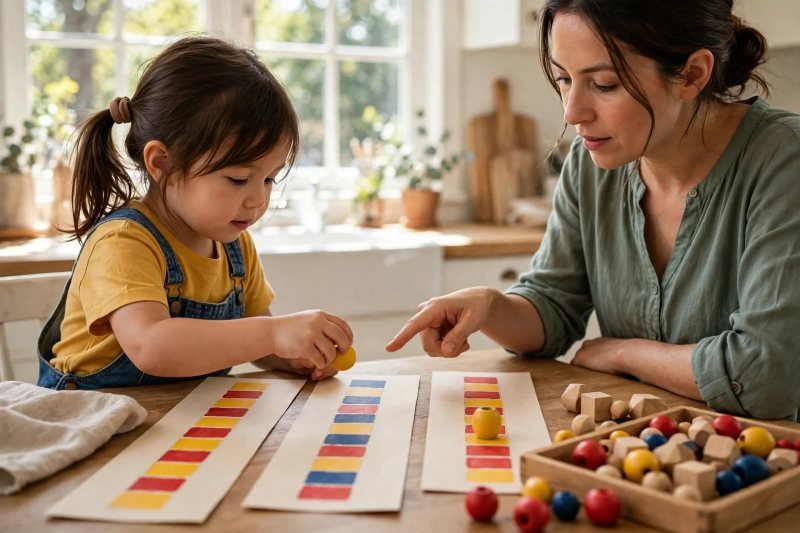
**Step 3 — Make your first pattern card.** Draw six big squares on a card strip: red, yellow, red, yellow, red, yellow. Say each color as you draw it. Prop the card where your child can see it. This card is the target for everything that follows — keep it simple and keep it visible.

-
**Step 4 — Copy the card, bead for bead.** Your child threads one bead per square, left to right, matching each bead to the square above it. Read it aloud as they go: "Red… yellow… red…" Slow is perfect. When the lace matches the card, read the whole necklace back together and celebrate it.
-
**Step 5 — Read the necklace back.** Slide your finger along the finished string and say every color, slow then faster, like a chant: "red, yellow, red, yellow." Have your child say it with you. Hearing the alternation — the back-and-forth rhythm — is what turns a pretty necklace into a learned rule.

-
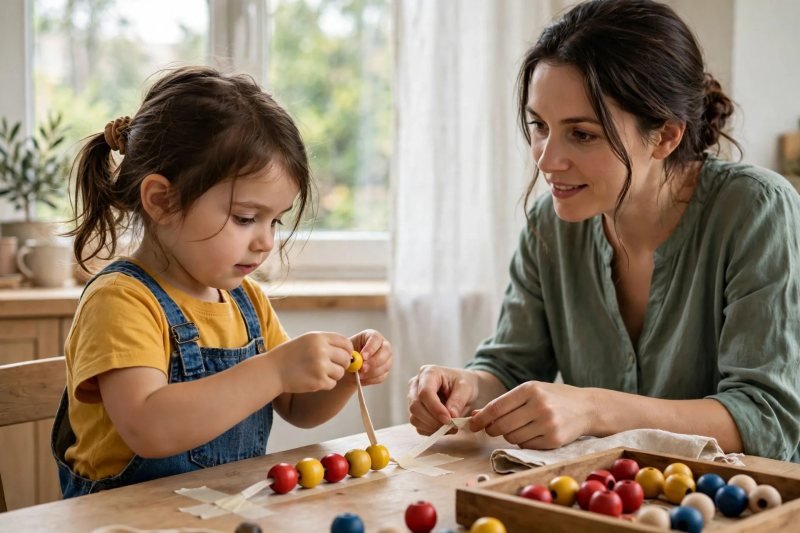
**Step 6 — Start a necklace; they finish it.** String the first four or five beads of an AB pattern yourself, then hand over the lace: "What comes next?" No card this time — they're continuing from the rule in their head. If they stall, read the strung beads aloud as a hint. Tie it off and admire the team effort.
-
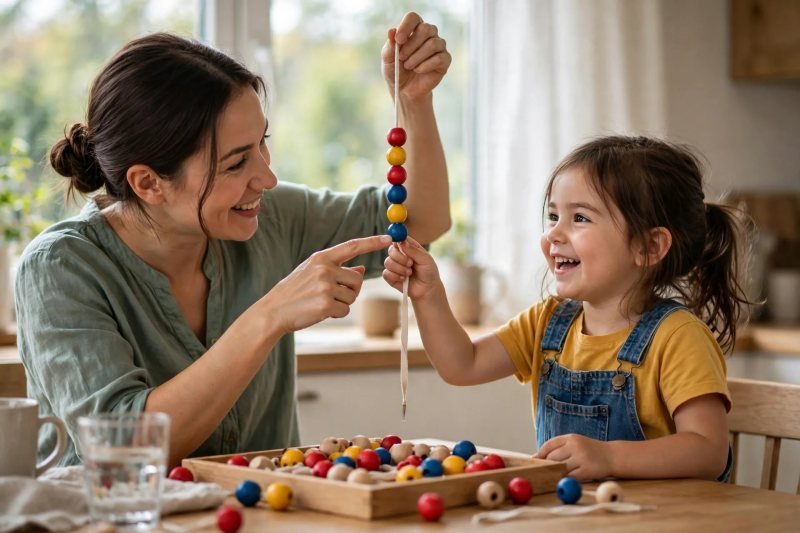
**Step 7 — Make a mistake on purpose.** String red, yellow, red, blue and hold it up: "Did I mess up?" Let them find the wrong bead, pull it off, and thread the right one. Take turns — now they build one with a mistake for you to find. Mistake-hunting teaches them to check the rule, not just follow it, and catching you is the best part of their day.
-
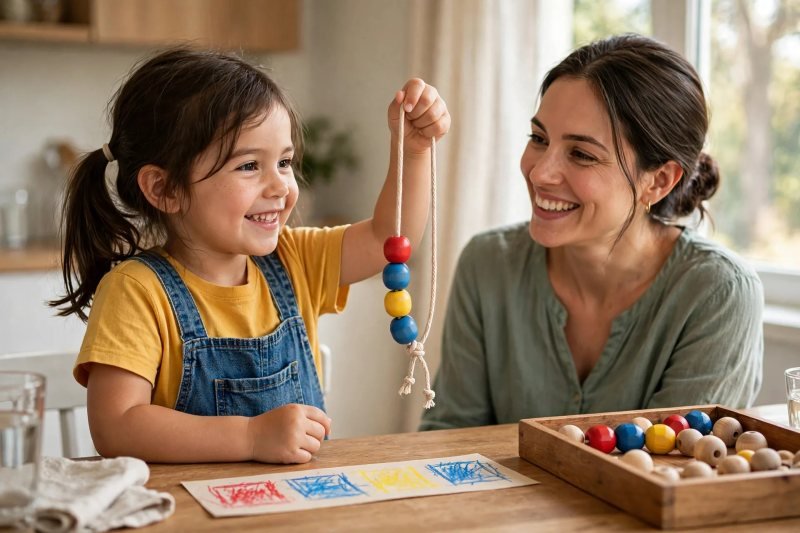
**Step 8 — Invent a sequence.** Hand them the mixed bowl and a blank card: "Make your own pattern — any colors, any rule." Whatever they string, read it back together and let them hear what they built. Then have them draw their pattern as a card — and you copy it. Their rule, their necklace, their card: the pattern is truly theirs now.
-
**Step 9 — Sort beads by pattern.** Lay out three pattern cards — AB, ABC, AAB — and tip a mixed bowl of beads onto the tray. Point to each card: "Which beads go with this rule?" Your child places beads onto each card's squares, matching the rule. This is bead sorting by pattern — same beads, new brainwork: they're reading three rules at once and sorting by which fits.
-
**Step 10 — Wear it and compare.** Tie off the finished necklace and put it on. Make a bracelet for yourself from their invented pattern and wear it too. Compare: "Mine goes red, blue — what's yours?" Photograph them side by side. A worn necklace is a pattern they carry around — and a gift-ready one for grandma.



Make it easier
- Use the biggest beads you can find and pipe cleaners instead of laces — the stiff wire threads itself. - Start with just two colors and AB only; tape the card right next to the tray so matching is a glance, not a memory task. - Pre-string the first two beads of every necklace so your child always starts with a visible rhythm. - Say every bead's color aloud yourself until they start saying it unprompted. - Work in two short 8-minute bursts instead of one long session.
Make it harder
- Move to ABC, AAB, and ABB cards once AB is effortless. - Cover the pattern card halfway through — can they finish the necklace from memory? - Add shape patterns: round bead, square bead, round bead — or big bead, small bead, big bead. - Count challenges: "String 12 beads in your pattern — how many are red?" (a counting game hiding inside craft time: [counting activities for toddlers](/activities/counting-activities-for-toddlers/)). - Two-strand patterns: twist two laces together so the colors interleave.
Other ways to play it
- - **Shape patterns:** sort and string by shape — round, cube, round, cube — instead of color. Great practice for the same shape-spotting muscle as our [shape hunt around the house](/activities/shape-hunt-around-the-house/).
- - **Size patterns:** big bead, small bead, big bead with chunky wooden beads in two sizes.
- - **Pasta beads:** dye wide rigatoni with food coloring, dry overnight, and string a dinner-table necklace.
- - **Nature beads:** alternate wooden beads with big dried pasta wheels or cardboard tube rings.
- - **Gift necklaces:** string a pattern in grandma's favorite colors and mail it with the pattern card.
- - **Pattern swap:** siblings each invent a pattern card, trade cards, and string each other's.
How it changes by age
- - **Ages 3–4:** this activity is designed for this band. Threes do best with AB patterns, the biggest beads, and cards kept visible the whole time. Fours can usually handle ABC and AAB, continue a started necklace without the card, and invent wilder sequences.
- - **Under 3:** beads are a choking hazard — little ones should not have access to beads at all. They can watch an older sibling string (from a safe distance, beads out of reach) and chant the colors along.
- - **Ages 5–6:** ready for longer sequences, ABB and ABBA patterns, and designing multi-card sets for younger siblings to copy.
What they're learning
- **Pattern rules:** spotting, continuing, fixing, and inventing repeating sequences — the earliest form of algebraic thinking. - **Fine motor control:** threading beads builds pincer grip, hand-eye coordination, and the finger strength writing needs later. - **Left-to-right sequencing:** matching cards and stringing in order trains the same direction reading flows. - **Color and shape vocabulary:** naming every bead as they string it grows precise color and shape words. - **Prediction:** "what comes next?" is a thinking skill, practiced here bead by bead. - **Counting:** counting beads, colors, and repeats folds number sense into craft time.
Clearing up
- Slide finished necklaces onto a tray and tie off laces so beads don't escape. - Tip leftover beads back into their color bowls, seal the jars, and store them high — out of reach of under-3s. - Wipe the tray; check the floor for runaway beads before younger siblings come in. - Keep pattern cards in an envelope for next time — the deck grows with your child. - Recycle worn-out cards; reuse laces and beads endlessly.
Questions parents ask
What size beads are safe for a 3-year-old?
My child keeps putting beads in their mouth. What should I do?
What is a bead pattern card?
How long should a bead pattern session last?
When should kids move from AB to ABC bead patterns?
Can I make my own large beads from things at home?
- This is a wonderful quiet-time activity — tray, beads, and cards fit in a shoebox for restaurants or waiting rooms (with you right there, of course). - Finished necklaces make genuinely loved gifts; a 4-year-old handing grandma a necklace they patterned themselves is a core memory in the making. - If your child loses interest mid-necklace, tie it off as a bracelet instead — a finished short piece beats an abandoned long one. - Take a photo of each invented pattern card. Six months from now, the gallery of their rules will show you exactly how far their math brain has traveled.

