


2D Shapes in Year 1: Sides, Corners and Sorting (UK Guide)
What Year 1 children learn about 2D shapes in England — recognising, naming, sides, corners and sorting — plus ten hands-on steps to practise at home.
In England, Year 1 children (ages 5–6) learn to recognise and name common 2D shapes — rectangles (including squares), circles and triangles — and to describe them using sides and corners. At home, practise by tracing shapes while counting sides and corners, building shapes from sticks and dots, and sorting shapes by number of sides.

The short version
- Year 1: naming rectangles (including squares), circles and triangles, in sides-and-corners language.
- Triangle 3/3, square 4/4, rectangle 4/4, circle 0/0; pentagon 5/5, hexagon 6/6 as stretch.
- A square is a special rectangle — "rectangles (including squares)".
- Build first (sticks = sides, dots = corners), quiz later.
- Sort by side count: classification practice that fixes the square–rectangle confusion.
- Age
- Ages 5–6
- Prep
- 5 min
- Play time
- 25 min
- Mess
- Low
- Difficulty
- Easy
- Where
- Indoor
Why kids love this
Children love knowing the proper words for things. A child who calls a cereal box a rectangle — and proves it by counting four sides and four corners — feels like a real mathematician. Ten steps turn the curriculum into building, sorting and detective games. ## What Year 1 teachers are looking for — The shape list comes from the England national curriculum programme of study for Year 1 maths, which asks children to recognise and name 2D shapes (rectangles including squares, circles and triangles) and describe them by their sides and corners.
What you'll need
- Wooden or foam shapes: circle, triangle, square, rectangle, pentagon, hexagon
- Lolly sticks, sticky dots, blank cards, crayons, one large paper sheet
- Two hoops or trays, glue stick, child-safe scissors
Before you start
1. Year 1 list: circle, triangle, square, rectangle — squares are a special kind of rectangle. Pentagon and hexagon are stretch shapes. 2. Pile shapes on the table with sticks, dots and cards nearby; clear floor space for step 5's sorting game.
How to do it
-
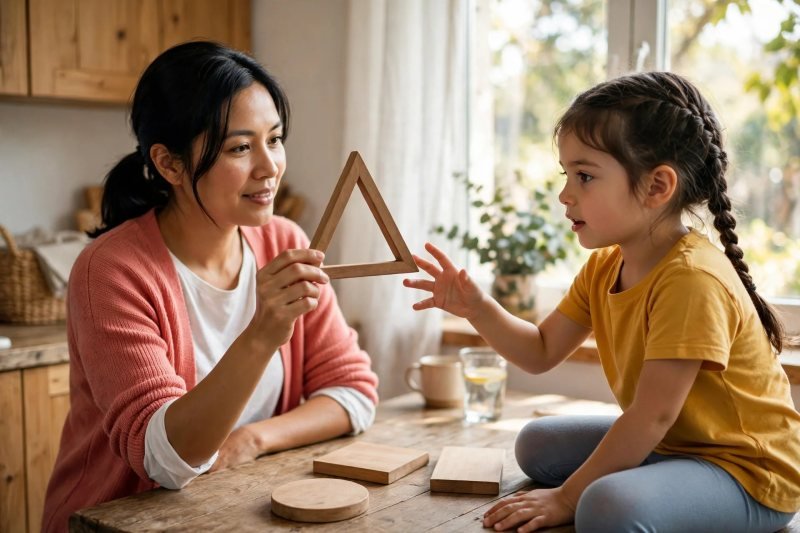
**1. Learn the vocabulary.** Circle: 0 sides, 0 corners. Triangle: 3 and 3. Square: 4 equal sides, 4 corners. Rectangle: 4 sides — two long, two short.
-
**2. Make vocabulary cards.** One card per shape: she draws it large, notes its side-and-corner count — her word mat for everything after.

-
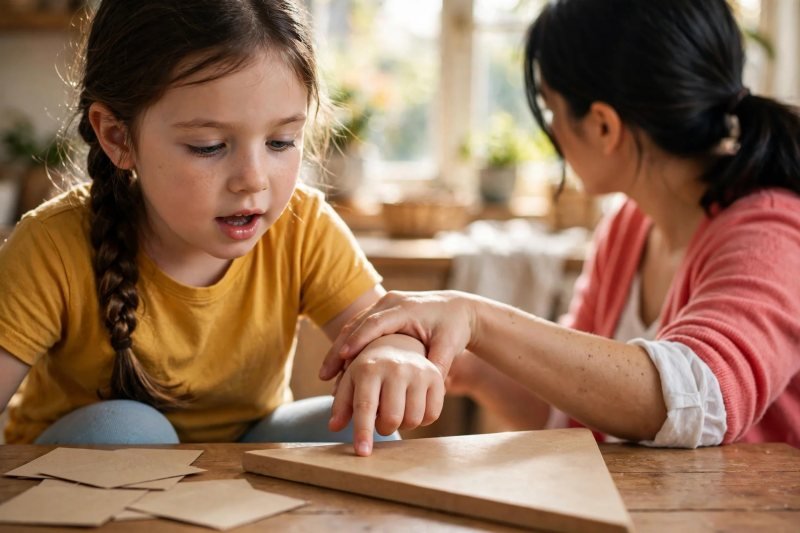
**3. Trace and count slowly.** Lay one wooden shape on the table and trace it together, saying: "Run your finger along this side — that's one. Stop at the corner and tap it. Now the next side — two." Her fingertip travels each side while you count aloud together, then you start again and tap every corner in turn, pausing at each one so the count has time to land. The common mistake is the finger racing ahead of the voice — she calls out "three" while her fingertip is still on the second side — or counting the starting corner twice and giving a square five corners. When that happens, hold the shape steady, slow right down, and press a sticky dot on the corner she started from, so she can see the moment she arrives back at it.
-
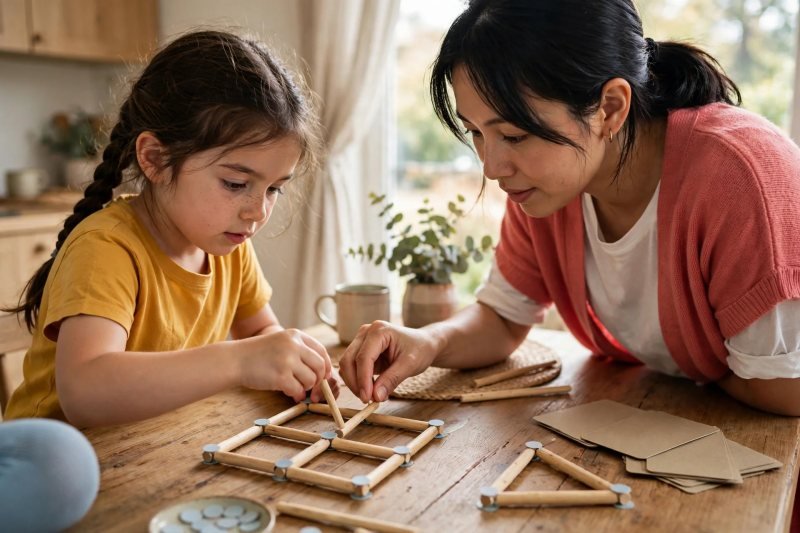
**4. Build with sticks and dots.** Sticks are sides, dots are corners. Build triangle, square, rectangle. A build that will not close has a stick too many or a dot missing.
-
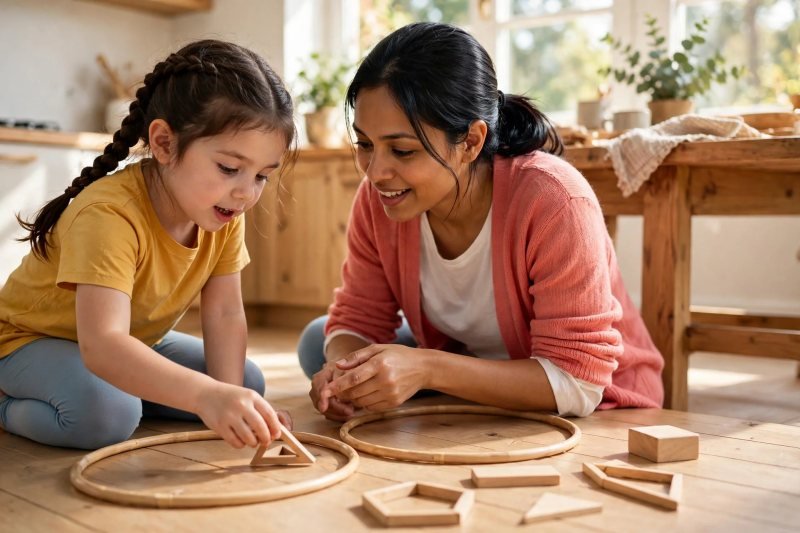
**5. Sort by number of sides.** Put two hoops on the floor and label them together: "This hoop is for shapes with three sides. This one is for four." Hand her one shape at a time and say: "Count the sides first — the count decides the hoop." She counts aloud, then drops it in. The common mistake is sorting by look instead of by count: a small square lands in the three-sides hoop, or the tilted square gets refused from the four-sides hoop because "it looks like a diamond". That tilted square is the point of the game — slide it in and say: "Tipped over, turned around — still four sides, still a square." Once two hoops feel easy, add a third labelled "5 or more" for the pentagon and hexagon, plus a long, thin triangle that looks nothing like the ones in books.
-
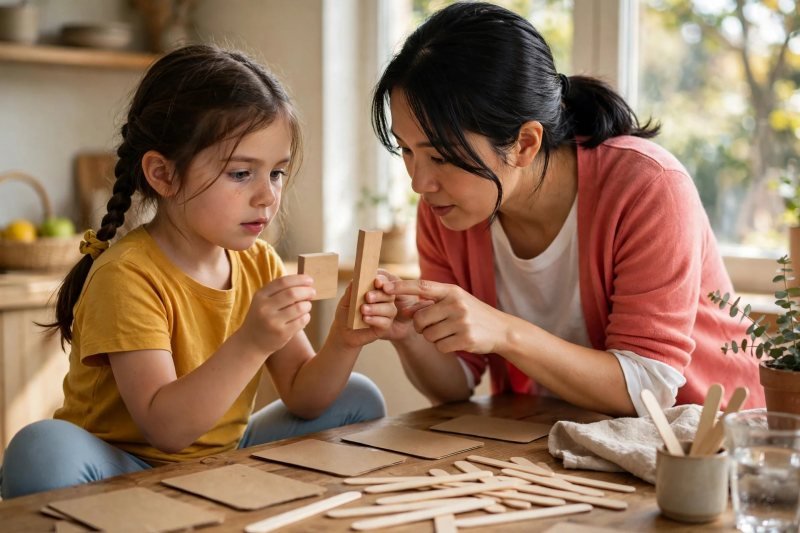
**6. Crack the square–rectangle question.** "Both have four and four — what's different?" The square's sides are all equal. The secret: squares are a special kind of rectangle.
-
**7. Hunt shapes around the house.** "Find three rectangles." She names each find: the TV (4 and 4), a clock face (none and none). Tally them.

-
**8. Play "describe it and I'll draw it".** Hide a shape behind a book where only she can see it, and say: "Describe your secret shape using sides and corners — no naming it. I'll draw exactly what you tell me." If she says "it has four sides", draw a long, thin rectangle when she meant a square, and let her spot what is missing: "What else does the drawer need to know?" The lesson lands the moment she adds "all the sides are the same" without being asked. The common mistake is describing by name or by object — "it's like a door" — instead of by properties. When that happens, draw the door, enjoy the laugh, and say: "Now tell me about its sides instead." Then swap roles: you describe, she draws, and you deliberately leave one clue vague so she feels the problem from the other side.

-
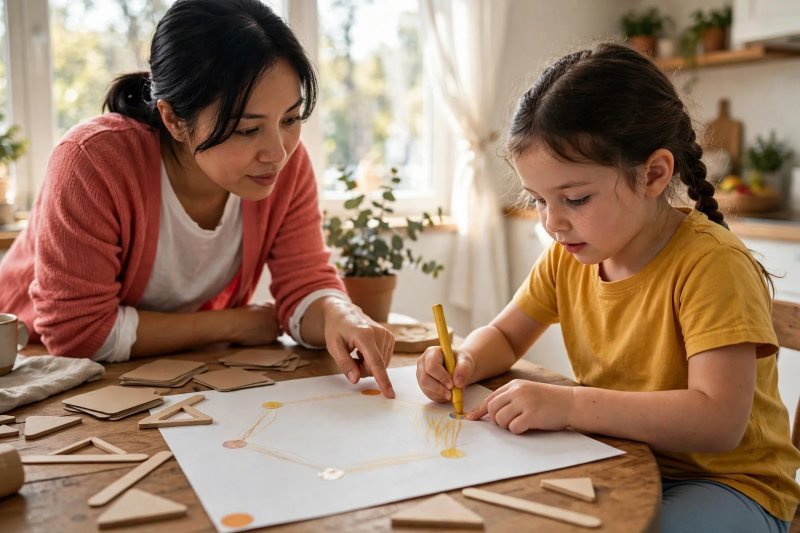
**9. Draw, dot and check.** Hand her the large sheet and say: "Draw the shape big, then press a sticky dot on every corner. Now count — do your dots match your sides?" A triangle should finish with three dots for three sides; a square with four for four. The common mistake is the two counts disagreeing: five dots on a square because she dotted the middle of one long side as well, or a wobbly drawn side that bends and gets counted as two. Treat every mismatch as the activity working, not failing, and say: "Your dots say five and your sides say four — which one is telling the truth?" She recounts, finds the spare dot or the bent side, and fixes it herself. That self-check is what makes this step stronger than a worksheet: the paper gives the feedback, not the adult.
-
**10. Quiz and the fridge gallery.** "Which shape has five sides? I have four equal sides — what am I?" Cards go on the fridge: every glance is free revision.



Make it easier
Start with circle, triangle, square; add the rest across later sessions. End with the hunt (step 7), not the quiz — hunting feels like play; repeat steps 3–4 for a week before sorting.
Make it harder
Add the semicircle: one straight edge, one curved edge, two corners. "Always, sometimes, never": "Does a rectangle always have two long sides?" Time the hunt across the week — beat the record with every answer accurate.
Other ways to play it
- Rainy afternoon: steps 1–4 and 8–10 need only the kitchen table.
- Car journeys: step 8 with words only, plus "I spy a rectangle".
- Outdoors: hunt at the park — manhole covers, road signs, almost-shapes to debate.
How it changes by age
- Ages 5–6 (Year 1): naming rectangles (including squares), circles, triangles, with sides-and-corners language. Steps 1–4 are the core; keep sessions short.
- Ages 6–8 (consolidation): for children who met these shapes in Year 1, this is consolidation and stretch, not new teaching. Add pentagon, hexagon and semicircle; step 5's sorting and step 6's square–rectangle secret land brilliantly. Towards 7–8, Year 2 compares and sorts more formally — "always, sometimes, never" and the timed hunt keep older children stretched.
What they're learning
Year 1 vocabulary: naming rectangles (including squares), circles and triangles. Sides, corners and vertices: describing shapes by properties — teachers also use the word vertices for corners, so both words are worth hearing at home. Square–rectangle link: a square is a special rectangle. Sorting by properties: grouping by side count — early classification. Shape constancy: stretching or tilting never changes a name. Precise talk: describing so someone else can draw it. Looking ahead: 3D shapes — cubes, cuboids, pyramids and spheres — are the other half of Year 1 geometry; this guide covers the flat 2D half.
Clearing up
Shapes, lolly sticks and sticky dots go back into one tub, so the whole kit is ready to grab next time. The vocabulary cards stay on the fridge (step 10) — everything else goes away. Hoops stack flat or hang on a hook, and any stray sticky dots get pressed onto scrap paper before they migrate onto socks and sleeves.
Questions parents ask
What 2D shapes do children learn in Year 1?
How many sides and corners does a rectangle have?
What is the difference between a side and a corner?
Is a square a rectangle in Year 1?
How can I help my Year 1 child learn 2D shapes at home?
**Two mix-ups to expect** — "No sides, no corners" for a circle feels like a trick — but try building one from straight sticks (step 4): you cannot. Some shapes are curves, and that is allowed. Second, calling every four-sided shape a square: the curriculum agrees with your child, because a square really is a special rectangle. Sorting the two side by side (steps 5–6) sharpens the distinction.

save it for later
Pin this for the next rainy afternoon
Keep it on a board so it is there when you need it, rather than when you happened to find it.
Save to Pinterest


