


Tidying Up Without the Battle
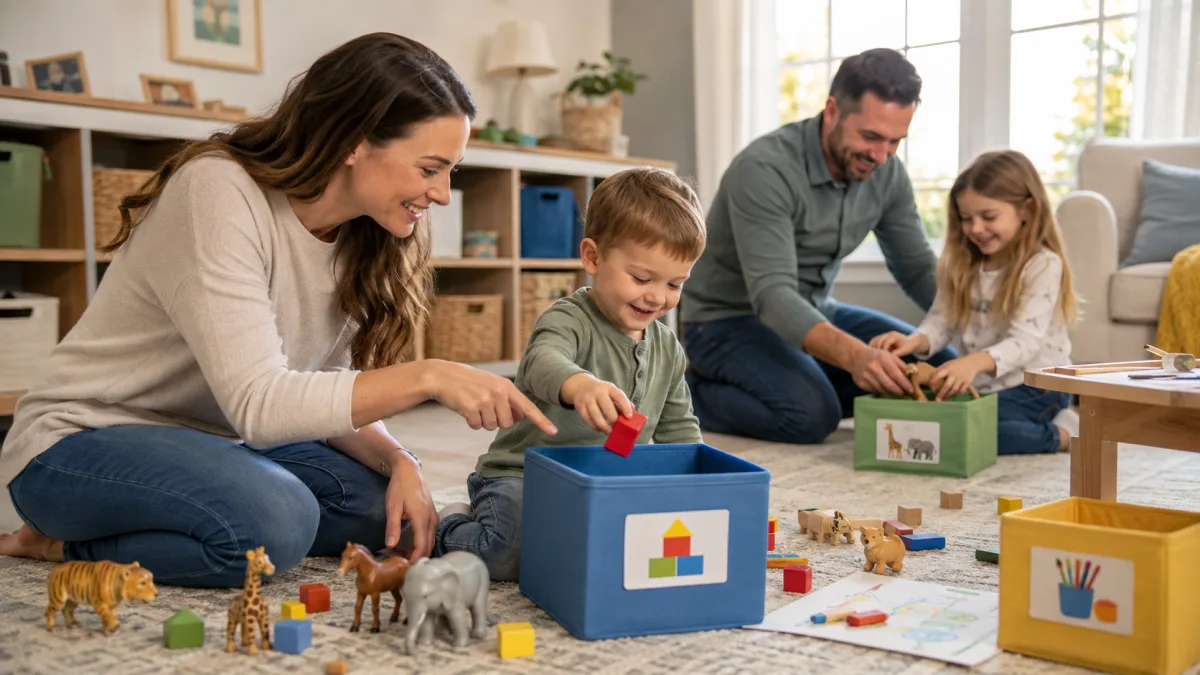
"Tidy up" is an impossible instruction. "Put the blocks in the blue box" is a job a three-year-old can finish.
How to make tidying up work with young children: give one specific task at a time, use containers that are not too big, label with pictures, and expect to do it together for longer than seems reasonable.
The short version
- One specific job at a time, not "tidy up".
- Small containers with pictures on them.
- Do it together, for longer than feels reasonable.
- Same time every day.
- Leave the big build standing.
- Age
- Ages 2–8
"Tidy up" asks a young child to look at a chaotic room, break it into categories, decide an order, and begin. That is a lot of thinking, and it is why the instruction so often produces a child standing in the middle of the room doing nothing at all.
Give one job instead. "Put the blocks in the blue box." When that is done, give the next one. It is slower to say and much faster to finish.
Make things findable. Containers with a picture of what goes in them, at child height, not too big. A container that is too large never looks full and never feels finished; three small baskets beat one big box every time.
Do it together for longer than feels reasonable. Tidying alongside a child is not failing to teach them independence — it is how they learn what the job actually involves. Most children need company with this well into school age.
Use a game when it stalls. Beat the timer, or everything red first, or "I bet you cannot get all the cars back before I count to twenty" — which they always can, and which works far more often than it should.
Tidy less often. Once a day, at a fixed point, is easier to sustain than a running battle. Some houses do it before dinner; some do it before the last story. Either is fine as long as it is the same time.
And tidy less. If putting everything away every night is impossible, leave the big construction up. A half-built thing that survives the night is often what gets played with first the next morning, which is a better outcome than a tidy floor.