


How to Teach Letter Sounds to Preschoolers in 5 Minutes a Day
A five-minute daily routine for how to teach letter sounds to preschoolers: a teaching order to introduce sounds (not A to Z), one sound a day with multisensory play, quick reviews, and gentle fixes for b/d mix-ups. Ages 3–4.
Teach letter sounds to preschoolers with one five-minute session a day: introduce a single sound in teaching order (s, a, t, p, i, n …), model it as a short pure sound, then practice it four ways — hear it, see it in a mirror, feel it, and move it — before a quick review of older sounds. Sounds first, letter names later.

The short version
- Teach one sound a day in teaching order — s, a, t, p, i, n, m, d, g, o — not the alphabet.
- Say every sound short and pure ("sss" not "suh", "mmm" not "muh"); your child copies exactly what they hear.
- Practice each sound four ways: hear it, see it in a mirror, feel it, and move it.
- Review old sounds daily with a 30-second beanbag toss so nothing fades.
- Teach sounds before letter names, and keep it playful — five minutes, then stop.
- Age
- Ages 3–4
- Prep
- 1 min
- Play time
- 5 min
- Mess
- None
- Difficulty
- Easy
- Where
- Indoor
Why kids love this
Five minutes is the perfect length for a three-year-old: long enough for a game, short enough to beat the wiggles. If you have wondered how to teach letter sounds to preschoolers without a classroom vibe, this is it — mirror faces, snake slithers, detective hunts, and silly sentences that get faster every round. The same tiny ritual each day becomes something they ask for, and every repetition quietly wires another sound into place.
What you'll need
- A small hand mirror
- A soft ball or beanbag (for the review game)
- A toy magnifying glass (optional, for the detective hunt)
- Large letter cards or magnetic letters, one per sound (optional)
Before you start
Learn one widely used teaching order: s, a, t, p, i, n, m, d, g, o — not the alphabet. These are among the easiest sounds to say purely, and they build real words quickly (sat, pin, tap, mat, dog). Practice them yourself first: stretch the hissy ones ("sss," "mmm") and clip the bouncy ones ("t," "p") with no "uh" on the end — your child will copy exactly what they hear. Pick a daily slot that always works: after breakfast or before bath. Each day runs the same ten steps: steps 1–8 teach one new sound four ways — hear it, see it, feel it, move it — and steps 9–10 review old sounds and end on a high. Five minutes total.
How to do it
-
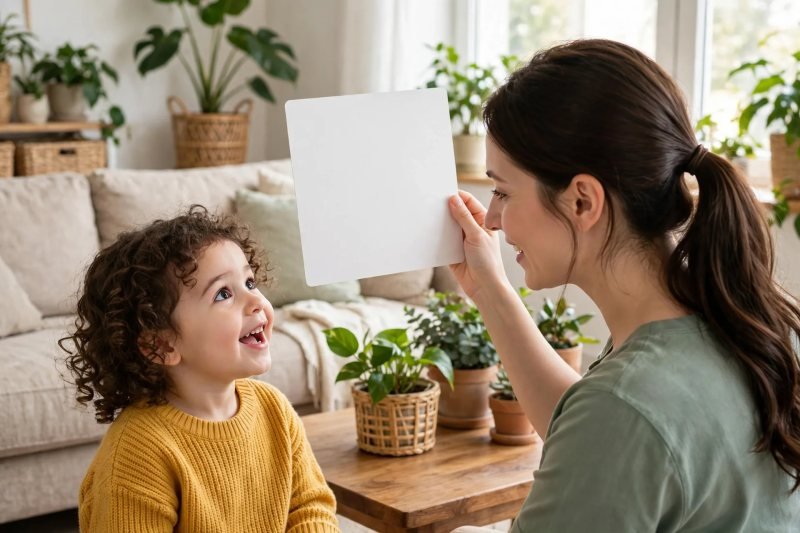
Pick today's sound. Take the next sound in the order s, a, t, p, i, n, m, d, g, o — never the alphabet. Alphabetical order starts with sounds that are hard to say purely and slow to build words with; this order hands your child the most useful sounds first. Announce it: "Today's sound is 'mmm'!"
-
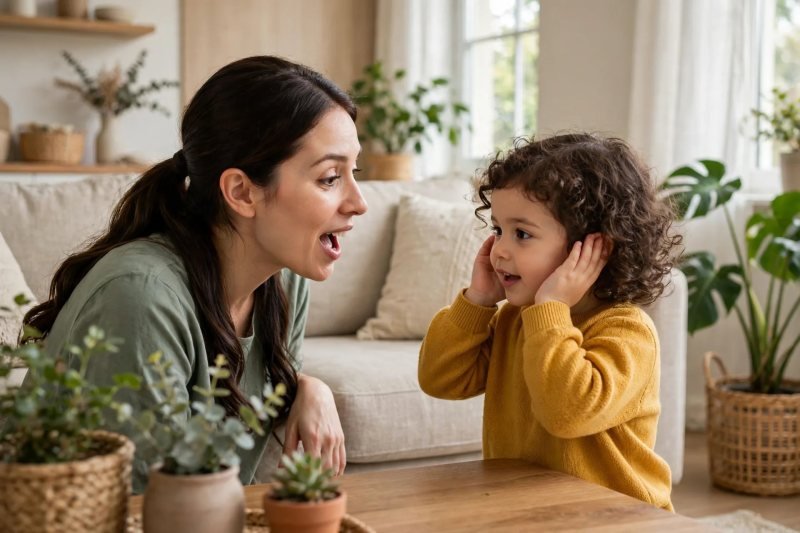
Echo it. Say the sound clearly three times — "mmm, mmm, mmm" — and let your child echo back like an echo in a cave. Keep it short and pure: "sss," not "suh." If your child adds an "uh," just model it correctly again with a smile. No lecture needed.
-
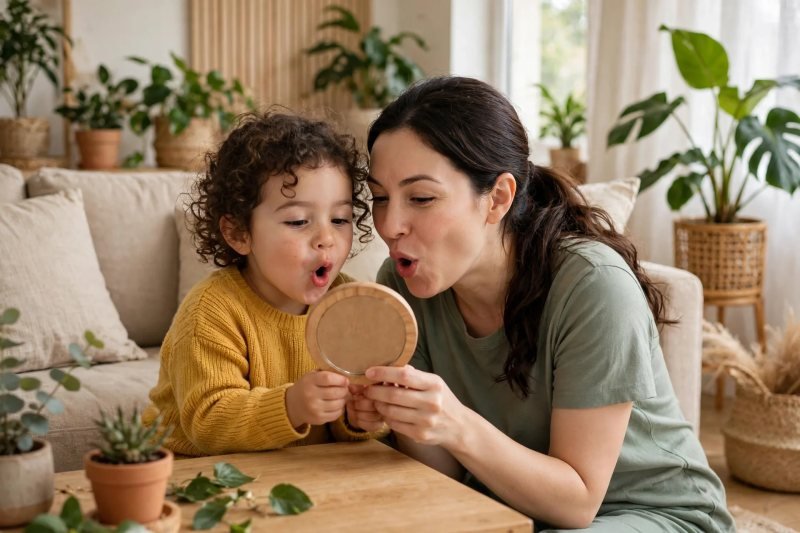
See it in the mirror. Hold the mirror so you both see your mouths. Make today's sound together and watch: lips press together for "mmm," the tongue hides behind the teeth for "sss," the mouth opens big and round for "o." Seeing how a sound is made helps children tell sounds apart.
-
Feel it. Two fingers lightly on the throat while humming "mmm" — they will feel the buzz. For "sss," hold a hand in front of the mouth to feel the puff of air. Feeling a sound gives the brain a second memory hook beyond hearing.

-
Move it. Give today's sound a whole-body action and do it three times together, saying the sound each time: slither like a snake for "sss," march and hum for "mmm," tap your knees like a drum for "t." Big movements are memory glue at this age.

-
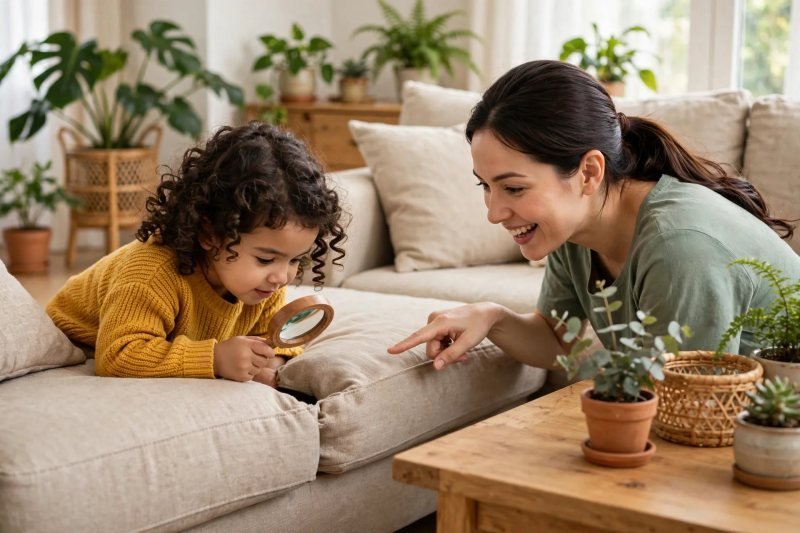
Hunt it like a detective. Grab the magnifying glass and find three things starting with today's sound: "I spy with my little eye something beginning with 'sss.'" Use the sound, never the letter name. Sun, sock, spoon — every find gets a dramatic detective announcement.
-
Say a silly sentence. Build a tongue twister with today's sound: "Silly Sammy sips soup!" Say it once slowly, then faster each round. Speed plus silliness locks in the starting sound, and your child will beg to go faster.

-
Sky-write it. Show the letter card briefly, then put it down. "Write" the shape huge in the air with a magic pointer finger while saying the sound — slow and smooth, voice matched to movement. This links the printed shape to the sound your child now owns.

-
Pop yesterday's sounds back. Toss the beanbag back and forth: you say an old sound, your child catches it and "pops" it back. Two or three old sounds, thirty seconds. This tiny review is what stops yesterday's sound from fading.

-
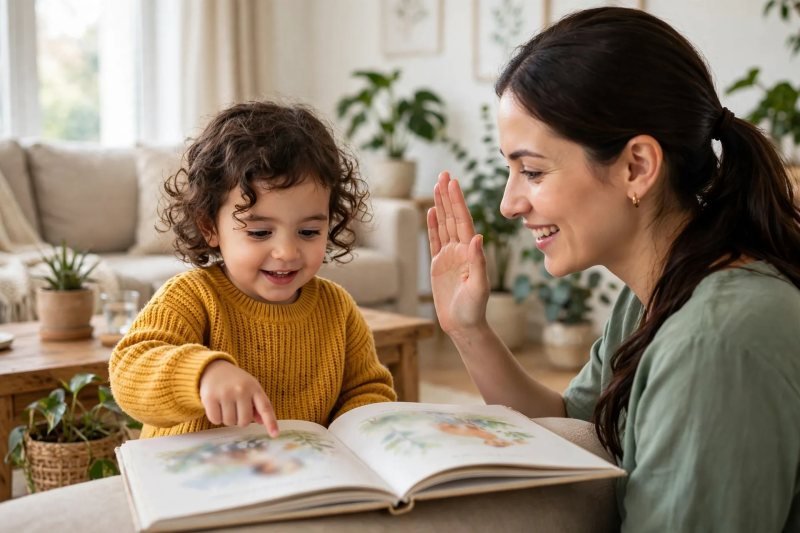
Spot it in a book. Open any picture book and hunt today's sound on one page: "Can you find something starting with 'mmm'?" Moon, mouse, man — point to each, close the book, high-five. Done.


Make it easier
Do it standing or marching — sitting still is optional. Let your child watch you do each step first; copying is learning. If five minutes feels long, split it into two two-minute bursts: steps 1–5 in the morning, steps 6–10 after lunch.
Make it harder
When the first ten sounds are solid, start blending: stretch two sounds together ("s-a-t") and let your child guess the word. Our blending sounds activities pick up blending from here. Add a second sound to the detective hunt. Once blending clicks, our phonics activities for preschoolers pick up right where this routine leaves off.
Other ways to play it
- Do the echo and move-it steps in the car — no materials needed.
- Hunt outside; parks overflow with "sss" sounds (sun, slide, swing).
- Play the routine in your home language first — sound skills transfer across languages.
- Let an older sibling "teach" steps 2–5; teaching locks in their own sounds too.
- The phonics hub gathers more sound-play ideas by stage, and for more one-sound games beyond this routine, letter sounds games for preschool widen the hunt.
How it changes by age
- Built for ages 3–4, when ears are ready for single sounds but attention is short. The 3-year-olds age hub has more activities for this year. Twos can join the mirror faces and movement steps. Fours who know these ten sounds can move on to blending, covered in Make it harder above, and alphabet activities for toddlers start even earlier for younger siblings. Letter names and shapes live in the alphabet hub for when your child is ready for them. Repeating one sound for three days is always fine.
What they're learning
Children learn to hear, say, and remember individual letter sounds and link each one to its printed letter — the core skill reading is built on — plus listening focus and memory strengthened through movement. Hearing comes first: telling "sss" from "mmm" by ear. Saying comes next: shaping the sound purely, without the extra "uh." Linking comes last: connecting the sound to the letter shape through sky-writing and the book hunt, so the printed letter starts to mean a sound, not just a shape.
Clearing up
Basket the mirror, beanbag, and cards so tomorrow's five minutes starts instantly. Track progress with a sticky note on the fridge: the sequence s, a, t, p, i, n, m, d, g, o, with a tick next to today's sound.
Questions parents ask
Why shouldn't I teach letter sounds in alphabetical order?
Should I teach letter names or letter sounds first?
What should I do if my child confuses b and d?
How long will it take my child to learn all the letter sounds?
What if my child won't sit still for five minutes?
Two mix-ups deserve special mention. If your child says the letter's NAME instead of its sound ("ess" for s), celebrate the knowledge — "Yes, that's the letter S!" — then model the sound: "Its sound is 'sss.' Can you say 'sss'?" Teach sounds first; names can wait, because "ess-ay-tee" never blends into "sat." If b and d get tangled later, relax: it is completely normal at this age, when mirror-image letters look nearly identical. Keep the two letters far apart in your teaching, give each its own unmistakable action, and never drill them side by side — the confusion untangles itself with playful exposure.

save it for later
Pin this for the next rainy afternoon
Keep it on a board so it is there when you need it, rather than when you happened to find it.
Save to Pinterest

