


Bird Feeder Craft for Preschoolers
This bird feeder craft for kids uses a pine cone, seed butter and wild birdseed to make a feeder you can hang outside today — then your preschooler watches the window for the first hungry visitor.
To make this bird feeder craft for kids, tie string around a pine cone, spread it thickly with peanut butter or nut-free sunflower-seed butter, and roll it in wild birdseed until fully coated. An adult hangs it from a low branch near a window; your preschooler watches for visitors and draws them in a simple log. Birds may take days to find it — the watching is the point.

The short version
- Check for peanut allergies first — sunflower-seed butter is the nut-free alternative, and birds like it just as much.
- Tie the string on firmly (adult job), spread the seed butter thick, and roll until no butter shows through.
- An adult hangs the feeder on a low, reachable branch near a window — never climb for it.
- Birds may take a few days to discover a new feeder; watch quietly and keep a simple log of every visitor.
- Age
- Ages 3–4
- Prep
- 10 min
- Mess
- Some
- Difficulty
- Easy
- Where
- Both
Why kids love this
Most crafts are finished, admired and forgotten by dinner. A bird feeder does the opposite — the making is only the opening act. Your preschooler spreads the sticky butter, rolls the cone in seeds, then the waiting begins: who will come first? Every trip past the window becomes a check-in, and the payoff — the first flash of wings — belongs entirely to them.
What you'll need
- 1–2 large pine cones (or empty cardboard toilet-paper rolls)
- About 1/2 cup of seed butter: peanut butter OR sunflower-seed butter (nut-free — see Safety notes)
- 1–2 cups of mixed wild birdseed
- A shallow tray or baking pan
- A butter knife or popsicle stick for spreading
- About 18 inches of string or yarn per feeder
- A shallow dish or saucer for water (optional)
- A notebook and crayons for the birdwatching log
Before you start
**Check allergies first.** Confirm your child has no peanut allergy — and check for a nut-free classroom rule. Any doubt? Use sunflower-seed butter; birds like it just as much. **Gather pine cones on a walk.** Let your child pick big, open, dry cones — seed butter clings best to open scales. No cones? Save two cardboard toilet-paper rolls. **Set up a seed-rolling station.** Cover the table with newspaper, pour seed into the tray, set out the seed butter and knife, and cut 18 inches of string. Sticky craft — dress for mess.
How to do it
-
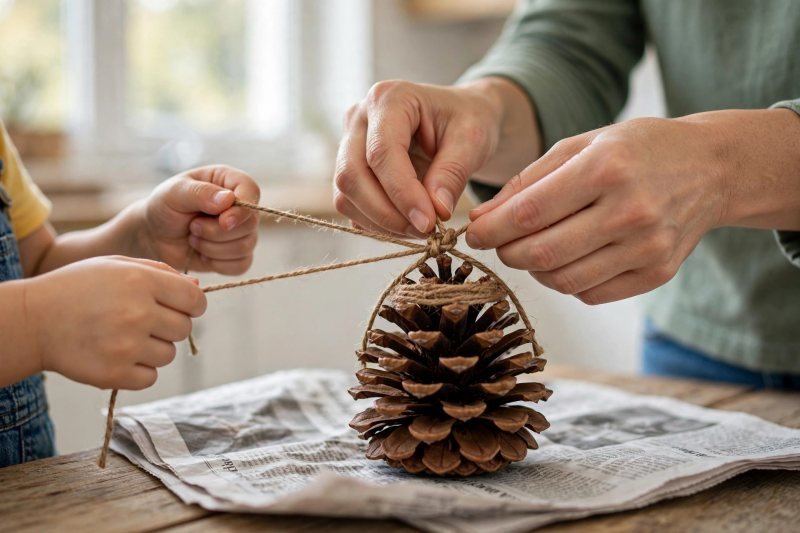
**Tie the string onto the pine cone first.** Loop 18 inches of string around the top of the cone and tie a firm knot — an adult job, since it must hold a heavy, seed-covered cone in the wind. Your child can hold the string ends.
-
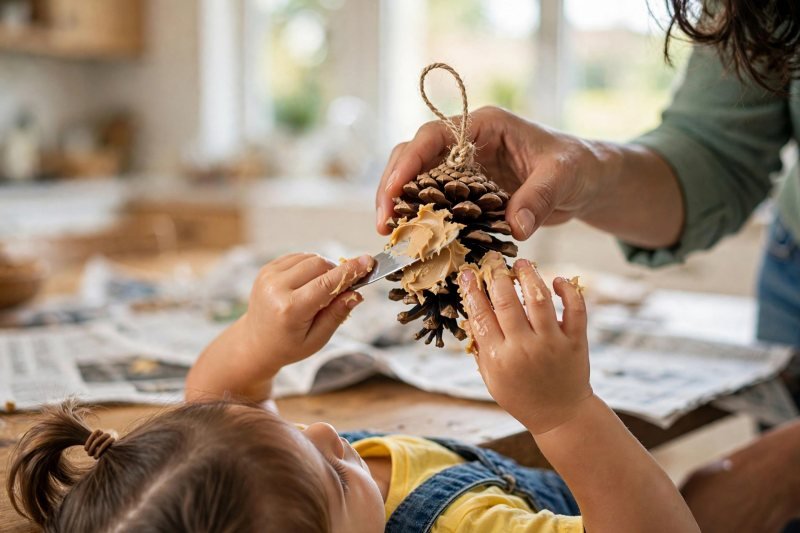
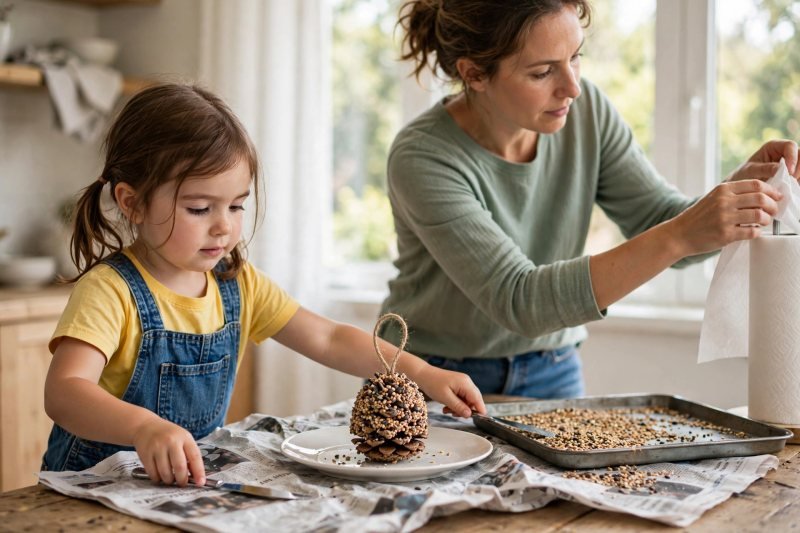
**Spread seed butter into every scale.** Let your child smear seed butter all over the cone with the butter knife, pushing it between the scales. Messy is good: thicker butter holds more seed. On a toilet-paper roll, coat the whole outside instead.
-
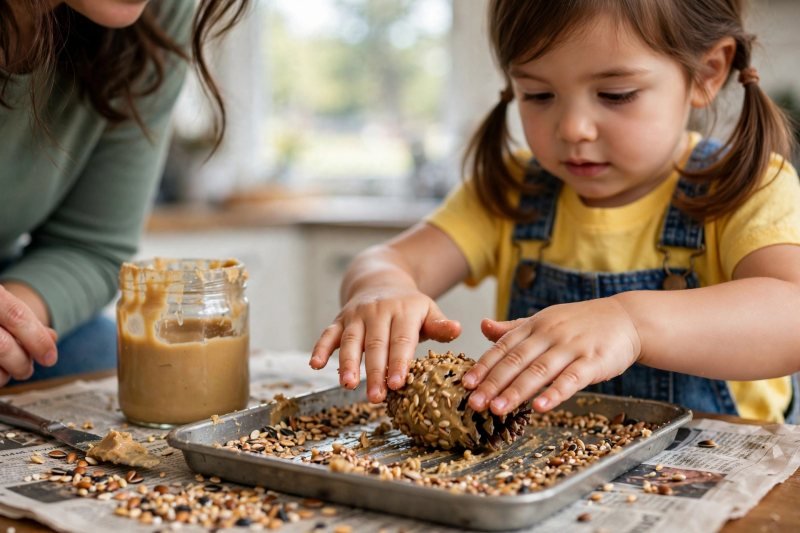
**Roll the sticky cone through the birdseed tray.** Roll the cone back and forth while your child presses gently so seeds stick on all sides. Lift, turn, roll again — aim for no butter showing through.
-
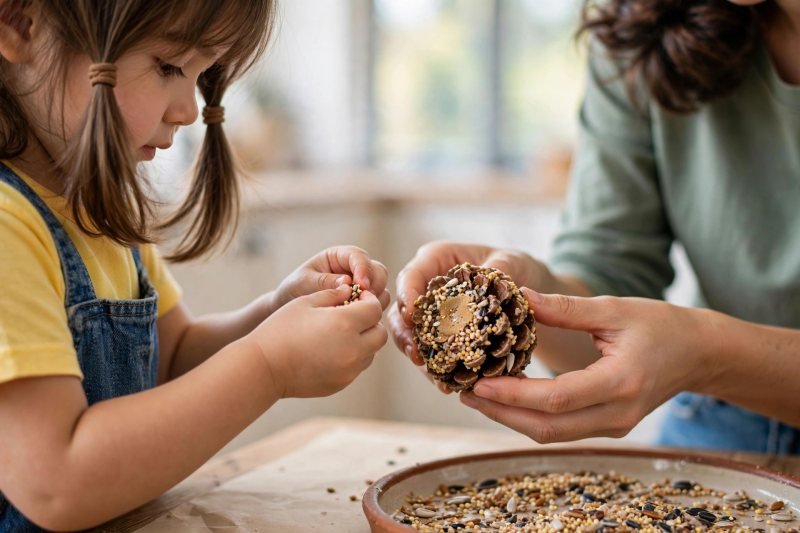
**Pat extra seed into the bare patches.** Find the bald spots where butter peeks through and let your child pinch on handfuls of seed — wonderful finger work for little hands.
-
**Let the feeder firm up for five minutes.** Rest it on a plate while you tidy the tray. Five minutes lets the butter set so the seeds do not shower off outside.
-
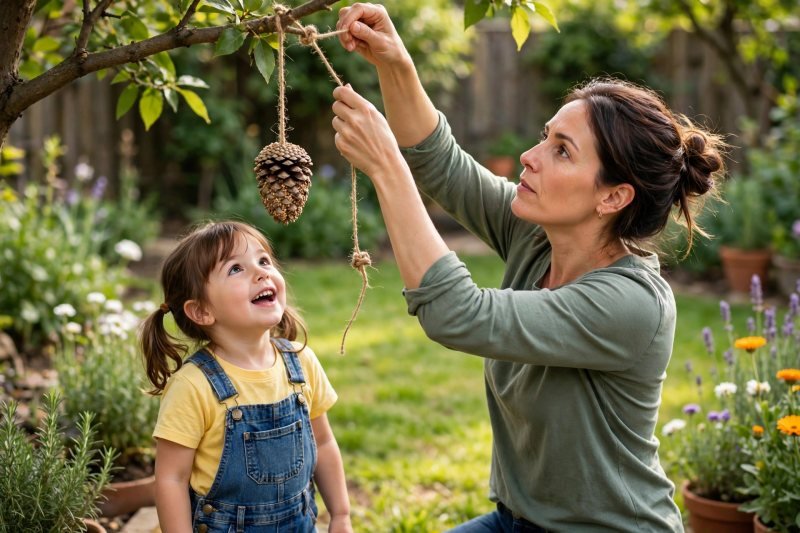
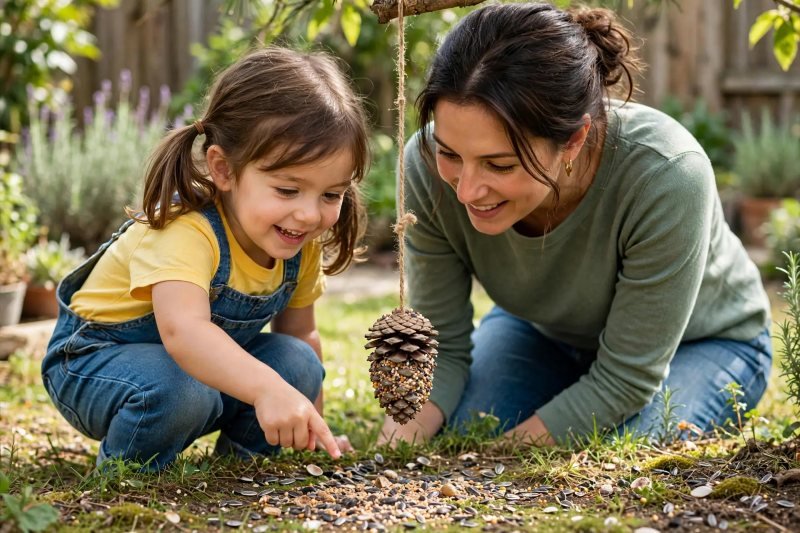
**Hang the feeder from a low branch.** An adult picks a branch or hook reachable from the ground — no climbing — ideally visible from a favorite window. Tie a solid knot, give it a tug, and let your child pick the spot.
-
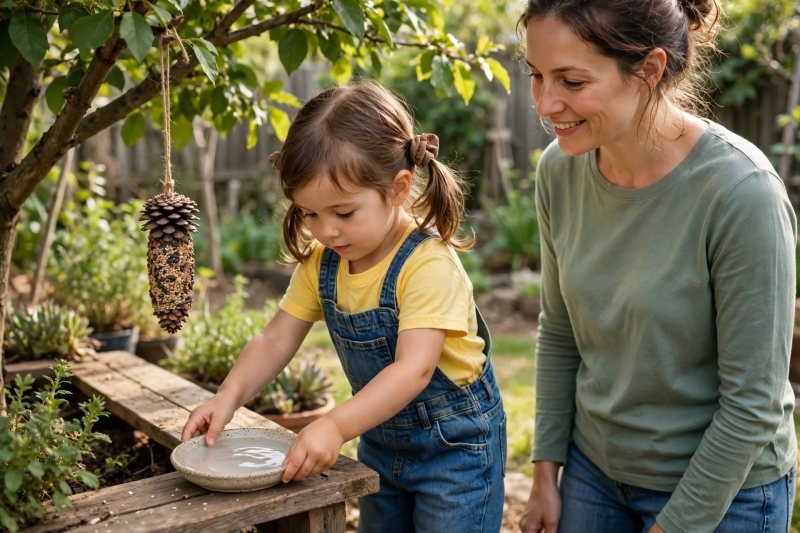
**Set out a saucer of water nearby.** A shallow dish of fresh water on the ground or a low bench gives visiting birds a drink — and your child a second thing to watch. Refill every day or two.
-
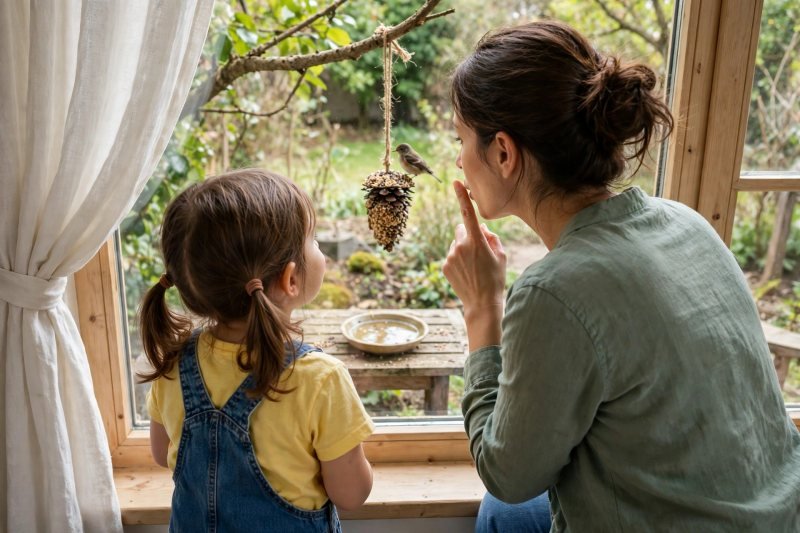
**Watch from the window, quietly.** Whisper voices, still bodies: sudden movement sends birds off. Ten quiet minutes beats an hour of fidgeting — and the watching itself is the activity.
-
**Keep coming back; birds take time.** Be honest: birds may need a few days to trust something new. Check after breakfast and before dinner — seed scattered underneath means somebody found it.
-
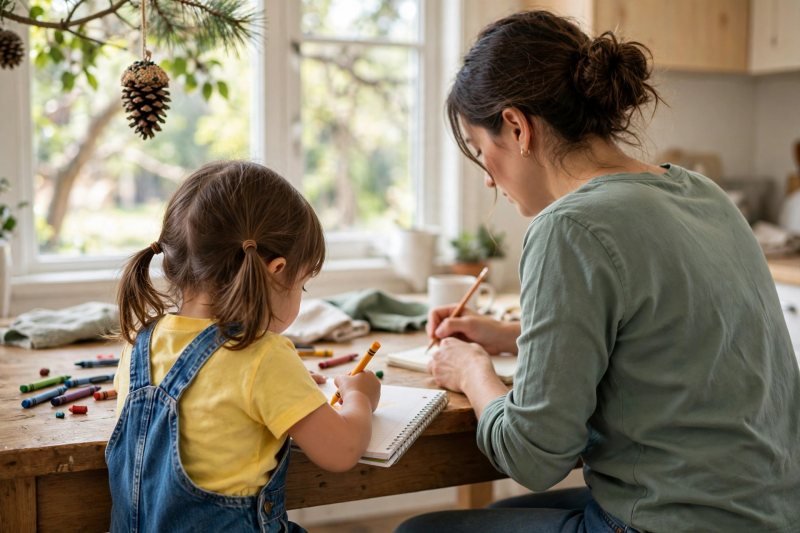
**Start a birdwatching log.** Keep the notebook by the window. Each visit, your child draws the bird or tells you its colors while you write them down. Date each page; after a week you will have a record of your feeder's regulars.


Make it easier
Make one feeder instead of two, and do the tying and hanging yourself while your child handles the spreading and rolling. Use a toilet-paper roll if pine cones are hard to find — it skips the knot-tying step, since you just thread the string through the tube.
Make it harder
Turn the log into a birdwatching journal: draw each visitor, note the time of day, and count how many different birds appear in a week. Look them up in a simple field guide — chickadees, cardinals, sparrows and blue jays are the usual backyard regulars across much of the US.
Other ways to play it
- **Toilet-roll feeders.** Thread string through an empty roll, spread with seed butter, roll in seed — a whole row along one branch looks wonderful.
- **Cookie-cutter seed ornaments.** Press the seed-butter mixture into cookie cutters, poke a hole with a straw before it sets, and hang the shapes with ribbon.
- **A second feeder for a friend.** Make an extra for grandparents or neighbors — preschoolers love delivering a present they made.
- **Pair it with a nature walk.** Before hanging the feeder, take the Five Senses Nature Walk and listen for the birds you hope will visit.
How it changes by age
- Adult-led for 3–4-year-olds. Three-year-olds can spread the butter, roll the cone and press on seeds; the string-tying and all hanging are adult jobs. Four-year-olds can manage the whole making process with an adult nearby, pour the water dish, and keep the birdwatching log going with daily reminders.
What they're learning
Real cause and effect: we made food, we hung it up, and living things came. That loop — action, waiting, result — is genuinely new thinking for a three-year-old, and it builds patience no lecture can. Rolling and pressing seeds works the small hand muscles that will later hold pencils. Watching and describing birds builds observation language — colors, sizes, "it hopped," "it pecked" — and the daily log is an early taste of recording data, the seed of real science. Extend the observation with a Garden Scavenger Hunt or Seasons Activities for Preschoolers.
Clearing up
Shake leftover seed back into its bag — it keeps for months in a cool, dry spot. Scrape seed butter off the tray with a paper towel before washing, wipe the table, and wash hands and smocks. String scraps and newspaper go in the trash or recycling; the notebook stays by the window.
Questions parents ask
Is peanut butter safe to use for a bird feeder craft with kids?
How long does it take for birds to find a new bird feeder?
What kind of birdseed is best for a homemade feeder?
Can you make a bird feeder without pine cones?
How do you keep squirrels off a homemade bird feeder?
What birds will visit a backyard bird feeder?
A pine-cone feeder lasts a week or two before the seeds are gone or the weather wins — just make a fresh one and rehang it on the same string. In rainy weeks, hang it with a little shelter, like under an eave, so the seed does not turn to mush. In hot weather, make small feeders and replace them often — seed butter can turn rancid in the heat. If squirrels discover it first, take it as a compliment and hang the next one from a thinner branch.

save it for later
Pin this for the next rainy afternoon
Keep it on a board so it is there when you need it, rather than when you happened to find it.
Save to Pinterest


