


Animal Habitats for Kids: Ocean, Desert, Forest
Animal habitats for kids become a hands-on sorting game: build three simple trays — a blue ocean, a sandy desert, a leafy forest — then sort toy animals into the home where each one really lives. Fifteen minutes of setup, twenty to thirty of play, and real science vocabulary like habitat, saltwater, and nocturnal along the way.
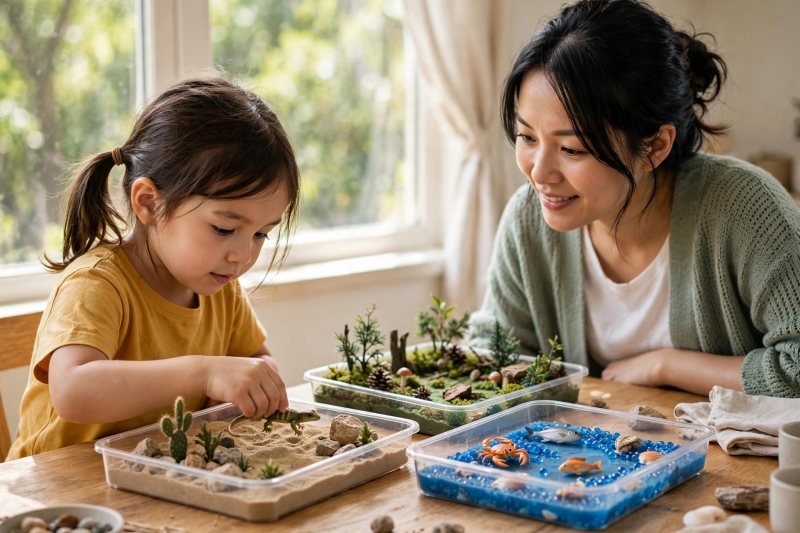
A habitat is an animal's home — the place where it finds its food, water, and shelter. Set out three trays: a blue ocean, a sandy desert, and a green forest. Put a mix of toy animals in front of your child. One animal at a time, name it, ask where it lives, and place it in the right tray. Say why each time — "the fish needs water to breathe" — and the word habitat sticks. Start with three obvious animals, then add trickier ones.

The short version
- Build the three habitat trays first, then sort the animals — building first makes the game feel real.
- Name every animal out loud before it moves; naming is where the science vocabulary sticks.
- Ask "what does this animal need to live?" instead of handing over the answer — clues beat corrections.
- Start with 3–4 obvious animals (fish, camel, bear), then add the trickier ones.
- End with a quick quiz round: you hold up each animal, your child points to the right tray.
- Age
- Ages 4–5
- Prep
- 15 min
- Play time
- 25 min
- Mess
- Low
- Difficulty
- Easy
- Where
- Indoor
Why kids love this
Sorting is a four-year-old's superpower, and this animal habitats for kids activity turns it into real science. There is drama in marching a toy camel to the desert tray and comedy when a grown-up "accidentally" drops the fish in the forest. Best of all is the expert swagger of a five-year-old announcing, "Actually, the owl is nocturnal." Most children re-sort the trays for days, and every replay cements the vocabulary deeper. ## What is an animal habitat, explained for kids? A habitat is more than where an animal happens to be — it is the one place where that animal can live its whole life: eating, sleeping, hiding, and raising its babies. A fish can flop onto dry sand for a second, but it cannot do any of those things there; only water works, all day and all night. That match between an animal and its place is what makes a home a habitat. Ask the little thought experiment — "what would happen to the fish in the desert?" — and you have done real science thinking with a four-year-old. ## What are the ocean, desert, and forest habitats? The ocean is saltwater — huge, deep, and covering most of the Earth. Fish, crabs, octopuses, and sharks breathe underwater through gills, so they cannot live anywhere else. Their bodies are built for moving in water, too: fish push and steer with fins and tails, crabs scuttle sideways on tiptoe legs, and an octopus jets backward by squirting water out behind it. Kid takeaway: the ocean is water, and it is salty. The desert is hot in the day and very, very dry, with hardly any rain all year. Cacti store water inside their thick stems, and camels store energy in their humps for long journeys between food and water. Some desert animals dodge the heat altogether: the fennec fox, with its enormous ears, sleeps in a cool burrow all day and comes out to hunt at night — it is nocturnal, just like the forest owl. Kid takeaway: the desert is hot and dry, so desert animals are water-savers. The forest is full of trees, and trees give shade and shelter. Bears, deer, foxes, and squirrels find food and hiding places among the trunks and leaves, and owls hunt at night — night-active animals are called nocturnal. The trees feed the forest, too: squirrels gather acorns and bury them to dig up in winter, and birds weave nests high in the branches to keep their chicks safe off the ground. Kid takeaway: the forest is trees, shade, and shelter.
What you'll need
- 3 shallow trays, baking pans, or large lids — one per habitat
- Blue cloth or paper for the ocean, sand-colored cloth or play sand for the desert, green cloth for the forest
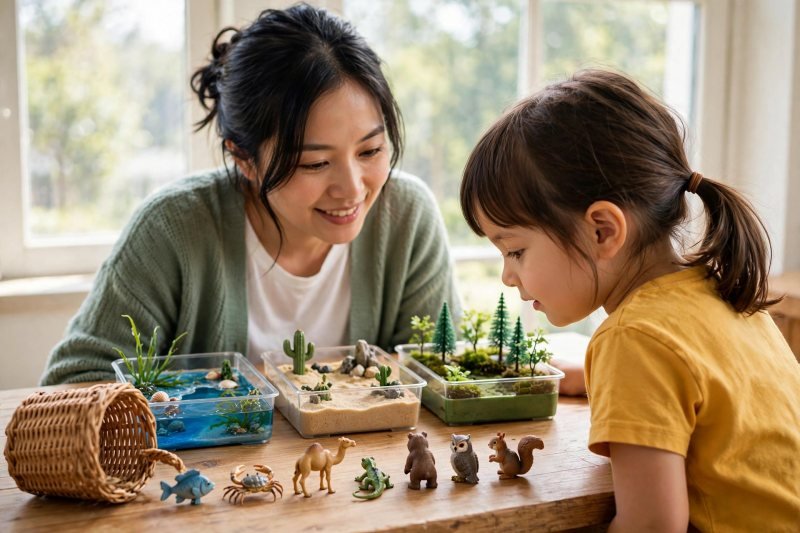
- Toy animals: fish, crab (ocean); camel, lizard (desert); bear, owl, squirrel (forest) — use whatever you have
- Habitat dressing: small rocks, pinecones, toy trees, strips of green paper as seaweed, a plastic cactus (never a real one — spines)
- Optional: three folded name cards reading "ocean," "desert," "forest," written by a grown-up
- A basket or box for cleanup.
Before you start
Line up the three empty trays left to right — ocean, desert, forest — and pile the cloths, rocks, pinecones, and seaweed strips in the middle where your child can reach everything. Keep the toy animals in one basket at your child's end of the table for now. Choose your starting lineup: a fish, a camel, and a bear make the perfect first round. If you use play sand, lay a tablecloth under the desert tray.
How to do it
-
**1. Lay out the three empty trays and announce the mission.** "We are going to build three animal homes: the ocean, the desert, and the forest." Let your child decide which tray becomes which.

-
**2. Build the ocean tray.** Drape the blue cloth over the first tray and add wavy strips of green paper as seaweed. Say it together: "The ocean is water — salty water."

-
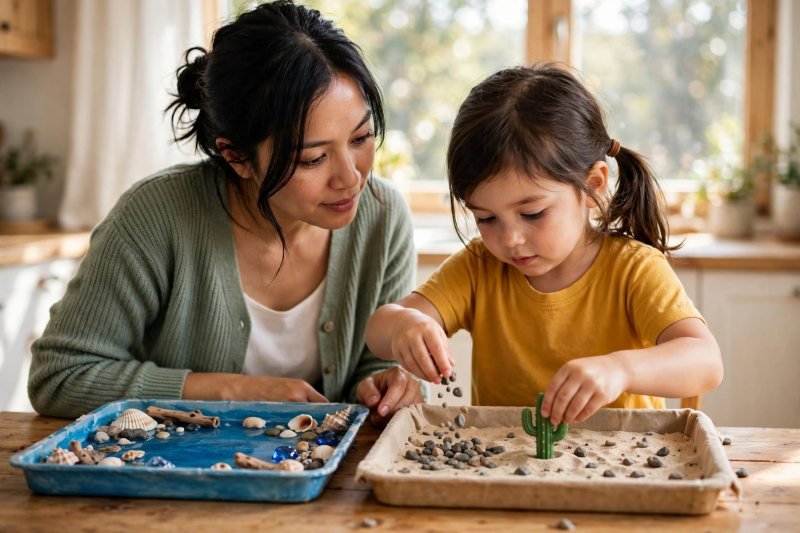
**3. Build the desert tray.** Cover the second tray with the sand-colored cloth or a thin layer of sand, scatter a few rocks, and add the plastic cactus. "The desert is hot and dry — hardly any rain."
-
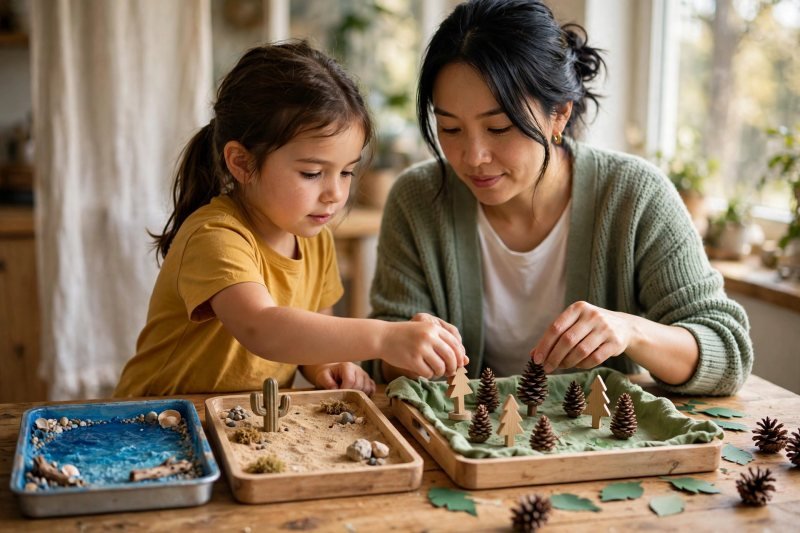
**4. Build the forest tray.** Spread the green cloth over the third tray and stand up toy trees, pinecones, and a few leaves. "The forest is full of trees — shade and shelter."
-
**5. Line up the toy animals in a mixed row.** Tip the basket out so every animal faces your young scientist. Sort nothing yet — the mixed row is the whole game.
-
**6. Tour each habitat with one-sentence facts.** Point to each tray: "Fish breathe water through gills." "Camels store energy in their humps." "Owls are nocturnal — awake at night." Then give those body tricks their science name: "That is called adaptation — every animal is built for its home." One sentence each; the sorting teaches the rest.

-
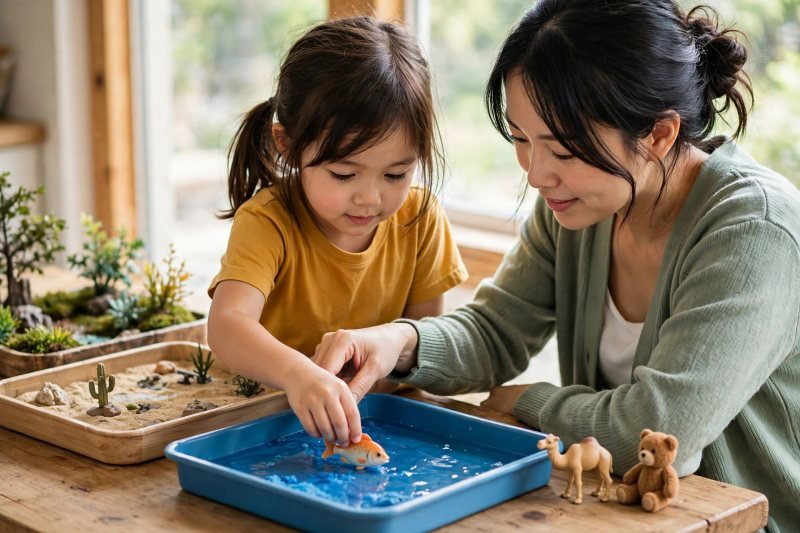
**7. Sort the easy animals first.** Hand your child the fish and ask, "Where does the fish live?" Let them place it, then say why together: "The fish needs water." Repeat with the camel and the bear.
-
**8. Sort the rest one animal at a time.** For each, ask, "What does it need to live?" A crab needs water — ocean. A lizard needs hot, dry ground — desert. Hint with questions ("where do we see trees?"), not answers.
-
**9. Make one gloriously wrong sort on purpose.** Drop the camel into the ocean tray with a straight face and wait. The outraged correction — "No! The camel lives in the DESERT!" — cements the learning better than any worksheet.

-
**10. Run the quiz round, then tidy away.** Hold up each animal and let your child point to the right tray — no touching allowed, which makes it feel like a real quiz. Then everything goes back in the basket: "Every animal is home!"



Make it easier
Start with just two habitats — ocean and desert look the most different. Use only 3 animals: fish, camel, bear. Sort as a team instead of taking turns.
Make it harder
Add a fourth tray: a white-and-blue Arctic for the polar bear and penguin. Add a "two-home" animal, like the frog, that splits time between water and land. Let your child run the whole game for a sibling or grandparent — teaching is the deepest learning.
Other ways to play it
- Real-water ocean: fill a shallow tub with an inch of water and float the fish in it.
- Picture-card sort: no toy animals? Draw or print animal pictures and sort the cards instead.
- Habitat scavenger hunt: on your next walk, spot real habitats: a puddle (mini ocean), a bare sunny patch (mini desert), a shady tree (mini forest).
- Zoo or aquarium follow-up: visit one real exhibit and play "which tray is this?" in front of the glass.
How it changes by age
- At 4, most children need hints beyond the first three animals — give them as questions, not answers. They will sort with huge confidence and occasionally total certainty about something wrong; correct gently and move on. At 5, many can sort independently and explain their reasoning ("the owl needs trees"). Guessing wildly? Drop back to two habitats and three animals for a week — the trays keep. Still fun to 7.
What they're learning
Science vocabulary: habitat, saltwater, nocturnal, gills — real words, learned by using them. Adaptation: animals are built for their home — the camel's hump stores energy for dry days, the owl's eyes are made for hunting in the dark. Categorizing: deciding what belongs with what — the root of all early science thinking. Cause and effect: "a fish needs water, so it goes in the ocean" is a complete little argument. Confidence and communication: explaining the "why" out loud builds both.
Clearing up
Under ten minutes: animals and dressing back in the basket, cloths folded, trays stacked. Make the tidy the game's final step — "Every animal is home, now the trays go home too" — and most four- and five-year-olds will do it themselves.
Questions parents ask
What is an animal habitat in simple words?
Which three habitats are easiest to teach preschoolers?
What animals live in the ocean, desert, and forest?
What age is this habitat sorting activity for?
What if I don't have toy animals?
Replay value is the point: leave the finished trays on a low table for the week and children will re-sort the animals daily, often inventing new rules ("today the owl visits the desert!") — enjoy the play, gently correct the science. "Habitat," "nocturnal," and "saltwater" are exactly the words that show up in kindergarten science units, so this activity doubles as school prep. No printable is attached; the materials list uses things most homes already own.

save it for later
Pin this for the next rainy afternoon
Keep it on a board so it is there when you need it, rather than when you happened to find it.
Save to Pinterest
